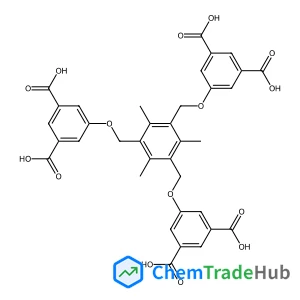
5,5',5''-(((2,4,6-Trimethylbenzene-1,3,5-triyl)tris(methylene))tris(oxy))triisophthalic acid
CAS Number:
1159974-70-5
Molecular Formula:
C36H30O15
M. C. E. Galbraith, C. T. L. Smeenk, G. Reitsma, A. Marciniak, V. Despré, J. Mikosch, N. Zhavoronkov, M. J. J. Vrakking, O. Kornilov, F. Lépine
Unraveling ultrafast dynamical processes in highly excited molecular species has an impact on our understanding of chemical processes such as combustion or the chemical composition of molecular clouds in the universe. In this article we use short (<7 fs) XUV pulses to produce excited cationic states of benzene molecules and probe their dynamics using few-cycle VIS/NIR laser pulses. The excited states produced by the XUV pulses lie in an especially complex spectral region where multi-electronic effects play a dominant role. We show that very fast τ ≈ 20 fs nonadiabatic processes dominate the relaxation of these states, in agreement with the timescale expected for most excited cationic states in benzene. In the CH3+ fragmentation channel of the doubly ionized benzene cation we identify pathways that involve structural rearrangement and proton migration to a specific carbon atom. Further, we observe non-trivial transient behavior in this fragment channel, which can be interpreted either in terms of propagation of the nuclear wavepacket in the initially excited electronic state of the cation or as a two-step electronic relaxation via an intermediate state.
Chao-Feng Wu, Tian-Ran Wei, Jing-Feng Li
DOI: 10.1039/C4CP06021K
Yuqing Zheng
DOI: 10.1039/C5CP01858G
Jinfeng Zhao, Junsheng Chen, Jianyong Liu, Mark R. Hoffmann
DOI: 10.1039/C4CP05651E
Robert Schennach
DOI: 10.1039/C5CP00070J
Debora Puglia, Josè M. Kenny, Jyotishkumar Parameswaranpillai, Poornima Vijayan P, Jűrgen Pionteck
DOI: 10.1039/C5CP00612K
Haoyu S. Yu, Pragya Verma, Donald G. Truhlar
DOI: 10.1039/C5CP01425E
Arpan Kool, Biswajoy Bagchi, Nur Amin Hoque, Sukhen Das, Papiya Nandy
DOI: 10.1039/C5CP01207D
Toru Utsunomiya, Shoko Tatsumi, Yasuyuki Yokota, Ken-ichi Fukui
DOI: 10.1039/C5CP01156F
Alvira Ayoub Arbab, Kyung Chul Sun, Iftikhar Ali Sahito, Muhammad Bilal Qadir, Sung Hoon Jeong
DOI: 10.1039/C5CP00818B
Tatiana Kuznetsova, Bjørnar Jensen, Bjørn Kvamme, Sara Sjøblom
DOI: 10.1039/C5CP00660K
Waste containing N-Methoxy-N-methyl-1,3-thiazole-5-carboxamide (CAS: 898825-89-3...
N-(4-Biphenylyl)dibenzo[b,d]furan-4-amine should be stored in a tightly sealed c...
The market for 3-Acetamido-5-amino-2,4,6-triiodobenzoic acid (CAS: 1713-07-1) is...
Benzyl 2-O-acetyl-3,4,6-tri-O-benzyl-beta-D-galactopyranoside (CAS: 61820-03-9) ...
2-Ethylpiperazine dihydrochloride (CAS: 438050-52-3) is regulated under the Glob...
1,1'-[1,3-Phenylenebis(methylene)]bis(3-methyl-1H-pyrrole-2,5-dione) (CAS: 11946...
Several alternatives can be used in the synthesis of 5-Fluoro-2-(1-pyrrolidinyl)...
Proper personal protective equipment (PPE) must be worn when handling this compo...
When handling 6-Bromoimidazo[1,2-a]pyridin-8-amine, it is important to wear appr...
Alternatives to (2S,4R)-4-(4-Nitrobenzyl)pyrrolidine-2-carboxylic acid hydrochlo...

Physical Chemistry Chemical Physics (PCCP) is an international journal co-owned by 19 physical chemistry and physics societies from around the world. This journal publishes original, cutting-edge research in physical chemistry, chemical physics and biophysical chemistry. To be suitable for publication in PCCP, articles must include significant innovation and/or insight into physical chemistry; this is the most important criterion that reviewers and Editors will judge against when evaluating submissions. The journal has a broad scope and welcomes contributions spanning experiment, theory, computation and data science. Topical coverage includes spectroscopy, dynamics, kinetics, statistical mechanics, thermodynamics, electrochemistry, catalysis, surface science, quantum mechanics, quantum computing and machine learning. Interdisciplinary research areas such as polymers and soft matter, materials, nanoscience, energy, surfaces/interfaces, and biophysical chemistry are welcomed if they demonstrate significant innovation and/or insight into physical chemistry. Joined experimental/theoretical studies are particularly appreciated when complementary and based on up-to-date approaches.
![4-Chloro-2-{[(2-chlorophenoxy)acetyl]amino}benzoic acid structure](https://static.chemtradehub.com/structs/351/351424-20-9-9467.webp "4-Chloro-2-{[(2-chlorophenoxy)acetyl]amino}benzoic acid structure")
![2-(7,7-Difluorobicyclo[4.1.0]hept-1-yl)ethanamine structure](https://static.chemtradehub.com/structs/209/2098065-08-6-ff24.webp "2-(7,7-Difluorobicyclo[4.1.0]hept-1-yl)ethanamine structure")