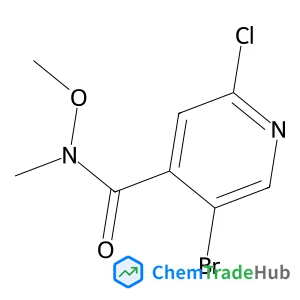
5-Bromo-2-chloro-N-methoxy-N-methylisonicotinamide
CAS Number:
1256790-08-5
Molecular Formula:
C8H8BrClN2O2
Maria Adobes-Vidal, Harriet Pearce, Patrick R. Unwin
Although the dissolution kinetics of calcite in acid waters has been studied for more than a century, the process is not fully understood, and for particles and microcrystals the process is often assumed to be diffusion-controlled. Herein, the dissolution kinetics of calcite single microcrystals in aqueous solution (pH ca. 3) has been investigated for the first time by a combination of real-time optical microscopy coupled with numerical simulations. The small size and well-defined geometry of rhombohedral calcite single crystals enables the measurement of the dissolution rates of the individual crystal faces exposed to the solvent and an assessment of the relative importance of corners and edges compared to the {104} faces. Data are used to parameterise finite element method (FEM) models for the quantitative analysis of dissolution kinetics. The simulations provide an accurate determination of the near-interface concentration of solution species during dissolution, as well as concentration gradients. The intrinsic first-order dissolution rate constant for the attack of protons on the exposed {104} faces, ksurf = (6.4 ± 2.8) × 10−4 m s−1, is in good agreement with previous microscopic and macroscopic measurements, corroborating the method. This study is a further demonstration of the power of simple in situ optical microscopy for quantitative interfacial (dissolution/growth) kinetic measurements, using a configuration of practical relevance for processes as diverse as the remediation of acid water and scale removal.
Bian-Bian Guo, Chang Liu, Jia-Hui Xin, Cheng-Ye Zhu, Zhi-Kang Xu
DOI: 10.1039/D1PY00594D
Laura Boggioni, Hitoshi Harakawa, Simona Losio, Kotohiro Nomura, Incoronata Tritto
DOI: 10.1039/D1PY00647A
Meike Warnken, Karoly Lázár, Michael Wark
DOI: 10.1039/B009045J
C. G. Eisenhardt
DOI: 10.1039/B009507I
DOI: 10.1039/A905267D
Narcís Homs, Jordi Llorca, Pilar Ramírez de la Piscina, Francisco Rodríguez-Reinoso, Antonio Sepúlveda-Escribano, Joaquín Silvestre-Albero
DOI: 10.1039/B100770J
D. J. Diestler, G. T. Gao, X. C. Zeng
DOI: 10.1039/B007772K
Francesca Benevelli, Waclaw Kolodziejski, Krzysztof Wozniak, Jacek Klinowski
DOI: 10.1039/B100894N
(3.beta.)-3-Hydroxy-N,N-dimethyl-chol-5-en-24-amide (CAS: 79066-03-8) is primari...
5-(Aminomethyl)-2-methoxyphenol (CAS: 89702-89-6) is classified under GHS as a s...
Thieno[2,3-c]pyridin-7(6H)-one (CAS: 28981-13-7) is a heterocyclic organic compo...
1-[(6-Methoxy-3-pyridinyl)methyl]-4-piperidinamine dihydrochloride is generally ...
[(2E)-3-Phenyl-2-propen-1-yl]phosphonic acid (CAS: 146404-58-2) is regulated und...
6-Bromo-7-methoxyquinoline (CAS: 1620515-86-7) falls under the scope of the Glob...
This compound is primarily used in the pharmaceutical industry for the developme...
1-Ethyl-7-[2-methyl-6-(4H-1,2,4-triazol-3-yl)-3-pyridinyl]-3,5-dihydropyrazino[2...
Alternative reagents such as 2-[(dimethylamino)methyl]phenylboronic acid or rela...
3-(Piperidin-4-yloxy)pyridine (CAS: 310881-48-2) is an organic compound with the...

Physical Chemistry Chemical Physics (PCCP) is an international journal co-owned by 19 physical chemistry and physics societies from around the world. This journal publishes original, cutting-edge research in physical chemistry, chemical physics and biophysical chemistry. To be suitable for publication in PCCP, articles must include significant innovation and/or insight into physical chemistry; this is the most important criterion that reviewers and Editors will judge against when evaluating submissions. The journal has a broad scope and welcomes contributions spanning experiment, theory, computation and data science. Topical coverage includes spectroscopy, dynamics, kinetics, statistical mechanics, thermodynamics, electrochemistry, catalysis, surface science, quantum mechanics, quantum computing and machine learning. Interdisciplinary research areas such as polymers and soft matter, materials, nanoscience, energy, surfaces/interfaces, and biophysical chemistry are welcomed if they demonstrate significant innovation and/or insight into physical chemistry. Joined experimental/theoretical studies are particularly appreciated when complementary and based on up-to-date approaches.
![5,7-Dihydroxy-3-(4-hydroxyphenyl)-6-[(1R,6R)-3-methyl-6-prop-1-en-2-ylcyclohex-2-en-1-yl]chromen-4-one structure](https://static.chemtradehub.com/structs/191/1914963-20-4-2b05.webp "5,7-Dihydroxy-3-(4-hydroxyphenyl)-6-[(1R,6R)-3-methyl-6-prop-1-en-2-ylcyclohex-2-en-1-yl]chromen-4-one structure")