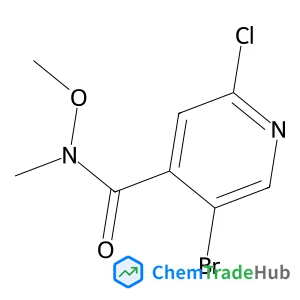
5-Bromo-2-chloro-N-methoxy-N-methylisonicotinamide
CAS Number:
1256790-08-5
Molecular Formula:
C8H8BrClN2O2
Laura Boggioni, Hitoshi Harakawa, Simona Losio, Kotohiro Nomura, Incoronata Tritto
Terpolymerizations of ethylene (E) and norbornene (N) with 1-octene (O) using different aryloxo- or ketimide-modified half-titanocene catalysts, Cp′TiCl2(O-2,6-iPr2C6H3) [Cp′ = indenyl (1), C5Me5 (Cp*, 2), tBuC5H4 (3)] and Cp′TiCl2(NCtBu2) [Cp′ = tBuC5H4 (4), Cp (5)], in the presence of MAO cocatalysts were investigated. The microstructures, termonomer contents, and molecular weights of the resultant terpolymers, and their thermal properties were determined. The ketimide-modified Cp′TiCl2(NCtBu2) (4 and 5) exhibited higher catalytic activities and yielded higher molecular weight terpolymers, poly(E-ter–N-ter–O)s, than the aryloxo-modified Cp′TiCl2(O-2,6-iPr2C6H3) (1–3); the 1-octene incorporation is often higher than that prepared using ansa-metallocenes, noticeably reaching 13.5 mol%. Terpolymers prepared using ketimide-modified Cp′TiCl2(NCtBu2) possessed significantly higher Mn values than the E/N copolymers; the same trend is observed in the terpolymers prepared using the Cp*-aryloxo analogue (2). This has been demonstrated to be correlated with the lower propensity of catalysts 4 and 5 to provide β-H elimination, which occurred at the last-inserted E unit, as suggested through the analysis of the vinyl end groups observed in the 1H NMR spectra. This unique behaviour is quite different from that of well-developed ansa-metallocenes. Thus, poly(E-ter–N-ter–O)s with high O contents, molar masses, and Tg values from 23 °C to 153 °C were obtained in high yields using 2, 4, and 5 half-titanocene catalysts.
(3.beta.)-3-Hydroxy-N,N-dimethyl-chol-5-en-24-amide (CAS: 79066-03-8) is primari...
5-(Aminomethyl)-2-methoxyphenol (CAS: 89702-89-6) is classified under GHS as a s...
Thieno[2,3-c]pyridin-7(6H)-one (CAS: 28981-13-7) is a heterocyclic organic compo...
1-[(6-Methoxy-3-pyridinyl)methyl]-4-piperidinamine dihydrochloride is generally ...
[(2E)-3-Phenyl-2-propen-1-yl]phosphonic acid (CAS: 146404-58-2) is regulated und...
6-Bromo-7-methoxyquinoline (CAS: 1620515-86-7) falls under the scope of the Glob...
This compound is primarily used in the pharmaceutical industry for the developme...
1-Ethyl-7-[2-methyl-6-(4H-1,2,4-triazol-3-yl)-3-pyridinyl]-3,5-dihydropyrazino[2...
Alternative reagents such as 2-[(dimethylamino)methyl]phenylboronic acid or rela...
3-(Piperidin-4-yloxy)pyridine (CAS: 310881-48-2) is an organic compound with the...

Polymer Chemistry welcomes submissions in all areas of polymer science that have a strong focus on macromolecular chemistry. Manuscripts may cover a broad range of fields, yet no direct application focus is required.