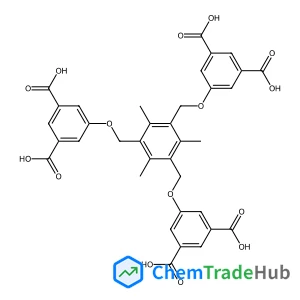
5,5',5''-(((2,4,6-Trimethylbenzene-1,3,5-triyl)tris(methylene))tris(oxy))triisophthalic acid
CAS Number:
1159974-70-5
Molecular Formula:
C36H30O15
Daniël J. Bakker, Arghya Dey, Daniel P. Tabor, Qin Ong, Jérôme Mahé, Marie-Pierre Gaigeot, Edwin L. Sibert, III, Anouk M. Rijs
Saligenin (2-(hydroxymethyl)phenol) exhibits both strong and weak intramolecular electrostatic interactions. The bonds that result from these interactions compete with intermolecular hydrogen bonds once saligenin binds to one or more water molecules. Infrared (IR) ultraviolet (UV) ion-dip spectroscopy was used to study isolated saligenin–(H2O)n clusters (n = 1–3) in the far- and mid-IR regions of the spectrum. Both harmonic and anharmonic (coupled local modes and Born–Oppenheimer molecular dynamics) quantum chemical calculations were applied to assign cluster geometries to the measured spectra, and to assign vibrational modes to all spectral features measured for each cluster. The hydrated clusters with n = 1 and 2 have geometries that are quite similar to benzyl alcohol–water clusters, whereas the larger clusters with n = 3 show structures equivalent to the isolated water pentamer. Systematic shifts in the frequencies of three hydrogen bond (H-bond) deforming modes, namely OH stretching, OH torsion and H-bond stretching, were studied as a function of the hydrogen bond strength represented by either the OH bond length or the H-bond length. The shifts of the frequencies of these three modes correlate linearly to the OH length, despite both intra- and intermolecular H-bonds being included in this analysis. The OH torsion vibration displays the largest frequency shift when H-bonded, followed by the OH stretching vibrations and finally the H-bond stretching frequency. The frequency shifts of these H-bond deforming modes behave non-linearly as a function of the H-bond length, asymptotically approaching the frequency expected for the non H-bonded modes. The nonlinear behavior was quantified using exponential functions.
Qing-Yun Xiang, Yu Wang, Shi-Yu Li, Lan-Hua Wang, Li-Bin Mo, Wen-Qing Yao, Li Zhang
DOI: 10.1039/C5CP00878F
S. D. Ramarao, V. R. K. Murthy
DOI: 10.1039/C5CP00569H
Xinqiang Wang, Hengjiang Zhu
DOI: 10.1039/C4CP05739B
Michio Ikezawa, Xiuying Wang, Pengtao Jing, Haibo Li, Yasuaki Masumoto
DOI: 10.1039/C5CP00034C
Diego Cortés-Arriagada, Alejandro Toro-Labbé
DOI: 10.1039/C5CP01313E
Changzeng Fan, Jian Li
DOI: 10.1039/C5CP00001G
DOI: 10.1039/C5CP01490E
F. Terenziani, A. Painelli
DOI: 10.1039/C5CP01485A
Zheyun Liu, Lijuan Wang, Dongping Zhong
DOI: 10.1039/C4CP05286B
Rui-Qin Zhang
DOI: 10.1039/C4CP05973E
Waste containing N-Methoxy-N-methyl-1,3-thiazole-5-carboxamide (CAS: 898825-89-3...
N-(4-Biphenylyl)dibenzo[b,d]furan-4-amine should be stored in a tightly sealed c...
The market for 3-Acetamido-5-amino-2,4,6-triiodobenzoic acid (CAS: 1713-07-1) is...
Benzyl 2-O-acetyl-3,4,6-tri-O-benzyl-beta-D-galactopyranoside (CAS: 61820-03-9) ...
2-Ethylpiperazine dihydrochloride (CAS: 438050-52-3) is regulated under the Glob...
1,1'-[1,3-Phenylenebis(methylene)]bis(3-methyl-1H-pyrrole-2,5-dione) (CAS: 11946...
Several alternatives can be used in the synthesis of 5-Fluoro-2-(1-pyrrolidinyl)...
Proper personal protective equipment (PPE) must be worn when handling this compo...
When handling 6-Bromoimidazo[1,2-a]pyridin-8-amine, it is important to wear appr...
Alternatives to (2S,4R)-4-(4-Nitrobenzyl)pyrrolidine-2-carboxylic acid hydrochlo...

Physical Chemistry Chemical Physics (PCCP) is an international journal co-owned by 19 physical chemistry and physics societies from around the world. This journal publishes original, cutting-edge research in physical chemistry, chemical physics and biophysical chemistry. To be suitable for publication in PCCP, articles must include significant innovation and/or insight into physical chemistry; this is the most important criterion that reviewers and Editors will judge against when evaluating submissions. The journal has a broad scope and welcomes contributions spanning experiment, theory, computation and data science. Topical coverage includes spectroscopy, dynamics, kinetics, statistical mechanics, thermodynamics, electrochemistry, catalysis, surface science, quantum mechanics, quantum computing and machine learning. Interdisciplinary research areas such as polymers and soft matter, materials, nanoscience, energy, surfaces/interfaces, and biophysical chemistry are welcomed if they demonstrate significant innovation and/or insight into physical chemistry. Joined experimental/theoretical studies are particularly appreciated when complementary and based on up-to-date approaches.
![[5-fluoro-2-(morpholine-4-carbonyl)phenyl]boronic acid structure](https://static.chemtradehub.com/structs/121/1217501-26-2-505c.webp "[5-fluoro-2-(morpholine-4-carbonyl)phenyl]boronic acid structure")