












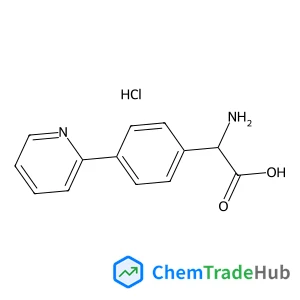
2-Amino-2-(4-(pyridin-2-YL)phenyl)acetic acid hydrochloride
CAS Number:
1135818-89-1
Molecular Formula:
C13H13ClN2O2
G. Capano, T. J. Penfold, M. Chergui, I. Tavernelli
On-the-fly excited state molecular dynamics is a valuable method for studying non-equilibrium processes in excited states and is beginning to emerge as a mature approach much like its ground state counterparts. In contrast to quantum wavepacket dynamics methods, it negates the need for modelling potential energy surfaces, which usually confine nuclear motion within a reduced number of vibrational modes. In addition, on-the-fly molecular dynamics techniques are easily combined with the atomistic description of the solvents (through the QM/MM approach) making it possible to explicitly address the effect of the environment. Herein, we study the nonadiabatic relaxation of photoexcited [Cu(dmp)2]+ (dmp = 2,9-dimethyl-1,10-phenanthroline) using QM/MM Trajectory Surface Hopping (TSH). We show that the decay of the initially excited singlet state into the lowest singlet (S1) state occurs within 100 fs, in agreement with previous experiments, and is slightly influenced by the solvent. Using a principal component analysis (PCA), we also identify the dominant normal modes activated during the excited state decay, which are then used to design the vibronic Hamiltonian for quantum wavepacket dynamics simulations.
J. R. Bamforth, J. H. Merkin, S. K. Scott, R. Tóth, V. Gáspár
DOI: 10.1039/B010094N
C. G. Eisenhardt
DOI: 10.1039/B009507I
Zoltán Paál, Tamás Koltai, (the late) Károly Matusek, Jean-Marie Manoli, Claude Potvin, Martin Muhler, Ute Wild, Pál Tétényi
DOI: 10.1039/B009047F
DOI: 10.1039/B008247N
S. Amira, G. Vanhaelewyn, F. Callens
DOI: 10.1039/B008249J
Cristina Ruiz Martínez, Juana M. Pérez, Francisco M. Arrabal-Campos, María Batuecas, Ignacio Fernández
DOI: 10.1039/D1PY00547B
Francesca Benevelli, Waclaw Kolodziejski, Krzysztof Wozniak, Jacek Klinowski
DOI: 10.1039/B100894N
Laura Boggioni, Hitoshi Harakawa, Simona Losio, Kotohiro Nomura, Incoronata Tritto
DOI: 10.1039/D1PY00647A
L. Zhang, A. J. C. Varandas
DOI: 10.1039/B010149O
(3.beta.)-3-Hydroxy-N,N-dimethyl-chol-5-en-24-amide (CAS: 79066-03-8) is primari...
5-(Aminomethyl)-2-methoxyphenol (CAS: 89702-89-6) is classified under GHS as a s...
Thieno[2,3-c]pyridin-7(6H)-one (CAS: 28981-13-7) is a heterocyclic organic compo...
1-[(6-Methoxy-3-pyridinyl)methyl]-4-piperidinamine dihydrochloride is generally ...
[(2E)-3-Phenyl-2-propen-1-yl]phosphonic acid (CAS: 146404-58-2) is regulated und...
6-Bromo-7-methoxyquinoline (CAS: 1620515-86-7) falls under the scope of the Glob...
This compound is primarily used in the pharmaceutical industry for the developme...
1-Ethyl-7-[2-methyl-6-(4H-1,2,4-triazol-3-yl)-3-pyridinyl]-3,5-dihydropyrazino[2...
Alternative reagents such as 2-[(dimethylamino)methyl]phenylboronic acid or rela...
3-(Piperidin-4-yloxy)pyridine (CAS: 310881-48-2) is an organic compound with the...

Physical Chemistry Chemical Physics (PCCP) is an international journal co-owned by 19 physical chemistry and physics societies from around the world. This journal publishes original, cutting-edge research in physical chemistry, chemical physics and biophysical chemistry. To be suitable for publication in PCCP, articles must include significant innovation and/or insight into physical chemistry; this is the most important criterion that reviewers and Editors will judge against when evaluating submissions. The journal has a broad scope and welcomes contributions spanning experiment, theory, computation and data science. Topical coverage includes spectroscopy, dynamics, kinetics, statistical mechanics, thermodynamics, electrochemistry, catalysis, surface science, quantum mechanics, quantum computing and machine learning. Interdisciplinary research areas such as polymers and soft matter, materials, nanoscience, energy, surfaces/interfaces, and biophysical chemistry are welcomed if they demonstrate significant innovation and/or insight into physical chemistry. Joined experimental/theoretical studies are particularly appreciated when complementary and based on up-to-date approaches.
![Ethanone, 1-[4-chloro-2-(methylthio)-5-pyrimidinyl]- structure](https://static.chemtradehub.com/structs/661/66116-82-3-863e.webp "Ethanone, 1-[4-chloro-2-(methylthio)-5-pyrimidinyl]- structure")
![4,4-Difluoro-2-methyl-1-{[(2-methyl-2-propanyl)oxy]carbonyl}-L-proline structure](https://static.chemtradehub.com/structs/119/1194032-23-9-f426.webp "4,4-Difluoro-2-methyl-1-{[(2-methyl-2-propanyl)oxy]carbonyl}-L-proline structure")



