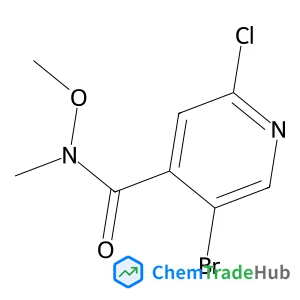
5-Bromo-2-chloro-N-methoxy-N-methylisonicotinamide
CAS Number:
1256790-08-5
Molecular Formula:
C8H8BrClN2O2
Cristina Ruiz Martínez, Juana M. Pérez, Francisco M. Arrabal-Campos, María Batuecas, Ignacio Fernández
We report herein the first lithium anthraquinoid catalyst able to produce polylactide at room temperature starting from both L- and rac-lactide in the absence of any other initiator. The new lithium-based system is selective towards cyclic polymers, having narrow dispersity and weight-average molecular weights ranging from 49.5 to 137.6 kDa. The cyclic structure of the PLA generated from the lithium catalyst has been determined by a combination of 1H NMR and DRIFT spectroscopy techniques and MALDI-TOF mass spectrometry. DFT calculations point to lithium aggregation as the key feature of the catalyst controlling the linear : cyclic polymer ratio. Molar mass distributions and dispersities were obtained through diffusion NMR experiments combined with inverse Laplace transform algorithms and compared with those obtained by SEC as the most established method.
(3.beta.)-3-Hydroxy-N,N-dimethyl-chol-5-en-24-amide (CAS: 79066-03-8) is primari...
5-(Aminomethyl)-2-methoxyphenol (CAS: 89702-89-6) is classified under GHS as a s...
Thieno[2,3-c]pyridin-7(6H)-one (CAS: 28981-13-7) is a heterocyclic organic compo...
1-[(6-Methoxy-3-pyridinyl)methyl]-4-piperidinamine dihydrochloride is generally ...
[(2E)-3-Phenyl-2-propen-1-yl]phosphonic acid (CAS: 146404-58-2) is regulated und...
6-Bromo-7-methoxyquinoline (CAS: 1620515-86-7) falls under the scope of the Glob...
This compound is primarily used in the pharmaceutical industry for the developme...
1-Ethyl-7-[2-methyl-6-(4H-1,2,4-triazol-3-yl)-3-pyridinyl]-3,5-dihydropyrazino[2...
Alternative reagents such as 2-[(dimethylamino)methyl]phenylboronic acid or rela...
3-(Piperidin-4-yloxy)pyridine (CAS: 310881-48-2) is an organic compound with the...

Polymer Chemistry welcomes submissions in all areas of polymer science that have a strong focus on macromolecular chemistry. Manuscripts may cover a broad range of fields, yet no direct application focus is required.
![Ethanone, 1-[4-chloro-2-(methylthio)-5-pyrimidinyl]- structure](https://static.chemtradehub.com/structs/661/66116-82-3-863e.webp "Ethanone, 1-[4-chloro-2-(methylthio)-5-pyrimidinyl]- structure")