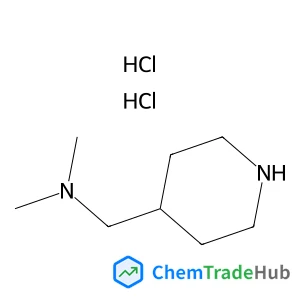
N,N-dimethyl(piperidin-4-yl)methanamine hydrochloride
CAS Number:
172281-72-0
Molecular Formula:
C8H20Cl2N2
Wujuan Zhang, Melissa Oehrle, Somchai Chutipongtanate, Duangrurdee Wattanasirichaigoon, Venette Inskeep, Mei Dai, Dao Pan, Ying Sun, Kenneth D. R. Setchell
Gaucher disease (GD) is caused by mutations on the GBA1 gene leading to deficiency in acid β-glucosidase (GCase) and subsequent accumulation of its substrates, glucosylceramide (GlcC) and glucosylsphingosine (GlcS). GlcS in plasma has been proposed as a highly sensitive and specific biomarker for the diagnosis of GD and for monitoring disease progression and response to therapy. Here we report a novel robust and accurate hydrophilic interaction liquid chromatography tandem mass spectrometric method (HILIC-MS/MS) for the direct measurement of glucosylsphingosine (GlcS) in dried plasma spots (DPS). The method was also capable of resolving the isomeric pair, glucosylsphingosine and galactosylsphingosine, the latter of which was proposed as a promising biomarker for Krabbe disease. The method was fully validated and applied to the analysis of 19 GD patients and carriers. The GlcS levels in 9 GD type I patients who have been on enzyme replacement therapy (ERT) were reduced to a mean of 31.0 nM, much lower compared to a pre-treated specimen at a level of 85.8 nM, but still significantly elevated compared to healthy controls. GlcS concentrations in three treated type III GD patients were much lower compared to an untreated patient. In our preclinical GD studies, 4L;C* mice (subacute nGD model) exhibited comparable levels of plasma GlcS, but had much higher GlcS accumulation in the brain than those of 9V/null mice (chronic neuropathic GD model). Our method for the measurement of GlcS in DPS proved to be a very convenient approach for sample collection, storage and shipping nationwide and internationally.
C. L. Ma, J. Hu
DOI: 10.1039/D1CP02554F
Thanh Lam Nguyen, Jozef Peeters
DOI: 10.1039/D1CP02234B
Marwa H. Farag, Arkajit Mandal
DOI: 10.1039/D1CP00943E
Yu Sha, Xiaobing Zhang
DOI: 10.1039/D1CP03317D
Lucía Pérez Ramírez, Anthony Boucly, Florent Saudrais, Emmanuel Maisonhaute, Aleksandar R. Milosavljević, Christophe Nicolas, François Rochet
DOI: 10.1039/D1CP01511G
Yanan Wang, Tomoya Taguchi, Huan Li, Ai Suzuki, Yanting Zhang, Akari Miura, Mitsuki Ikeda, Hidenori Goto, Ritsuko Eguchi, Takafumi Miyazaki, Yen-Fa Liao, Hirofumi Ishii, Yoshihiro Kubozono
DOI: 10.1039/D1CP00042J
Sukai Teng, Jia Li, Xiujuan Mao, Fuli He, Ze Liu, Jiaxi Wang, Yafan Wang
DOI: 10.1039/D1CP02039K
Luca Bergamasco, Matteo Morciano, Matteo Fasano
DOI: 10.1039/D1CP00708D
Aleksandr Chernatynskiy, Xiao-Feng Zhao
DOI: 10.1039/D1CP03544D
DOI: 10.1039/D1CP00096A
Ethyl 4-chlorothieno[2,3-b]pyridine-5-carboxylate (CAS: 59713-58-5) can be synth...
5-Methyl-1H-indole-3-carbaldehyde (CAS: 52562-50-2) is subject to various regula...
(1,3-Dimethyl-2,4-dioxo-1,2,3,4-tetrahydro-5-pyrimidinyl)boronic acid is a white...
Waste containing Sulfocostunolide A (CAS: 1016983-51-9) should be handled with c...
When handling Murraxocin (CAS: 88478-44-8), ensure proper personal protective eq...
Formvar (CAS: 63148-64-1) is an alkyd resin characterized by a high molecular we...
(S)-4-benzyl-2-((benzyloxy)methyl)morpholine is generally safe when handled with...
Methyl 1-(5-bromo-2-pyrimidinyl)cyclopropanecarboxylate (CAS: 1447607-69-3) is p...
2-Methyl-1-phenyl-1-propanamine hydrochloride (CAS: 24290-47-9) is generally con...
3-(4-Bromophenyl)-2-methylpropanoic acid is synthesized through a multi-step pro...

Analyst publishes analytical and bioanalytical research that reports premier fundamental discoveries and inventions, and the applications of those discoveries, unconfined by traditional discipline barriers.