












Recent developments for the photoinduced Ar–X bond dissociation reaction
Literature Information
Publication Date
2016-06-13
DOI
10.1039/C6QO00103C
Impact Factor
5.281
Authors
Guanyinsheng Qiu, Yuewen Li
View Original
Abstract
Recent developments in the photochemical carbon–carbon and carbon–heteroatom bond formation via photoinduced Ar–X bond dissociation are summarized. The transformations through the Ar–X bond dissociation enabled by photoenergy include nucleophilic substitution, arylation, alkylation, aminocarbonylation, aminosulfonylation and decarboxylative coupling reactions. Usually, the reactions undergo one-electron-transfer couplings and aryl radicals or cations are involved as the key intermediates. Under ultraviolet irradiation or visible light, the reactions of aryl halides with reactive partners proceed smoothly under mild conditions. In some cases, the transformations can proceed without any metals or photo-redox catalysts. Moreover, the broad reaction scope is demonstrated with good functional group tolerance.
Related Literature
Synthesis of hollow silica nanospheres with a microemulsion as the template
Yu-Shen Lin, Si-Han Wu, Chih-Ta Tseng, Yann Hung, Chen Chang, Chung-Yuan Mou
2009-05-06
Communication
DOI: 10.1039/B902681A
The anomalous solid state decomposition of ammonium dinitramide: a matter of surface polarization
Tore Brinck
2009-04-06
Communication
DOI: 10.1039/B900915A
A simple recycling and reuse hydrothermal route to ZnOnanorod arrays, nanoribbon bundles, nanosheets, nanocubes and nanoparticles
Peng Gao, Yujin Chen, Ying Wang, Qin Zhang, Xuefei Li, Min Hu
2009-03-25
Communication
DOI: 10.1039/B900391F
Two- to one-dimensional transition of self-assembled coordination networks at surfaces by organic ligand addition
Alexander Langner, Rajadurai Chandrasekar, Mario Ruben
2009-04-02
Communication
DOI: 10.1039/B822476E
Metal–organic macrocycles, metal–organic polyhedra and metal–organic frameworks
M. Jaya Prakash, Myoung Soo Lah
2009-04-28
Feature Article
DOI: 10.1039/B902988E
Magnetic PEDOT hollow capsules with single holes
Shyh-Chyang Luo, Jiang Jiang, Sean S. Liour, Shujun Gao, Jackie Y. Ying, Hsiao-hua Yu
2009-03-23
Communication
DOI: 10.1039/B821989C
You might also like
Compound Q&A
How should waste containing (6-Bromo-2-naphthyl)oxy](dimethyl)(2-methyl-2-propanyl)silane be handled?
Waste containing (6-Bromo-2-naphthyl)oxy](dimethyl)(2-methyl-2-propanyl)silane (...
100751-65-3[(6-Bromo-2-naphthyl...
Compound Q&A
How is 7-Fluoro-4-isoquinolinecarboxylic acid (CAS: 1841081-40-0) typically synthesized?
7-Fluoro-4-isoquinolinecarboxylic acid can be synthesized via a multi-step proce...
1841081-40-07-Fluoro-4-isoquinol...
Compound Q&A
What are the physical and chemical properties of 2,3,5,6-Tetrabromothieno[3,2-b]thiophene (CAS: 124638-53-5)?
2,3,5,6-Tetrabromothieno[3,2-b]thiophene is a crystalline compound with a high m...
124638-53-52,3,5,6-Tetrabromoth...
Compound Q&A
Is 1-[4-(Benzylamino)-7,8-dihydro-5H-pyrano[4,3-d]pyrimidin-2-yl]-2-methyl-1H-indole-4-carboxamide (CAS: 1542705-92-9) safe?
1-[4-(Benzylamino)-7,8-dihydro-5H-pyrano[4,3-d]pyrimidin-2-yl]-2-methyl-1H-indol...
1542705-92-91-[4-(Benzylamino)-7...
Compound Q&A
What is the market or research trend for imidazo[5,1-d]-1,2,3,5-tetrazine-8-carboxylic acid, 3,4-dihydro-3-methyl-4-oxo- (CAS: 113942-30-6)?
The market for imidazo[5,1-d]-1,2,3,5-tetrazine-8-carboxylic acid, 3,4-dihydro-3...
113942-30-6Imidazo[5,1-d]-1,2,3...
Compound Q&A
What is 3-(Triisopropylsilyl)propiolaldehyde (CAS: 163271-80-5)?
3-(Triisopropylsilyl)propiolaldehyde is a synthetic organic compound with the CA...
163271-80-53-(Triisopropylsilyl...
Compound Q&A
What regulatory guidelines apply to 6-Nitro-2H-1,4-benzoxazin-3(4H)-one (CAS: 81721-87-1)?
6-Nitro-2H-1,4-benzoxazin-3(4H)-one (CAS: 81721-87-1) is subject to various regu...
81721-87-16-Nitro-2H-1,4-benzo...
Compound Q&A
How should waste containing (3-Fluorophenyl)(4-{[(2-methyl-2-propanyl)oxy]carbonyl}-1-piperazinyl)acetic acid (CAS: 885272-91-3) be handled?
Waste containing (3-Fluorophenyl)(4-{[(2-methyl-2-propanyl)oxy]carbonyl}-1-piper...
885272-91-3(3-Fluorophenyl)(4-{...
Compound Q&A
What are the physical and chemical properties of N,N'-4,4'-Biphenyldiyldiisonicotinamide (CAS: 55119-40-9)?
N,N'-4,4'-Biphenyldiyldiisonicotinamide is a white crystalline solid with a mole...
55119-40-9N,N'-4,4'-Biphenyldi...
Compound Q&A
What industries use 6-Bromo-8-fluoro-2-quinazolinol (CAS: 1036756-15-6)?
6-Bromo-8-fluoro-2-quinazolinol is primarily used in the pharmaceutical industry...
1036756-15-66-Bromo-8-fluoro-2-q...
Source Journal
Organic Chemistry Frontiers

CiteScore:
7.8
Self-citation Rate:
8.7%
Articles per Year:
724
Organic Chemistry Frontiers publishes high-quality research from across organic chemistry. Emphases are placed on studies that make significant contributions to the field of organic chemistry by reporting either new or significantly improved protocols or methodologies. Topics include, but are not limited to the following: Organic synthesis Development of synthetic methodologies Catalysis Natural products Functional organic materials Supramolecular and macromolecular chemistry Physical and computational organic chemistry
Recommended Compounds
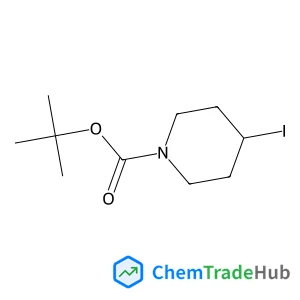
2-Methyl-2-propanyl 4-iodo-1-piperidinecarboxylate
CAS Number:
301673-14-3
Molecular Formula:
C10H18INO2
![10-(1-Azabicyclo[2.2.2]oct-3-ylmethyl)-10H-phenothiazine structure](https://static.chemtradehub.com/structs/292/29216-28-2-1d81.webp "10-(1-Azabicyclo[2.2.2]oct-3-ylmethyl)-10H-phenothiazine structure")
10-(1-Azabicyclo[2.2.2]oct-3-ylmethyl)-10H-phenothiazine
CAS Number:
29216-28-2
Molecular Formula:
C20H22N2S
Recommended Suppliers



Disclaimer
This page provides academic journal information for reference and research purposes only. We are not affiliated with any journal publishers and do not handle publication submissions. For publication-related inquiries, please contact the respective journal publishers directly.
If you notice any inaccuracies in the information displayed, please contact us at support@chemtradehub.com. We will promptly review and address your concerns.