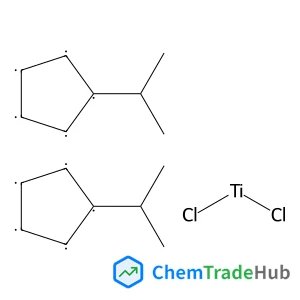
BIS(I-PROPYLCYCLOPENTADIENYL)TITANIUM DICHLORIDE
CAS Number:
12130-65-3
Molecular Formula:
C16H22Cl2Ti
Zafer Kahveci, Ali K. Sekizkardes, Ravi K. Arvapally, Logan Wilder, Hani M. El-Kaderi
The formation of boron–nitrogen (B–N) bonds has been widely explored for the synthesis of small molecules, oligomers, or linear polymers; however, its use in constructing porous organic frameworks remains very scarce. In this study, three highly porous diazaborole-linked polymers (DBLPs) have been synthesized by condensation reactions using 2,3,6,7,14,15-hexaaminotriptycene and aryl boronic acids. DBLPs are microporous and exhibit high Brunauer–Emmett–Teller surface area (730–986 m2 g−1) which enable their use in small gas storage and separation. At ambient pressure, the amorphous polymers show high CO2 (DBLP-4: 4.5 mmol g−1 at 273 K) and H2 (DBLP-3: 2.13 wt% at 77 K) uptake while their physicochemical nature leads to high CO2/N2 (35–42) and moderate CO2/CH4 (4.9–6.2) selectivity. The electronic impact of integrating diazaborole moieties into the backbone of these polymers was investigated for DBLP-4 which exhibits green emission with a broad peak ranging from 350 to 680 nm upon excitation with 340 nm in DMF without photobleaching. This study demonstrates the effectiveness of B–N formation in targeting highly porous frameworks with promising optical properties.

Heteroatom Chemistry

Electroanalysis

Chinese Journal of Chemistry

Journal of the Indian Institute of Science

Main Group Chemistry

Journal of Asian Natural Products Research

Biocatalysis and Biotransformation

Bioorganic & Medicinal Chemistry

Medicinal Chemistry Research

Acta Metallurgica Sinica-English Letters
Florian Lotz, Paula Baar, Bernhard Spengler, Sabine Schulz
DOI: 10.1039/D0AN02281K
Oliver Deeg, Peer Kirsch, Detlef Pauluth, Peter Bäuerle
DOI: 10.1039/B207630F
Arnaud Lavalette, Jacqueline Hamblin, Andrew Marsh, David M. Haddleton, Michael J. Hannon
DOI: 10.1039/B210019C
Haifa M. Almughamsi, Makella K. Howell, Samuel R. Parry, Joule E. Esene, Jacob B. Nielsen, Gregory P. Nordin, Adam T. Woolley
DOI: 10.1039/D1AN01365C
Harald Schoeny, Yasin El Abiead, Felina Hildebrand, Olivia Zach
DOI: 10.1039/D0AN02443K
Francesco De Riccardis, Marcello Di Filippo, Davide Garrisi, Irene Izzo, Fabrizio Mancin, Lucia Pasquato, Paolo Scrimin, Paolo Tecilla
DOI: 10.1039/B208943B
Robin N. Perutz
DOI: 10.1039/B206154F
Yali Wang, Yuan Zhang, Lijun Yang, Huiyuan Wu, Nathaniel Finney
DOI: 10.1039/D1AN00147G
Hafiz Muhammad Junaid, Amber Rehana Solangi, Madeeha Batool
DOI: 10.1039/D0AN02399J
2-Methylbenzene-1,4-diamine dihydrochloride (CAS: 615-45-2) should be stored in ...
(1S,4S)-2,5-Diazabicyclo[2.2.1]heptane dihydrobromide is generally considered sa...
(6-Chloropyridazin-3-YL)methanamine finds applications in the pharmaceutical ind...
2-Fluoro-3-methylphenol is primarily used in the synthesis of pharmaceuticals, p...
When handling 3-Methoxy-4-nitrobenzonitrile, it is important to wear appropriate...
When handling 1,3-Oxazolo[4,5-b]pyridine-2(3H)-thione (CAS: 211949-57-4), it is ...
4-Ethynylbenzamide (CAS: 90347-86-7) falls under various regulatory guidelines i...
3-(2-Ethylphenyl)-2-thioxo-4-imidazolidinone is primarily used as an intermediat...
(2-Fluoro-6-methoxyphenyl)acetic acid, also known as 4-fluoro-3-methoxybenzoic a...
Market trends for 2-[4-(Hydroxymethyl)phenoxy]ethanol (CAS: 102196-18-9) indicat...

Polymer Chemistry welcomes submissions in all areas of polymer science that have a strong focus on macromolecular chemistry. Manuscripts may cover a broad range of fields, yet no direct application focus is required.