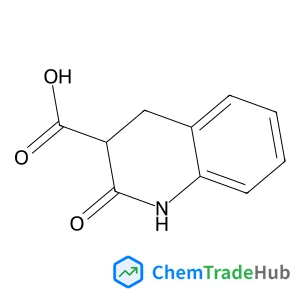
2-Oxo-1,2,3,4-tetrahydro-3-quinolinecarboxylic acid
CAS Number:
246867-17-4
Molecular Formula:
C10H9NO3
Anh T. N. Dao, K. Nakayama, T. Taniike
Recent successes in the production of recombinant spider silk have boosted numerous attempts for its industrialization as a robust and extremely tough material. In spite of the acceleration of the materials science, the inherent weakness of the spider silk against harsh environments has not been sufficiently addressed. Here, the thermal degradation of recombinant spider silk powder was systematically studied under an oxidative atmosphere, based on multilateral characterization including thermogravimetric analysis (TGA), chemiluminescence (CL), nuclear magnetic resonance (NMR), X-ray diffraction (XRD), IR spectroscopy, and X-ray photoelectron spectroscopy (XPS). Spectroscopic changes throughout the degradation were analyzed using a spectral expression of correlation coefficients for resolving the structural and conformational modification of recombinant spider silk. The combination of the comprehensive characterization and statistical analysis clarified a crucial role of oxidative degradation. TGA exhibited a mass loss behavior of recombinant spider silk, typical for the auto-oxidation of polymers. Oxidation significantly promoted the decomposition of recombinant spider silk with chemiluminescence emission. We also identified the formation of carbonyl species as the main oxidation product, the preferential decomposition of amino acid residues in the amorphous phase, and aromatization and Tyr dimerization that could account for discoloration.
Joel H. Bombile, Shreya Shetty, Michael J. Janik, Scott T. Milner
DOI: 10.1039/C9CP06039A
Alireza Mashaghi
DOI: 10.1039/C9CP03175H
Xiaohan Song, Yang Liu, Yanmei Yang, Weifeng Li, Mingwen Zhao
DOI: 10.1039/C9CP03676H
Fuhua Li, Qing Tang
DOI: 10.1039/C9CP03469B
Hong-Ge Tan, Gang Xia, Li-Xiang Liu, Bing Miao
DOI: 10.1039/C9CP03819A
Soniya Gahlawat, Jaspreet Singh, Ashok Kumar Yadav, Pravin P. Ingole
DOI: 10.1039/C9CP04132J
Luis I. Domenianni, Reinhold Fligg, Annett Schäfermeier, Steffen Straub, Julia Beerhues, Biprajit Sarkar, Peter Vöhringer
DOI: 10.1039/C9CP04350K
Helmar Görls
DOI: 10.1039/D0CP00232A
When handling 2-Methyl-2-propanyl 5-amino-2-thiophenecarboxylate (CAS: 1498311-5...
5-Bromo-1,2-dichloro-3-fluorobenzene (CAS: 1000572-93-9) is a crystalline solid ...
(2R)-2-Amino-2-(4-bromophenyl)ethanol (CAS: 354153-64-3) should be stored in a c...
Methyl 4-(aminomethyl)tetrahydro-2H-pyran-4-carboxylate hydrochloride (CAS: 3627...
1,4-Dimethyl-1H-pyrazole-5-sulfonyl chloride is primarily used as an intermediat...
Dinaphtho[1,2-b:2',1'-d]furan is generally safe when handled with appropriate pe...
The market for 7-Methyl-7,9-dihydro-1H-purine-2,6,8(3H)-trione (CAS: 612-37-3) i...
2-(4-Chlorophenyl)malonaldehyde (CAS: 205676-17-1) is a colorless or light yello...
2-Methylchrysene (CAS: 3351-32-4) is typically synthesized via the reaction of c...
N-(6-aminopyrimidin-4-yl)acetamide (CAS: 89533-23-3) is generally considered saf...

Polymer Chemistry welcomes submissions in all areas of polymer science that have a strong focus on macromolecular chemistry. Manuscripts may cover a broad range of fields, yet no direct application focus is required.
![N-[(1-Ethyl-2-pyrrolidinyl)methyl]-2-hydroxy-5-sulfamoylbenzamide structure](https://static.chemtradehub.com/structs/673/67381-52-6-877f.webp "N-[(1-Ethyl-2-pyrrolidinyl)methyl]-2-hydroxy-5-sulfamoylbenzamide structure")