












![4,10-Dihydroxy-3H-pyrano[3,4,5-kl]xanthen-3-one structure](https://static.chemtradehub.com/structs/125/1259330-61-4-de48.webp "4,10-Dihydroxy-3H-pyrano[3,4,5-kl]xanthen-3-one structure")
Soft and rigid core latex nanoparticles prepared by RAFT-mediated surfactant-free emulsion polymerization for cellulose modification – a comparative study
Literature Information
Publication Date
2017-01-02
DOI
10.1039/C6PY01904H
Impact Factor
5.582
Authors
F. L. Hatton, F. D'Agosto, M. Lansalot, E. Malmström
View Original
Abstract
Latex nanoparticles comprising cationically charged coronas and hydrophobic cores with different glass transition temperatures (Tg) have been prepared by surfactant-free, RAFT-mediated emulsion polymerization, where the particles form through a polymerization-induced self-assembly (PISA) type mechanism. Poly(2-dimethylaminoethyl methacrylate-co-methacrylic acid) (P(DMAEMA-co-MAA)) was utilized as a hydrophilic macroRAFT agent for the polymerization of methyl methacrylate (MMA) or n-butyl methacrylate (nBMA), respectively, resulting in two different latexes, with either a core of high (PMMA) or low (PnBMA) Tg polymer. By varying the molar mass of the hydrophobic block, latexes of different sizes were obtained (DHca. 40–120 nm). The adsorption of the latexes to cellulose model surfaces and cellulose nanofibrils (CNF) was studied using quartz crystal microbalance with dissipation monitoring (QCM-D). The surfaces with adsorbed PnBMA latexes yielded hydrophobic surfaces both before and after annealing, whereas surfaces with adsorbed PMMA latex became hydrophobic only after annealing, clearly showing the influence of the Tg of the core. The latexes were also used to modify macroscopic cellulose in the form of filter papers. Similar to the CNF surfaces, no annealing was required to achieve hydrophobic surfaces with PnBMA latexes. Finally, nanocomposites of CNF and the polymer nanoparticles were prepared through a one-pot mixing procedure. It was found that the largest synthesized PMMA latex (120 nm) facilitated a more strainable CNF network at 50% relative humidity, with a nearly 200% increase in strain at break compared to the neat CNF reference film as well as to the composite films with PnBMA latexes or to the smaller sized PMMA latexes. This difference was attributed to the spherical shape and rigidity of the large PMMA latex nanoparticles during composite formation. This highly interesting result should indeed be considered in the future design of novel biocomposites.
Related Literature
Dependence of water adsorption on the surface structure of silicon wafers aged under different environmental conditions
Lei Chen, Dien Ngo, Jiawei Luo, Yunfei Gong, Chen Xiao, Xin He, Bingjun Yu, Linmao Qian, Seong H. Kim
2019-11-05
Paper
DOI: 10.1039/C9CP04776J
Computational modeling of ionic currents through difform graphene nanopores with consistent cross-sectional areas
2019-11-07
Paper
DOI: 10.1039/C9CP05459F
Electronic couplings and rates of excited state charge transfer processes at poly(thiophene-co-quinoxaline)–PC71BM interfaces: two- versus multi-state treatments
Tuuva Kastinen, Demetrio Antonio da Silva Filho, Lassi Paunonen, Luiz Antonio Ribeiro Junior, Terttu I. Hukka
2019-11-01
Paper
DOI: 10.1039/C9CP04837E
Theoretical study of the optical and thermodynamic properties of LaxSr1−xCo1−yFeyO3−δ (x/y = 0.25, 0.5, 0.75) perovskites
Ting Jia, Paul Ohodnicki, Benjamin Chorpening, Jonathan Lekse, Gregory Hackett, Yuhua Duan
2019-11-04
Paper
DOI: 10.1039/C9CP04921E
Capturing unconventional metallofullerene M@C60 through activation of the unreactive [5,6] bond toward Diels–Alder reaction
Yabei Wu, Yuhang Jiang, Jianjun Deng, Zhiyong Wang
2020-10-16
Paper
DOI: 10.1039/D0CP04506C
Simultaneous determination of deuteron quadrupole coupling constants and rotational correlation times: the model case of hydrogen bonded ionic liquids
P. Stange, A. Appelhagen, D. Michalik, D. Paschek
2019-10-18
Paper
DOI: 10.1039/C9CP04983E
Hydrogen attachment dissociation of peptides containing disulfide bonds
Daiki Asakawa, Hidenori Takahashi, Shinichi Iwamoto, Koichi Tanaka
2019-11-12
Paper
DOI: 10.1039/C9CP03923F
Ultra-low lattice thermal conductivity of monolayer penta-silicene and penta-germanene
Zhibin Gao, Zhaofu Zhang, Gang Liu, Jian-Sheng Wang
2019-10-30
Paper
DOI: 10.1039/C9CP05246A
Artificial neural networks for the prediction of solvation energies based on experimental and computational data
Jiyoung Yang, Matthias J. Knape, Oliver Burkert, Virginia Mazzini, Alexander Jung, Vincent S. J. Craig, Ramón Alain Miranda-Quintana, Erich Bluhmki
2020-10-12
Paper
DOI: 10.1039/D0CP03701J
Enhanced solvent resistance and electrical performance of electrohydrodynamic jet printed PEDOT:PSS composite patterns: effects of hardeners on the performance of organic thin-film transistors
Xiaowu Tang, Hyeok-jin Kwon, Heqing Ye, Jae Young Kim, Jaewoong Lee, Yong Jin Jeong, Se Hyun Kim
2019-11-12
Paper
DOI: 10.1039/C9CP04864B
You might also like
Compound Q&A
What are the main uses of (5-Sulfamoyl-3-pyridinyl)boronic acid (CAS: 951233-61-7)?
(5-Sulfamoyl-3-pyridinyl)boronic acid is primarily used in chemical synthesis, p...
951233-61-7(5-Sulfamoyl-3-pyrid...
Compound Q&A
How is Benzyl 2-methyl-2-(methylsulfonyl)-4-pentenoate (CAS: 1942858-50-5) typically synthesized?
Benzyl 2-methyl-2-(methylsulfonyl)-4-pentenoate is typically synthesized via est...
1942858-50-5Benzyl 2-methyl-2-(m...
Compound Q&A
What precautions should be taken when handling 8-Fluoroquinolin-6-ol (CAS: 209353-22-0)?
When handling 8-Fluoroquinolin-6-ol (CAS: 209353-22-0), it is important to use p...
209353-22-08-Fluoroquinolin-6-o...
Compound Q&A
What are the physical and chemical properties of 1,3-Dibromo-5-(2-methyl-2-propanyl)benzene (CAS: 129316-09-2)?
1,3-Dibromo-5-(2-methyl-2-propanyl)benzene (CAS: 129316-09-2) is a crystalline c...
129316-09-21,3-Dibromo-5-(2-met...
Compound Q&A
What industries use Ethyl 7-chloro-4-oxo-1-(1,3-thiazol-2-yl)-1,4-dihydro-1,8-naphthyridine-3-carboxylate (CAS: 174726-87-5)?
Ethyl 7-chloro-4-oxo-1-(1,3-thiazol-2-yl)-1,4-dihydro-1,8-naphthyridine-3-carbox...
174726-87-5Ethyl 7-chloro-4-oxo...
Compound Q&A
What precautions should be taken when handling Delta-7-Avenasterol (CAS: 23290-26-8)?
When handling Delta-7-Avenasterol (CAS: 23290-26-8), it is important to wear app...
23290-26-8Delta-7-Avenasterol
Compound Q&A
What precautions should be taken when handling N-({(5R)-3-[3-Fluoro-4-(4-morpholinyl)phenyl]-2-oxo-1,3-oxazolidin-5-yl}methyl)acetamide (CAS: 872992-20-6)?
Proper handling involves the use of personal protective equipment such as gloves...
872992-20-6N-({(5R)-3-[3-Fluoro...
Compound Q&A
What precautions should be taken when handling 2-Methyl-2-proanyl 4-[(2-aminophenyl)amino]-1-piperidinecarboxylate (CAS: 79099-00-6)?
When handling 2-Methyl-2-proanyl 4-[(2-aminophenyl)amino]-1-piperidinecarboxylat...
79099-00-62-Methyl-2-propanyl ...
Compound Q&A
What is N-Methyl-4-chlorobenzylamine hydrochloride (CAS: 65542-24-7)?
N-Methyl-4-chlorobenzylamine hydrochloride (CAS: 65542-24-7) is a organic compou...
65542-24-7N-Methyl-4-chloroben...
Compound Q&A
Is [2-(Dodecyloxy)ethoxy]acetic acid (CAS: 27306-90-7) safe?
[2-(Dodecyloxy)ethoxy]acetic acid (CAS: 27306-90-7) is generally considered safe...
27306-90-7[2-(Dodecyloxy)ethox...
Source Journal
Polymer Chemistry

CiteScore:
8.6
Self-citation Rate:
7.3%
Articles per Year:
457
Polymer Chemistry welcomes submissions in all areas of polymer science that have a strong focus on macromolecular chemistry. Manuscripts may cover a broad range of fields, yet no direct application focus is required.
Recommended Compounds
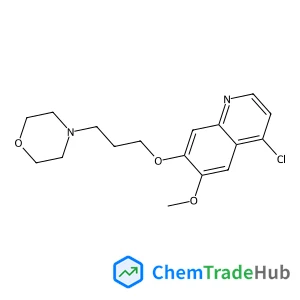
4-(3-((4-Chloro-6-methoxyquinolin-7-yl)oxy)propyl)morpholine
CAS Number:
205448-32-4
Molecular Formula:
C17H21ClN2O3
Recommended Suppliers









Disclaimer
This page provides academic journal information for reference and research purposes only. We are not affiliated with any journal publishers and do not handle publication submissions. For publication-related inquiries, please contact the respective journal publishers directly.
If you notice any inaccuracies in the information displayed, please contact us at support@chemtradehub.com. We will promptly review and address your concerns.