


Computational modeling of ionic currents through difform graphene nanopores with consistent cross-sectional areas
Literature Information
Publication Date
2019-11-07
DOI
10.1039/C9CP05459F
Impact Factor
3.676
Authors
View Original
Abstract
Understanding the mechanism of ion transport and the related ionic current through a nanopore is significant for improving the sensing accuracy of biophysical and diagnostic applications using the nanopore technology. Here, systematic theoretical studies of ionic current dependence on the geometry of a nanopore were performed. Surprisingly, it was found that the ionic current through a nanopore with a smaller perimeter was obviously larger than that through a nanopore with a larger perimeter although all the nanopores had consistent cross-sectional areas; this was also found for nanopores with different hydrophobicities. This interesting result originates from the decrease in ion concentration, mobility and conductivity in proximity to the nanopore surface. Besides, an obvious ionic current enhancement was observed for hydrophobic nanopores compared to that for the hydrophilic nanopores, which was caused by the increased ion mobility through the hydrophobic nanopores. A simple model that combined the distribution of ion conductivity as well as the traditional Ohm's law was successfully applied to predict the ionic current through difform nanopores with different hydrophobicities. This work will aid the development of high-resolution nanopore sensors in the near future.
Recommended Journals

Herald of the Russian Academy of Sciences

Atomization and Sprays

Biocatalysis and Biotransformation

Bioorganic & Medicinal Chemistry

Cellulose

Chinese Journal of Chemistry

Acta Metallurgica Sinica-English Letters

Medicinal Chemistry Research

Journal of Chemical Sciences

Journal of the Indian Institute of Science
Related Literature
In situ antimony doping of solution-grown ZnOnanorods
Joe Briscoe, Diego E. Gallardo, Steve Dunn
2009-01-19
Communication
DOI: 10.1039/B820797F
Microwave synthesis of Cr nanowires on polymeric substrate
Daeseob Shim, Seung-Ho Jung, Eun-Ha Kim, Dong-Myung Yoon, Kun-Hong Lee, Soo-Hwan Jeong
2008-12-24
Communication
DOI: 10.1039/B816534C
(H2NC4H8NCH2CH2NH2)2Zn2Sn2Se7: a hybrid ternary semiconductor stabilized by amine molecules acting simultaneously as ligands and counterions
Aggelos Philippidis, Thomas Bakas, Pantelis N. Trikalitis
2009-02-03
Communication
DOI: 10.1039/B821859E
Unsuspected mesomorphism in “tail-free” cyclopalladated 3,5-disubstituted-2-(2′-pyridyl)pyrroles
Daniela Pucci, Iolinda Aiello, Alessia Aprea, Anna Bellusci, Alessandra Crispini, Mauro Ghedini
2009-02-20
Communication
DOI: 10.1039/B818603K
Structural and electronic response upon hole doping of rare-earth iron oxyarsenides Nd1−xSrxFeAsO (0 < x≤ 0.2)
Karolina Kasperkiewicz, Jan-Willem G. Bos, Andrew N. Fitch, Kosmas Prassides, Serena Margadonna
2008-12-19
Communication
DOI: 10.1039/B815830D
Exploring the limits of encapsulation within hexameric pyrogallol[4]arene nano-capsules‡
Tamas Szabo, Ali Siavosh-Haghighi, Carol A. Deakyne, John E. Adams, Jerry L. Atwood
2009-01-09
Communication
DOI: 10.1039/B819276F
Chemoenzymatic syntheses of carbasugar analogues of nucleoside diphosphate sugars: UDP-carba-Gal, UDP-carba-GlcNAc, UDP-carba-Glc, and GDP-carba-Man‡
Kyung-Chang Seo, Young-Geol Kwon, Dae-Hee Kim, In-Sook Jang, Jin-Won Cho, Sung-Kee Chung
2009-02-06
Communication
DOI: 10.1039/B821058F
Detection of single-nucleotide mismatches using scanning electrochemical microscopy
Piotr Michal Diakowski, Heinz-Bernhard Kraatz
2009-01-05
Communication
DOI: 10.1039/B819876D
You might also like
Compound Q&A
What are the main uses of (5-Sulfamoyl-3-pyridinyl)boronic acid (CAS: 951233-61-7)?
(5-Sulfamoyl-3-pyridinyl)boronic acid is primarily used in chemical synthesis, p...
951233-61-7(5-Sulfamoyl-3-pyrid...
Compound Q&A
How is Benzyl 2-methyl-2-(methylsulfonyl)-4-pentenoate (CAS: 1942858-50-5) typically synthesized?
Benzyl 2-methyl-2-(methylsulfonyl)-4-pentenoate is typically synthesized via est...
1942858-50-5Benzyl 2-methyl-2-(m...
Compound Q&A
What precautions should be taken when handling 8-Fluoroquinolin-6-ol (CAS: 209353-22-0)?
When handling 8-Fluoroquinolin-6-ol (CAS: 209353-22-0), it is important to use p...
209353-22-08-Fluoroquinolin-6-o...
Compound Q&A
What are the physical and chemical properties of 1,3-Dibromo-5-(2-methyl-2-propanyl)benzene (CAS: 129316-09-2)?
1,3-Dibromo-5-(2-methyl-2-propanyl)benzene (CAS: 129316-09-2) is a crystalline c...
129316-09-21,3-Dibromo-5-(2-met...
Compound Q&A
What industries use Ethyl 7-chloro-4-oxo-1-(1,3-thiazol-2-yl)-1,4-dihydro-1,8-naphthyridine-3-carboxylate (CAS: 174726-87-5)?
Ethyl 7-chloro-4-oxo-1-(1,3-thiazol-2-yl)-1,4-dihydro-1,8-naphthyridine-3-carbox...
174726-87-5Ethyl 7-chloro-4-oxo...
Compound Q&A
What precautions should be taken when handling Delta-7-Avenasterol (CAS: 23290-26-8)?
When handling Delta-7-Avenasterol (CAS: 23290-26-8), it is important to wear app...
23290-26-8Delta-7-Avenasterol
Compound Q&A
What precautions should be taken when handling N-({(5R)-3-[3-Fluoro-4-(4-morpholinyl)phenyl]-2-oxo-1,3-oxazolidin-5-yl}methyl)acetamide (CAS: 872992-20-6)?
Proper handling involves the use of personal protective equipment such as gloves...
872992-20-6N-({(5R)-3-[3-Fluoro...
Compound Q&A
What precautions should be taken when handling 2-Methyl-2-proanyl 4-[(2-aminophenyl)amino]-1-piperidinecarboxylate (CAS: 79099-00-6)?
When handling 2-Methyl-2-proanyl 4-[(2-aminophenyl)amino]-1-piperidinecarboxylat...
79099-00-62-Methyl-2-propanyl ...
Compound Q&A
What is N-Methyl-4-chlorobenzylamine hydrochloride (CAS: 65542-24-7)?
N-Methyl-4-chlorobenzylamine hydrochloride (CAS: 65542-24-7) is a organic compou...
65542-24-7N-Methyl-4-chloroben...
Compound Q&A
Is [2-(Dodecyloxy)ethoxy]acetic acid (CAS: 27306-90-7) safe?
[2-(Dodecyloxy)ethoxy]acetic acid (CAS: 27306-90-7) is generally considered safe...
27306-90-7[2-(Dodecyloxy)ethox...
Source Journal
Physical Chemistry Chemical Physics

CiteScore:
5.5
Self-citation Rate:
10.3%
Articles per Year:
3036
Physical Chemistry Chemical Physics (PCCP) is an international journal co-owned by 19 physical chemistry and physics societies from around the world. This journal publishes original, cutting-edge research in physical chemistry, chemical physics and biophysical chemistry. To be suitable for publication in PCCP, articles must include significant innovation and/or insight into physical chemistry; this is the most important criterion that reviewers and Editors will judge against when evaluating submissions. The journal has a broad scope and welcomes contributions spanning experiment, theory, computation and data science. Topical coverage includes spectroscopy, dynamics, kinetics, statistical mechanics, thermodynamics, electrochemistry, catalysis, surface science, quantum mechanics, quantum computing and machine learning. Interdisciplinary research areas such as polymers and soft matter, materials, nanoscience, energy, surfaces/interfaces, and biophysical chemistry are welcomed if they demonstrate significant innovation and/or insight into physical chemistry. Joined experimental/theoretical studies are particularly appreciated when complementary and based on up-to-date approaches.
Recommended Compounds
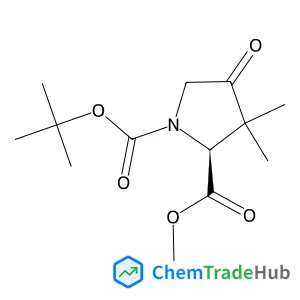
2-Methyl 1-(2-methyl-2-propanyl) (2S)-3,3-dimethyl-4-oxo-1,2-pyrrolidinedicarboxylate
CAS Number:
478698-30-5
Molecular Formula:
C13H21NO5
Recommended Suppliers





Disclaimer
This page provides academic journal information for reference and research purposes only. We are not affiliated with any journal publishers and do not handle publication submissions. For publication-related inquiries, please contact the respective journal publishers directly.
If you notice any inaccuracies in the information displayed, please contact us at support@chemtradehub.com. We will promptly review and address your concerns.