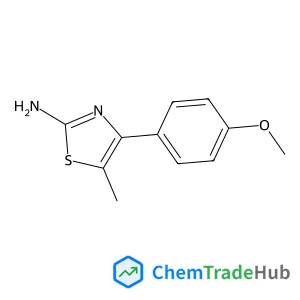
4-(4-Methoxyphenyl)-5-methyl-1,3-thiazol-2-amine
CAS Number:
105512-88-7
Molecular Formula:
C11H12N2OS
Daiki Asakawa, Hidenori Takahashi, Shinichi Iwamoto, Koichi Tanaka
A combination of tandem mass spectrometry (MS/MS) and hydrogen attachment dissociation (HAD) is a useful method for peptide sequence analysis. In this study, gas-phase fragmentation induced by the attachment of hydrogen to peptides containing disulfide bonds was investigated. Hydrogen attachment induced the cleavage of either the disulfide or N–Cα bond, which competitively occurred during HAD. The disulfide bond cleavage proceeded through an intermediate, which contains a thiyl radical (–S˙) and a thiol group (–SH). In contrast, N–Cα bond cleavage produced an intermediate containing an enol-imine group and α-carbon radical. The intermediate α-carbon radical then attacked the disulfide bond, resulting in a cyclic [z]+ fragment. The counterpart, [c + H]+˙ with a thiyl radical underwent further hydrogen attachment, producing [c + 2H]+. Because both disulfide and N–Cα bonds were cleaved by a single hydrogen attachment event, HAD-MS/MS can provide sequence information for the backbone region in the disulfide loop.

Bioorganic & Medicinal Chemistry Letters

Medicinal Chemistry Research

Bioorganic & Medicinal Chemistry

Herald of the Russian Academy of Sciences

Cellulose

Chinese Journal of Chemistry

Journal of Chemical Sciences

Critical Reviews in Solid State and Materials Sciences

Heteroatom Chemistry

Main Group Chemistry
Xiaolong Wang, Miao Chen, Feng Zhou, Weimin Liu, Qunji Xue
DOI: 10.1039/B818633B
Oksana Sereda, Amélie Blanrue, René Wilhelm
DOI: 10.1039/B817991C
Isamu Shiina, Hiroki Fukui
DOI: 10.1039/B814375G
Neil M. Boag, K. Mohan Rao
DOI: 10.1039/B818537A
Stuart T. Caldwell, Louis J. Farrugia, Shanika Gunatilaka Hewage, Nadiya Kryvokhyzha, Vincent M. Rotello, Graeme Cooke
DOI: 10.1039/B900269N
A. Prasanna de Silva, Catherine M. Dobbin, Thomas P. Vance
DOI: 10.1039/B822181B
Dae-Wi Yoon, Dustin E. Gross, Vincent M. Lynch, Chang-Hee Lee, Philip C. Bennett, Jonathan L. Sessler
DOI: 10.1039/B818077F
Na Tian, Zhi-You Zhou, Shi-Gang Sun
DOI: 10.1039/B819751B
Zhixun Luo, Yi Luo, Jie Li, Kai Liu, Hongbing Fu, Ying Ma, Jiannian Yao
DOI: 10.1039/B819402E
(5-Sulfamoyl-3-pyridinyl)boronic acid is primarily used in chemical synthesis, p...
Benzyl 2-methyl-2-(methylsulfonyl)-4-pentenoate is typically synthesized via est...
When handling 8-Fluoroquinolin-6-ol (CAS: 209353-22-0), it is important to use p...
1,3-Dibromo-5-(2-methyl-2-propanyl)benzene (CAS: 129316-09-2) is a crystalline c...
Ethyl 7-chloro-4-oxo-1-(1,3-thiazol-2-yl)-1,4-dihydro-1,8-naphthyridine-3-carbox...
When handling Delta-7-Avenasterol (CAS: 23290-26-8), it is important to wear app...
Proper handling involves the use of personal protective equipment such as gloves...
When handling 2-Methyl-2-proanyl 4-[(2-aminophenyl)amino]-1-piperidinecarboxylat...
N-Methyl-4-chlorobenzylamine hydrochloride (CAS: 65542-24-7) is a organic compou...
[2-(Dodecyloxy)ethoxy]acetic acid (CAS: 27306-90-7) is generally considered safe...

Physical Chemistry Chemical Physics (PCCP) is an international journal co-owned by 19 physical chemistry and physics societies from around the world. This journal publishes original, cutting-edge research in physical chemistry, chemical physics and biophysical chemistry. To be suitable for publication in PCCP, articles must include significant innovation and/or insight into physical chemistry; this is the most important criterion that reviewers and Editors will judge against when evaluating submissions. The journal has a broad scope and welcomes contributions spanning experiment, theory, computation and data science. Topical coverage includes spectroscopy, dynamics, kinetics, statistical mechanics, thermodynamics, electrochemistry, catalysis, surface science, quantum mechanics, quantum computing and machine learning. Interdisciplinary research areas such as polymers and soft matter, materials, nanoscience, energy, surfaces/interfaces, and biophysical chemistry are welcomed if they demonstrate significant innovation and/or insight into physical chemistry. Joined experimental/theoretical studies are particularly appreciated when complementary and based on up-to-date approaches.