












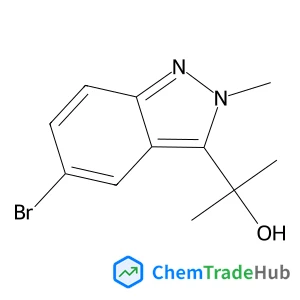
2-(5-Bromo-2-methyl-2H-indazol-3-yl)-2-propanol
CAS Number:
1823787-20-7
Molecular Formula:
C11H13BrN2O
Z. Pinar Gumus, Huseyin Akbulut, Ebru Aldemir, Hakan Coskunol, Demet Goen Colak, Shuhei Yamada, Takeshi Endo, Yusuf Yagci
Polypeptide-functionalized macromonomers are very fascinating candidates for the modification of various surfaces of different sizes as well as geometry, and have attracted considerable attention for biomolecule stabilization, biomedical device fabrication and bioanalytical applications. In the present work, synthesis and characterization of a novel poly-L-phenylalanine-bearing electroactive macromonomer (EDOT–BTDA–PPhe) were carried out. In the following steps, a glassy carbon electrode was covered with this material, and then cocaine aptamer was immobilized to obtain a biofunctional surface for the biosensing of ‘Abused Drug’ model. Aptamers attached to polypeptide side chains on the macromonomer with good orientation are induced for conformational change into three-way junction form as a result of selective binding of cocaine or its metabolite. This aptamer folding-based conformational response provides detectable signals due to formation of a compact interface which restricts electron transfer of redox probe. The stepwise modification of the surface was confirmed by electrochemical techniques. At the final step, the aptasensor was applied for the electrochemical detection of cocaine and its major metabolite, benzoylecgonine (BE), which exhibited a linear correlation between 1.0 and 10 nM and between 0.5 and 10 μM respectively. The proposed methods were successfully employed for the analysis of synthetic biological fluids.
Katsuhiko Satoh
DOI: 10.1039/C9CP03296G
Yongnan Xiong, Xiaofan Li, Shifang Xiao, Huiqiu Deng, Bowen Huang, Wenjun Zhu, Wangyu Hu
DOI: 10.1039/C9CP02920F
V. K. Sharma, D. K. Rai, E. Mamontov
DOI: 10.1039/C9CP03767E
Madeleine F. Dupont, Edwin Mayes, Kay Latham
DOI: 10.1039/C9CP04542B
M. Jotkar, L. Rongy, A. De Wit
DOI: 10.1039/C9CP03044A
Arifin Luthfi Maulana, Refaldi Intri Dwi Putra
DOI: 10.1039/C9CP02970B
Yujie Zhang, Jingwei Shen, Xue Li, Zhongxue Chen, Shun-an Cao, Ting Li, Fei Xu
DOI: 10.1039/C9CP03836A
When handling 2-Methyl-2-propanyl 5-amino-2-thiophenecarboxylate (CAS: 1498311-5...
5-Bromo-1,2-dichloro-3-fluorobenzene (CAS: 1000572-93-9) is a crystalline solid ...
(2R)-2-Amino-2-(4-bromophenyl)ethanol (CAS: 354153-64-3) should be stored in a c...
Methyl 4-(aminomethyl)tetrahydro-2H-pyran-4-carboxylate hydrochloride (CAS: 3627...
1,4-Dimethyl-1H-pyrazole-5-sulfonyl chloride is primarily used as an intermediat...
Dinaphtho[1,2-b:2',1'-d]furan is generally safe when handled with appropriate pe...
The market for 7-Methyl-7,9-dihydro-1H-purine-2,6,8(3H)-trione (CAS: 612-37-3) i...
2-(4-Chlorophenyl)malonaldehyde (CAS: 205676-17-1) is a colorless or light yello...
2-Methylchrysene (CAS: 3351-32-4) is typically synthesized via the reaction of c...
N-(6-aminopyrimidin-4-yl)acetamide (CAS: 89533-23-3) is generally considered saf...

Polymer Chemistry welcomes submissions in all areas of polymer science that have a strong focus on macromolecular chemistry. Manuscripts may cover a broad range of fields, yet no direct application focus is required.
![L-Lysine,N6-[2-[[(1,1-dimethylethoxy)carbonyl]amino]benzoyl]-N2-[(9H-fluoren-9-ylmethoxy)carbonyl]- structure](https://static.chemtradehub.com/structs/159/159322-59-5-c046.webp "L-Lysine,N6-[2-[[(1,1-dimethylethoxy)carbonyl]amino]benzoyl]-N2-[(9H-fluoren-9-ylmethoxy)carbonyl]- structure")






