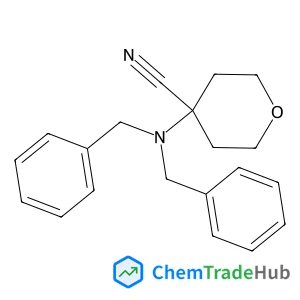
4-(Dibenzylamino)tetrahydro-2H-pyran-4-carbonitrile
CAS Number:
1630906-81-8
Molecular Formula:
C20H22N2O
Srinivas Thanneeru, Lei Jin, Curtis J. Guild
We report a facile approach to designing multiblock thermoplastic elastomers using a two-step thiol–ene polyaddition reaction. It is based on the utilization of intermolecular hydrogen bonding of widely available and cost-effective monomer of N,N′-methylenebis(acrylamide) (MBAm) as physical cross-links. Thiol-terminated “soft” prepolymers were first prepared using ethylene glycol dimethacrylate (EGDMA) and an excess of 1,6-hexanedithiol (HDT); subsequently, the thiol-terminated prepolymers were further reacted with MBAm as a chain-extension reaction to yield the multiblock thermoplastic elastomers. The prepolymers with oligo(ethylene glycol) segments had a low glass-transition temperature, acting as elastic “soft” blocks; while MBAm units could form up to 4 hydrogen bonds that serve as physical networks to endow the elasticity to multiblock polymers. Proton nuclear magnetic resonance spectroscopy and gel permeation chromatography indicated the occurrence of the two-step thiol–ene reactions. The reaction kinetics of thiol–ene reactions was found to be highly dependent on the molecular weights of monomers. The first thiol–ene reaction of EGDMA and HDT could reach >90% conversion of both monomers within 5 min; while the kinetics of the second chain extension reaction was relatively slow and it took approximately 7 h to reach 90% conversion. The formation of the intermolecular hydrogen bonding between amide groups of MBAm units was confirmed by variable-temperature Fourier transform infrared spectroscopy and differential scanning calorimetry. The viscoelasticity and elasticity of the thermoplastic elastomers were found to be largely determined by the content of MBAm. With a molar ratio of 15% MBAm relative to EGDMA, the maximum elongation at break of elastomers reached >400%. Our synthetic method has the advantages of mild reaction conditions, high conversion and adjustable mechanical properties of elastomers; additionally, it does not involve heavy syntheses and expensive monomers/catalysts. Our findings conceivably stand out as a new tool to synthesize and engineer thermoplastic elastomers using the combination of thiol–ene chemistry and supramolecular interaction.
Xin Li, Ming Gao, Qi Liu, Huiqin Wang, Pengwei Huo
DOI: 10.1039/D1SE00974E
DOI: 10.1039/D1SE01400E
Wenxue Guo, Xiujuan Luan, Peng Sun, Tao Wang, Haotian Luo, Xiaotong Li, Chengde Li, Wei Tan, Jingkun Bai, Qiang Wang
DOI: 10.1039/D1SE01225H
Zhenyu Xie, Daping Qiu, Min Li
DOI: 10.1039/D1SE01627J
Koray Alper, Yun-Yan Wang, Xianzhi Meng, Kubilay Tekin, Selhan Karagoz
DOI: 10.1039/D1SE01316E
Yulia Galagan, Hamid Ez-Zahraouy
DOI: 10.1039/D1SE00687H
Rong-hao Cen, Xueping Zong, Yang Cheng, Mei Zhao, Ming Luo, Yantao Zhang, Song Xue
DOI: 10.1039/D1SE90080C
Heeyeon An
DOI: 10.1039/D1SE01784E
Dinesh Bhalothia, Yu-Min Yu, Yi-Ru Lin, Tzu- Hsi Huang, Che Yan, Jyh-Fu Lee, Kuan-Wen Wang
DOI: 10.1039/D1SE01331A
When handling 2-Methyl-2-propanyl 5-amino-2-thiophenecarboxylate (CAS: 1498311-5...
5-Bromo-1,2-dichloro-3-fluorobenzene (CAS: 1000572-93-9) is a crystalline solid ...
(2R)-2-Amino-2-(4-bromophenyl)ethanol (CAS: 354153-64-3) should be stored in a c...
Methyl 4-(aminomethyl)tetrahydro-2H-pyran-4-carboxylate hydrochloride (CAS: 3627...
1,4-Dimethyl-1H-pyrazole-5-sulfonyl chloride is primarily used as an intermediat...
Dinaphtho[1,2-b:2',1'-d]furan is generally safe when handled with appropriate pe...
The market for 7-Methyl-7,9-dihydro-1H-purine-2,6,8(3H)-trione (CAS: 612-37-3) i...
2-(4-Chlorophenyl)malonaldehyde (CAS: 205676-17-1) is a colorless or light yello...
2-Methylchrysene (CAS: 3351-32-4) is typically synthesized via the reaction of c...
N-(6-aminopyrimidin-4-yl)acetamide (CAS: 89533-23-3) is generally considered saf...

Polymer Chemistry welcomes submissions in all areas of polymer science that have a strong focus on macromolecular chemistry. Manuscripts may cover a broad range of fields, yet no direct application focus is required.
![N-[(1-Ethyl-2-pyrrolidinyl)methyl]-2-hydroxy-5-sulfamoylbenzamide structure](https://static.chemtradehub.com/structs/673/67381-52-6-877f.webp "N-[(1-Ethyl-2-pyrrolidinyl)methyl]-2-hydroxy-5-sulfamoylbenzamide structure")
methyl]-N,2-dimethyl-2-propanesulfinamide structure](https://static.chemtradehub.com/structs/256/2565792-50-7-8a26.webp "N-[(R)-[3-(Benzyloxy)-2-(dicyclohexylphosphino)phenyl](phenyl)methyl]-N,2-dimethyl-2-propanesulfinamide structure")