













Well-defined polyethylene-based graft terpolymers by combining nitroxide-mediated radical polymerization, polyhomologation and azide/alkyne “click” chemistry
Literature Information
Publication Date
2016-03-30
DOI
10.1039/C6PY00331A
Impact Factor
5.582
Authors
Nazeeha Alkayal, Hakan Durmaz, Umit Tunca, Nikos Hadjichristidis
View Original
Abstract
Novel well-defined polyethylene-based graft terpolymers were synthesized via the “grafting onto” strategy by combining nitroxide-mediated radical polymerization (NMP), polyhomologation and copper(I)-catalyzed azide–alkyne cycloaddition (CuAAC) “click” chemistry. Three steps were involved in this approach: (i) synthesis of alkyne-terminated polyethylene-b-poly(ε-caprolactone) (PE-b-PCL-alkyne) block copolymers (branches) by esterification of PE-b-PCL-OH with 4-pentynoic acid; the PE-b-PCL-OH was obtained by polyhomologation of dimethylsulfoxonium methylide to afford PE-OH, followed by ring opening polymerization of ε-caprolactone using PE-OH as a macroinitiator, (ii) synthesis of random copolymers of styrene (St) and 4-chloromethylstyrene (4-CMS) with various CMS contents, by nitroxide-mediated radical copolymerization (NMP), and conversion of chloride to azide groups by reaction with sodium azide (NaN3) (backbone) and (iii) “click” linking reaction to afford the PE-based graft terpolymers. All intermediates and final products were characterized by high-temperature size exclusion chromatography (HT-SEC), Fourier transform infrared spectroscopy (FTIR), proton nuclear magnetic resonance spectroscopy (1H NMR) and differential scanning calorimetry (DSC).
Recommended Journals
Related Literature
Discrimination of Robusta Amazônico coffee farmed by indigenous and non-indigenous people in Amazon: comparing benchtop and portable NIR using ComDim and duplex
Patrícia Valderrama, Enrique Anastácio Alves, Juliana Azevedo Lima Pallone, Federico Marini
2023-02-28
Paper
DOI: 10.1039/D3AN00104K
Molecular simulation-guided aptasensor design of robust and sensitive lateral flow strip for cadmium ion detection
Muhammad Irfan, Ghulam Murtaza, Shangnan Fu, Ailiang Chen, Feng Qu, Xin Su
2023-03-20
Paper
DOI: 10.1039/D3AN00202K
Smartphone-based microplate reader for high-throughput quantitation of disease markers in serum
Rong Deng, Xiaoxin Chao, Haiqin Li, Xiaochun Li, Zehua Yang
2022-12-14
Paper
DOI: 10.1039/D2AN01571D
Monitoring bacterial spore metabolic activity using heavy water-induced Raman peak evolution
Rasmus Öberg, Tobias Dahlberg, Dmitry Malyshev
2023-04-04
Paper
DOI: 10.1039/D2AN02047E
Self-supervised learning for inter-laboratory variation minimization in surface-enhanced Raman scattering spectroscopy
Seongyong Park, Abdul Wahab
2023-02-10
Paper
DOI: 10.1039/D2AN01569B
Determination of vitamin D3 conjugated metabolites: a complementary view on hydroxylated metabolites
Roger Bouillon
2022-12-20
Paper
DOI: 10.1039/D2AN01982E
Differential response for multiple ions: a smart probe to construct optically tunable molecular logic systems
Monaj Karar, Rikitha S. Fernandes, Nilanjan Dey
2023-02-04
Paper
DOI: 10.1039/D2AN01945K
Evaluation of kasugamycin as a chiral selector in capillary electrophoresis
Chunyan Zhang, Yifeng Fan, Liangliang Cai, Xiaofei Ma
2023-02-14
Paper
DOI: 10.1039/D2AN01949C
You might also like
Compound Q&A
What are the main uses of 4-Nitrophenyl phosphate disodium salt hexahydrate (CAS: 333338-18-4)?
4-Nitrophenyl phosphate disodium salt hexahydrate is primarily used as a substra...
333338-18-44-Nitrophenyl phosph...
Compound Q&A
What are the main uses of 2-(Trifluoromethyl)-1,3-oxazole-4-carboxylic Acid (CAS: 1060816-01-4)?
2-(Trifluoromethyl)-1,3-oxazole-4-carboxylic Acid (CAS: 1060816-01-4) is widely ...
1060816-01-42-(Trifluoromethyl)-...
Compound Q&A
How should 2-Fluoro-4-biphenylcarboxylic acid (CAS: 137045-30-8) be stored?
2-Fluoro-4-biphenylcarboxylic acid should be stored in a cool, dry place at room...
137045-30-82-Fluoro-4-biphenylc...
Compound Q&A
What industries use Prednisolone-21-Carboxylic Acid (CAS: 61549-70-0)?
Prednisolone-21-Carboxylic Acid is primarily used in the pharmaceutical industry...
61549-70-0Prednisolone-21-Carb...
Compound Q&A
How should 4-(Hydrazinomethyl)-1,2,3-benzenetriol (CAS: 3614-72-0) be stored?
4-(Hydrazinomethyl)-1,2,3-benzenetriol (CAS: 3614-72-0) should be stored in a co...
3614-72-04-(Hydrazinomethyl)-...
Compound Q&A
What industries use 4-Amino-1-methyl-1H-pyrazole-5-carboxylic acid hydrochloride (CAS: 92534-70-8)?
4-Amino-1-methyl-1H-pyrazole-5-carboxylic acid hydrochloride (CAS: 92534-70-8) i...
92534-70-84-Amino-1-methyl-1H-...
Compound Q&A
What regulatory guidelines apply to dehydropachymic acid (CAS: 77012-31-8)?
Dehydropachymic acid (CAS: 77012-31-8) is regulated by various agencies. It fall...
77012-31-8Dehydropachymic acid
Compound Q&A
What is the market or research trend for 6-[(2,2-Dimethylpropanoyl)amino]nicotinic acid (CAS: 898561-66-5)?
The market and research trends for 6-[(2,2-Dimethylpropanoyl)amino]nicotinic aci...
898561-66-56-[(2,2-Dimethylprop...
Compound Q&A
How should 1,10-Phenanthroline-2,9-dicarbaldehyde (CAS: 57709-62-3) be stored?
1,10-Phenanthroline-2,9-dicarbaldehyde should be stored in a cool, dry place awa...
57709-62-31,10-Phenanthroline-...
Compound Q&A
How is 5-Carbamoyl-11-oxo-10,11-dihydro-5H-dibenzo[b,f]azepin-10-yl acetate (CAS: 113952-21-9) typically synthesized?
5-Carbamoyl-11-oxo-10,11-dihydro-5H-dibenzo[b,f]azepin-10-yl acetate can be synt...
113952-21-95-Carbamoyl-11-oxo-1...
Source Journal
Polymer Chemistry

CiteScore:
8.6
Self-citation Rate:
7.3%
Articles per Year:
457
Polymer Chemistry welcomes submissions in all areas of polymer science that have a strong focus on macromolecular chemistry. Manuscripts may cover a broad range of fields, yet no direct application focus is required.
Recommended Compounds

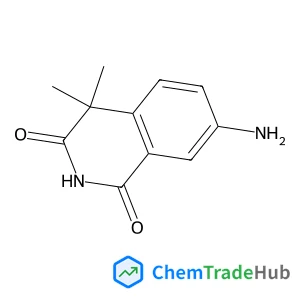
1,3(2H,4H)-Isoquinolinedione, 7-amino-4,4-dimethyl-
CAS Number:
14576-22-8
Molecular Formula:
C11H12N2O2

cis-3-Amino-1-(trifluoromethyl)cyclobutanol hydrochloride (1:1)
CAS Number:
1408075-16-0
Molecular Formula:
C5H9ClF3NO

Recommended Suppliers




Disclaimer
This page provides academic journal information for reference and research purposes only. We are not affiliated with any journal publishers and do not handle publication submissions. For publication-related inquiries, please contact the respective journal publishers directly.
If you notice any inaccuracies in the information displayed, please contact us at support@chemtradehub.com. We will promptly review and address your concerns.