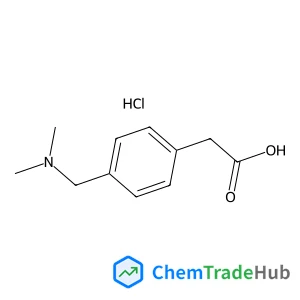
4-(Dimethylaminomethyl)phenylacetic acid hydrochloride
CAS Number:
99985-52-1
Molecular Formula:
C11H16ClNO2
Rafael Tapia-Rojo, Juan J. Mazo, Fernando Falo
Single-molecule force spectroscopy is a powerful technique based on the application of controlled forces to macromolecules. In order to relate the measured response of the molecule to its equilibrium and dynamic properties, a suitable physical picture of the involved process is necessary. In this work, we introduce a plausible model for mechanical unbinding of some molecular complexes, based on a novel free energy profile. We combine two standard theoretical frameworks for analyzing force spectroscopy experiments on two protein:protein complexes, obtaining key magnitudes of the underlying free energy profile, which are only understood within the mentioned model. Additionally, we carry out detailed stochastic dynamics simulations to prove the validity of the analysis protocol and the reliability of the free energy profile. Remarkably, we can compare directly the obtained unbinding free energies with the previously known bulk binding free energies, bridging the gap between bulk and single molecule techniques.

Colloid Journal

Journal of Asian Natural Products Research

Polycyclic Aromatic Compounds

Atomization and Sprays

Medicinal Chemistry Research

Journal of the Indian Institute of Science

Biocatalysis and Biotransformation

Critical Reviews in Solid State and Materials Sciences

Heteroatom Chemistry

Acta Metallurgica Sinica-English Letters
Atsushi Beniya, Noritake Isomura, Hirohito Hirata, Yoshihide Watanabe
DOI: 10.1039/C4CP01767F
Chengxi Huang, Haiping Wu, Kaiming Deng, Weihua Tang
DOI: 10.1039/C4CP04385E
Yi Tong, Rui Liu, Tonglai Zhang
DOI: 10.1039/C4CP02237H
Marie Olšinová, Piotr Jurkiewicz, Michal Pozník, Radek Šachl, Tereza Prausová, Martin Hof, Václav Kozmík, Filip Teplý, Jiří Svoboda, Marek Cebecauer
DOI: 10.1039/C4CP00888J
Hammad Cheema, Ashraful Islam, Robert Younts, Bhoj Gautam, Idriss Bedja, Ravindra Kumar Gupta, Liyuan Han, Kenan Gundogdu, Ahmed El-Shafei
DOI: 10.1039/C4CP04120H
Yao Jiang, Hongkunag Yuan
DOI: 10.1039/C4CP03631J
André Severo Pereira Gomes, Florent Réal, Nicolas Galland, Celestino Angeli, Renzo Cimiraglia, Valérie Vallet
DOI: 10.1039/C3CP55294B
Dana Georgeta Popescu, Marius Adrian Huşanu, Lucian Trupinǎ, Luminiţa Hrib, Lucian Pintilie, Alexei Barinov, Silvano Lizzit, Paolo Lacovig, Cristian Mihail Teodorescu
DOI: 10.1039/C4CP04546G
Wei Li, Jian Wang, Jie Chen, Fu-Quan Bai, Hong-Xing Zhang
DOI: 10.1039/C4CP00968A
Lukasz Poltorak, Manuel Dossot, Grégoire Herzog, Alain Walcarius
DOI: 10.1039/C4CP03254C
Waste containing N-Methoxy-N-methyl-1,3-thiazole-5-carboxamide (CAS: 898825-89-3...
N-(4-Biphenylyl)dibenzo[b,d]furan-4-amine should be stored in a tightly sealed c...
The market for 3-Acetamido-5-amino-2,4,6-triiodobenzoic acid (CAS: 1713-07-1) is...
Benzyl 2-O-acetyl-3,4,6-tri-O-benzyl-beta-D-galactopyranoside (CAS: 61820-03-9) ...
2-Ethylpiperazine dihydrochloride (CAS: 438050-52-3) is regulated under the Glob...
1,1'-[1,3-Phenylenebis(methylene)]bis(3-methyl-1H-pyrrole-2,5-dione) (CAS: 11946...
Several alternatives can be used in the synthesis of 5-Fluoro-2-(1-pyrrolidinyl)...
Proper personal protective equipment (PPE) must be worn when handling this compo...
When handling 6-Bromoimidazo[1,2-a]pyridin-8-amine, it is important to wear appr...
Alternatives to (2S,4R)-4-(4-Nitrobenzyl)pyrrolidine-2-carboxylic acid hydrochlo...

Physical Chemistry Chemical Physics (PCCP) is an international journal co-owned by 19 physical chemistry and physics societies from around the world. This journal publishes original, cutting-edge research in physical chemistry, chemical physics and biophysical chemistry. To be suitable for publication in PCCP, articles must include significant innovation and/or insight into physical chemistry; this is the most important criterion that reviewers and Editors will judge against when evaluating submissions. The journal has a broad scope and welcomes contributions spanning experiment, theory, computation and data science. Topical coverage includes spectroscopy, dynamics, kinetics, statistical mechanics, thermodynamics, electrochemistry, catalysis, surface science, quantum mechanics, quantum computing and machine learning. Interdisciplinary research areas such as polymers and soft matter, materials, nanoscience, energy, surfaces/interfaces, and biophysical chemistry are welcomed if they demonstrate significant innovation and/or insight into physical chemistry. Joined experimental/theoretical studies are particularly appreciated when complementary and based on up-to-date approaches.
![4-Chloro-2-{[(2-chlorophenoxy)acetyl]amino}benzoic acid structure](https://static.chemtradehub.com/structs/351/351424-20-9-9467.webp "4-Chloro-2-{[(2-chlorophenoxy)acetyl]amino}benzoic acid structure")
![[(5-Methyl-1,3,4-thiadiazol-2-yl)sulfanyl]acetic acid structure](https://static.chemtradehub.com/structs/509/50918-26-8-4ce8.webp "[(5-Methyl-1,3,4-thiadiazol-2-yl)sulfanyl]acetic acid structure")