












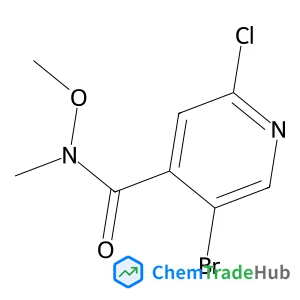
5-Bromo-2-chloro-N-methoxy-N-methylisonicotinamide
CAS Number:
1256790-08-5
Molecular Formula:
C8H8BrClN2O2
Emanuela Di Cola, Martin In, Maria Giordani, Sandra Ristori
Gene therapy is based on nucleic acid delivery to pathogenic cells in order to modulate their gene expression. The most used non viral vectors are lipid-based nanoaggregates, which are safer than viral carriers and have been shown to assemble easily with both DNA and RNA. However, the transfection efficiency of non viral carriers still needs to be improved before intensive practise in clinical trials can be implemented. For this purpose, the in depth characterization of the complexes formed by nucleic acids and their transporters is of great relevance. In particular, information on the structure and assembly mechanism can be useful to improve our general knowledge of these artificial transfection agents. In this paper, the complexation mechanism of short interfering RNA and DNA molecules (siRNA and siDNA, respectively) with cationic micelles is investigated by combining small angle X-ray scattering experiments and molecular dynamics simulations. Micelles were obtained by Gemini surfactants with different spacer lengths (12-3-12, 12-6-12). The siRNA and siDNA used were double strand molecules characterized by the same length and homologous sequence, in order to perform a close comparison. We showed that complexes appear in solution immediately after mixing and, therefore, the investigation of complex formation requires fast experimental techniques, such as time resolved synchrotron SAXS (Tr-SAXS). The obtained systems had internal arrangement constituted by layers of squeezed micelles alternating the nucleic acids. Both SAXS and MD analyses allowed us to evaluate the mean size of complexes in the range of a few nanometers, with looser and less ordered stacking for the DNA containing aggregates.
Junnan He, Nan Zheng, Ming Li, YuBin Zheng, Wangze Song
DOI: 10.1039/D1PY00650A
Mark A. Spackman, Anthony S. Mitchell
DOI: 10.1039/B009159F
Gauthier Vanhaelewyn, Philippe Lahorte, Frank De Proft, Wim Mondelaers, Paul Geerlings, Freddy Callens
DOI: 10.1039/B008248L
Marina G. Taylor, Stewart F. Parker, Kenneth Simkiss, Philip C. H. Mitchell
DOI: 10.1039/B005666I
W. Zhu, F. Kapteijn, B. van der Linden, J. A. Moulijn
DOI: 10.1039/B100941I
Yichao Zheng, Jit Sarkar, Hiroshi Niino, Shunsuke Chatani, Shu Yao Hsu, Atsushi Goto
DOI: 10.1039/D1PY00663K
(3.beta.)-3-Hydroxy-N,N-dimethyl-chol-5-en-24-amide (CAS: 79066-03-8) is primari...
5-(Aminomethyl)-2-methoxyphenol (CAS: 89702-89-6) is classified under GHS as a s...
Thieno[2,3-c]pyridin-7(6H)-one (CAS: 28981-13-7) is a heterocyclic organic compo...
1-[(6-Methoxy-3-pyridinyl)methyl]-4-piperidinamine dihydrochloride is generally ...
[(2E)-3-Phenyl-2-propen-1-yl]phosphonic acid (CAS: 146404-58-2) is regulated und...
6-Bromo-7-methoxyquinoline (CAS: 1620515-86-7) falls under the scope of the Glob...
This compound is primarily used in the pharmaceutical industry for the developme...
1-Ethyl-7-[2-methyl-6-(4H-1,2,4-triazol-3-yl)-3-pyridinyl]-3,5-dihydropyrazino[2...
Alternative reagents such as 2-[(dimethylamino)methyl]phenylboronic acid or rela...
3-(Piperidin-4-yloxy)pyridine (CAS: 310881-48-2) is an organic compound with the...

Physical Chemistry Chemical Physics (PCCP) is an international journal co-owned by 19 physical chemistry and physics societies from around the world. This journal publishes original, cutting-edge research in physical chemistry, chemical physics and biophysical chemistry. To be suitable for publication in PCCP, articles must include significant innovation and/or insight into physical chemistry; this is the most important criterion that reviewers and Editors will judge against when evaluating submissions. The journal has a broad scope and welcomes contributions spanning experiment, theory, computation and data science. Topical coverage includes spectroscopy, dynamics, kinetics, statistical mechanics, thermodynamics, electrochemistry, catalysis, surface science, quantum mechanics, quantum computing and machine learning. Interdisciplinary research areas such as polymers and soft matter, materials, nanoscience, energy, surfaces/interfaces, and biophysical chemistry are welcomed if they demonstrate significant innovation and/or insight into physical chemistry. Joined experimental/theoretical studies are particularly appreciated when complementary and based on up-to-date approaches.
![Ethanone, 1-[4-chloro-2-(methylthio)-5-pyrimidinyl]- structure](https://static.chemtradehub.com/structs/661/66116-82-3-863e.webp "Ethanone, 1-[4-chloro-2-(methylthio)-5-pyrimidinyl]- structure")
![7-Bromo-5-chloro-1H-pyrazolo[4,3-b]pyridine structure](https://static.chemtradehub.com/structs/135/1351813-70-1-a716.webp "7-Bromo-5-chloro-1H-pyrazolo[4,3-b]pyridine structure")


