












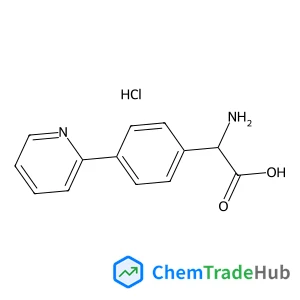
2-Amino-2-(4-(pyridin-2-YL)phenyl)acetic acid hydrochloride
CAS Number:
1135818-89-1
Molecular Formula:
C13H13ClN2O2
W. Zhu, F. Kapteijn, B. van der Linden, J. A. Moulijn
The equilibrium adsorption of linear and branched C6 alkanes n-hexane, 2-methylpentane, 3-methylpentane and 2,3-dimethylbutane on silicalite-1 has been investigated using a novel technique—the tapered element oscillating microbalance (TEOM). For n-hexane, a small “kink ” in the isotherm is observed at about 4 molecule (unit cell of silicalite-1)−1. The measured isotherms of both 2-methylpentane and 3-methylpentane at 303 K for the first time show a second-step adsorption at loadings over 4 molecule (unit cell)−1. A two-step adsorption behavior is confirmed for single branched C6 alkanes. This observation is in good agreement with the picture of two distinct adsorption locations for single branched alkanes in silicalite-1 indicated by other techniques. The maximum loading for 2,3-dimethylbutane is about 4 molecule (unit cell)−1 under the conditions investigated and the molecules reside completely in the intersections. A dual-site Langmuir expression appropriately describes the equilibrium data for n-hexane, 2-methylpentane and 3-methylpentane, while the isotherms of 2,3-dimethylbutane can be described by the Langmuir model. The derived thermodynamic properties such as adsorption enthalpy and entropy agree with those available, determined by other techniques. The observed two-step adsorption behavior for single branched C6 alkanes on silicalite-1 is attributed to the large difference in the adsorption entropy between the molecular locations in the channel intersections and in the zigzag channels.
(3.beta.)-3-Hydroxy-N,N-dimethyl-chol-5-en-24-amide (CAS: 79066-03-8) is primari...
5-(Aminomethyl)-2-methoxyphenol (CAS: 89702-89-6) is classified under GHS as a s...
Thieno[2,3-c]pyridin-7(6H)-one (CAS: 28981-13-7) is a heterocyclic organic compo...
1-[(6-Methoxy-3-pyridinyl)methyl]-4-piperidinamine dihydrochloride is generally ...
[(2E)-3-Phenyl-2-propen-1-yl]phosphonic acid (CAS: 146404-58-2) is regulated und...
6-Bromo-7-methoxyquinoline (CAS: 1620515-86-7) falls under the scope of the Glob...
This compound is primarily used in the pharmaceutical industry for the developme...
1-Ethyl-7-[2-methyl-6-(4H-1,2,4-triazol-3-yl)-3-pyridinyl]-3,5-dihydropyrazino[2...
Alternative reagents such as 2-[(dimethylamino)methyl]phenylboronic acid or rela...
3-(Piperidin-4-yloxy)pyridine (CAS: 310881-48-2) is an organic compound with the...

Physical Chemistry Chemical Physics (PCCP) is an international journal co-owned by 19 physical chemistry and physics societies from around the world. This journal publishes original, cutting-edge research in physical chemistry, chemical physics and biophysical chemistry. To be suitable for publication in PCCP, articles must include significant innovation and/or insight into physical chemistry; this is the most important criterion that reviewers and Editors will judge against when evaluating submissions. The journal has a broad scope and welcomes contributions spanning experiment, theory, computation and data science. Topical coverage includes spectroscopy, dynamics, kinetics, statistical mechanics, thermodynamics, electrochemistry, catalysis, surface science, quantum mechanics, quantum computing and machine learning. Interdisciplinary research areas such as polymers and soft matter, materials, nanoscience, energy, surfaces/interfaces, and biophysical chemistry are welcomed if they demonstrate significant innovation and/or insight into physical chemistry. Joined experimental/theoretical studies are particularly appreciated when complementary and based on up-to-date approaches.
![(3E)-3-[4-Hydroxy-3,5-bis(2-methyl-2-propanyl)benzylidene]dihydro-2(3H)-furanone structure](https://static.chemtradehub.com/structs/102/102271-49-8-cba7.webp "(3E)-3-[4-Hydroxy-3,5-bis(2-methyl-2-propanyl)benzylidene]dihydro-2(3H)-furanone structure")






