


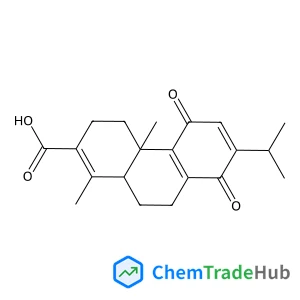
(4aS,10aS)-7-Isopropyl-1,4a-dimethyl-5,8-dioxo-3,4,4a,5,8,9,10,10a-octahydro-2-phenanthrenecarboxylic acid
CAS Number:
142950-86-5
Molecular Formula:
C20H24O4
Hanno Schmiedt, Stephan Schlemmer, Sergey N. Yurchenko, Per Jensen
We report a new semi-classical method to compute highly excited rotational energy levels of an asymmetric-top molecule. The method forgoes the idea of a full quantum mechanical treatment of the ro-vibrational motion of the molecule. Instead, it employs a semi-classical Green's function approach to describe the rotational motion, while retaining a quantum mechanical description of the vibrations. Similar approaches have existed for some time, but the method proposed here has two novel features. First, inspired by the path integral method, periodic orbits in the phase space and tunneling paths are naturally obtained by means of molecular symmetry analysis. Second, the rigorous variational method is employed for the first time to describe the molecular vibrations. In addition, we present a new robust approach to generating rotational energy surfaces for vibrationally excited states; this is done in a fully quantum-mechanical, variational manner. The semi-classical approach of the present work is applied to calculating the energies of very highly excited rotational states and it reduces dramatically the computing time as well as the storage and memory requirements when compared to the fullly quantum-mechanical variational approach. Test calculations for excited states of SO2 yield semi-classical energies in very good agreement with the available experimental data and the results of fully quantum-mechanical calculations.

Herald of the Russian Academy of Sciences

Atomization and Sprays

Journal of the Indian Institute of Science

Journal of Chemical Sciences

Bioorganic & Medicinal Chemistry

Bioorganic & Medicinal Chemistry Letters

Heteroatom Chemistry

Critical Reviews in Solid State and Materials Sciences

Journal of Asian Natural Products Research

Chinese Journal of Chemistry
DOI: 10.1039/A906191F
Lorenzo Franco, Luigi Pasimeni, Glauco Ponterini, Marco Ruzzi, Ulderico Segre
DOI: 10.1039/B009427G
T. Nakamura, K. Kaiya, N. Takahashi, T. Matsuzawa, M. Ohta, C. C. Rowlands, G. M. Smith, P. C. Riedi
DOI: 10.1039/B008251L
Yichao Zheng, Jit Sarkar, Hiroshi Niino, Shunsuke Chatani, Shu Yao Hsu, Atsushi Goto
DOI: 10.1039/D1PY00663K
K. E. Gubbins, R. Radhakrishnan
DOI: 10.1039/B009792F
Narcís Homs, Jordi Llorca, Pilar Ramírez de la Piscina, Francisco Rodríguez-Reinoso, Antonio Sepúlveda-Escribano, Joaquín Silvestre-Albero
DOI: 10.1039/B100770J
Uwe Langer, Christof Hoelger, Gerd Buntkowsky, Hans-Martin Vieth, Hans-Heinrich Limbach
DOI: 10.1039/B007564G
Zoltán Paál, Tamás Koltai, (the late) Károly Matusek, Jean-Marie Manoli, Claude Potvin, Martin Muhler, Ute Wild, Pál Tétényi
DOI: 10.1039/B009047F
Walter Richter, Gert Rapp, Alfred Blume
DOI: 10.1039/B009881G
DOI: 10.1039/A906184C
(3.beta.)-3-Hydroxy-N,N-dimethyl-chol-5-en-24-amide (CAS: 79066-03-8) is primari...
5-(Aminomethyl)-2-methoxyphenol (CAS: 89702-89-6) is classified under GHS as a s...
Thieno[2,3-c]pyridin-7(6H)-one (CAS: 28981-13-7) is a heterocyclic organic compo...
1-[(6-Methoxy-3-pyridinyl)methyl]-4-piperidinamine dihydrochloride is generally ...
[(2E)-3-Phenyl-2-propen-1-yl]phosphonic acid (CAS: 146404-58-2) is regulated und...
6-Bromo-7-methoxyquinoline (CAS: 1620515-86-7) falls under the scope of the Glob...
This compound is primarily used in the pharmaceutical industry for the developme...
1-Ethyl-7-[2-methyl-6-(4H-1,2,4-triazol-3-yl)-3-pyridinyl]-3,5-dihydropyrazino[2...
Alternative reagents such as 2-[(dimethylamino)methyl]phenylboronic acid or rela...
3-(Piperidin-4-yloxy)pyridine (CAS: 310881-48-2) is an organic compound with the...

Physical Chemistry Chemical Physics (PCCP) is an international journal co-owned by 19 physical chemistry and physics societies from around the world. This journal publishes original, cutting-edge research in physical chemistry, chemical physics and biophysical chemistry. To be suitable for publication in PCCP, articles must include significant innovation and/or insight into physical chemistry; this is the most important criterion that reviewers and Editors will judge against when evaluating submissions. The journal has a broad scope and welcomes contributions spanning experiment, theory, computation and data science. Topical coverage includes spectroscopy, dynamics, kinetics, statistical mechanics, thermodynamics, electrochemistry, catalysis, surface science, quantum mechanics, quantum computing and machine learning. Interdisciplinary research areas such as polymers and soft matter, materials, nanoscience, energy, surfaces/interfaces, and biophysical chemistry are welcomed if they demonstrate significant innovation and/or insight into physical chemistry. Joined experimental/theoretical studies are particularly appreciated when complementary and based on up-to-date approaches.
![7-Bromo-5-chloro-1H-pyrazolo[4,3-b]pyridine structure](https://static.chemtradehub.com/structs/135/1351813-70-1-a716.webp "7-Bromo-5-chloro-1H-pyrazolo[4,3-b]pyridine structure")
![4-[(4-Bromophenyl)sulfonyl]thiomorpholine structure](https://static.chemtradehub.com/structs/223/223555-81-5-2d67.webp "4-[(4-Bromophenyl)sulfonyl]thiomorpholine structure")
![Ethanone, 1-[4-chloro-2-(methylthio)-5-pyrimidinyl]- structure](https://static.chemtradehub.com/structs/661/66116-82-3-863e.webp "Ethanone, 1-[4-chloro-2-(methylthio)-5-pyrimidinyl]- structure")





