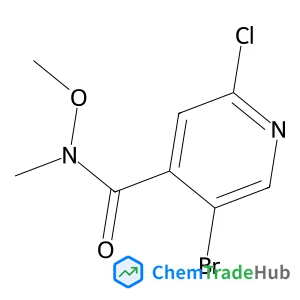
5-Bromo-2-chloro-N-methoxy-N-methylisonicotinamide
CAS Number:
1256790-08-5
Molecular Formula:
C8H8BrClN2O2
Time resolved emission spectroscopy of a water insoluble aminocoumarin derivative, BC I, in n-heptane–AOT–water reversed micelles is investigated using a nanosecond fluorescence spectrometer. The extent of the time-dependent Stokes shift is found to be smaller for W0=4 than for W0=10 and also for W0=40 (W0, molar ratio of water and AOT). A monoexponential decay of the dynamic Stokes shift correlation function with a time constant of 4.5 ns is observed at W0=4. At W0=10 the time-correlation function shows a bi-exponential decay with a fast component of ∽600 ps and another of 3.3 ns comparable to the fluorescence lifetime of the dye. The time correlation function at W0=40 shows an extremely slow component of the solvation time which is at least an order of magnitude larger than the fluorescence lifetime of the probe dye. In addition a faster component with a solvation time of 2.15 ns is also observed. The solvation time observed is likely due to the diffusion of the probe dye within the micellar interface or due to the reorganization of the water molecules bound to the polar head groups of AOT. Steady-state absorption and fluorescence, and time resolved fluorescence study of another aminocoumarin, C 480, give evidence of equilibrium between the distribution of the dye molecules between the interface and water pool. The time resolved shift of the emission spectra is more likely due to the diffusion of the probe between the interface and water pool rather than reorientation of the water molecules (solvent relaxation) in the core of the reversed micelles as it has been reported earlier.
(3.beta.)-3-Hydroxy-N,N-dimethyl-chol-5-en-24-amide (CAS: 79066-03-8) is primari...
5-(Aminomethyl)-2-methoxyphenol (CAS: 89702-89-6) is classified under GHS as a s...
Thieno[2,3-c]pyridin-7(6H)-one (CAS: 28981-13-7) is a heterocyclic organic compo...
1-[(6-Methoxy-3-pyridinyl)methyl]-4-piperidinamine dihydrochloride is generally ...
[(2E)-3-Phenyl-2-propen-1-yl]phosphonic acid (CAS: 146404-58-2) is regulated und...
6-Bromo-7-methoxyquinoline (CAS: 1620515-86-7) falls under the scope of the Glob...
This compound is primarily used in the pharmaceutical industry for the developme...
1-Ethyl-7-[2-methyl-6-(4H-1,2,4-triazol-3-yl)-3-pyridinyl]-3,5-dihydropyrazino[2...
Alternative reagents such as 2-[(dimethylamino)methyl]phenylboronic acid or rela...
3-(Piperidin-4-yloxy)pyridine (CAS: 310881-48-2) is an organic compound with the...

Physical Chemistry Chemical Physics (PCCP) is an international journal co-owned by 19 physical chemistry and physics societies from around the world. This journal publishes original, cutting-edge research in physical chemistry, chemical physics and biophysical chemistry. To be suitable for publication in PCCP, articles must include significant innovation and/or insight into physical chemistry; this is the most important criterion that reviewers and Editors will judge against when evaluating submissions. The journal has a broad scope and welcomes contributions spanning experiment, theory, computation and data science. Topical coverage includes spectroscopy, dynamics, kinetics, statistical mechanics, thermodynamics, electrochemistry, catalysis, surface science, quantum mechanics, quantum computing and machine learning. Interdisciplinary research areas such as polymers and soft matter, materials, nanoscience, energy, surfaces/interfaces, and biophysical chemistry are welcomed if they demonstrate significant innovation and/or insight into physical chemistry. Joined experimental/theoretical studies are particularly appreciated when complementary and based on up-to-date approaches.