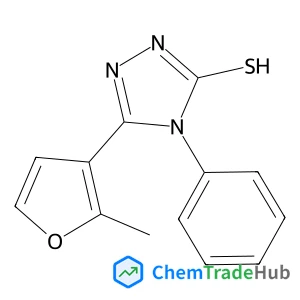
5-(2-Methyl-3-furyl)-4-phenyl-2,4-dihydro-3H-1,2,4-triazole-3-thione
CAS Number:
346464-59-3
Molecular Formula:
C13H11N3OS
Filippo Caracciolo, Marta Filibian, Pietro Carretta, Alberto Rosso, Andrea De Luca
In dynamic nuclear polarization (DNP) experiments, the compound is driven out-of-equilibrium by the microwave (MW) irradiation of the radical electron spins. Their stationary state has been recently probed via electron double resonance (ELDOR) techniques showing, at low temperature, a broad depolarization of the electron paramagnetic resonance (EPR) spectrum under microwave irradiation. In this theoretical manuscript, we develop a numerical method to compute exactly the EPR spectrum in the presence of dipolar interactions. Our results reproduce the observed broad depolarisation and provide a microscopic justification for the spectral diffusion mechanism. We show the validity of the spin-temperature approach for typical radical concentration used in dissolution DNP protocols. In particular once the interactions are properly taken into account, the spin-temperature is consistent with the non-monotonic behavior of the EPR spectrum with a wide minimum around the irradiated frequency.

Current Pharmaceutical Biotechnology

Environmental Toxicology and Pharmacology

Faraday Discussions

Coloration Technology

Physical Chemistry Chemical Physics

Advanced Engineering Materials

Photochemical & Photobiological Sciences

Journal of Medical Biochemistry

Green Chemistry

Mini-Reviews in Medicinal Chemistry
Ze Li, Chunyong Wu, Lifeng Liu, Meijiang Li, Xiongfa Yang, Chaowei Hao, Qiu Chen, Ziqiang Hu, Mengxian Luo, Guoqiao Lai, Tien-Yau Luh
DOI: 10.1039/C6PY01841F
Wenmei Liu, Jie Chen, Dandan Zhou, Xiaojuan Liao, Meiran Xie, Ruyi Sun
DOI: 10.1039/C6PY01571A
Meng Zhu, Quan Chen, Yanxia Su, Zhijie Zhang, Lei Liu, Yiguang Wang, Linan An, Nanwen Li
DOI: 10.1039/C7PY90053H
Bin Mu, Qian Li, Xiao Li, Jian Chen, Jianglin Fang, Dongzhong Chen
DOI: 10.1039/C7PY00471K
Elizabeth M. Nofen, Nicholas Zimmer, Avi Dasgupta, Ryan Gunckel, Bonsung Koo, Aditi Chattopadhyay, Lenore L. Dai
DOI: 10.1039/C6PY01463A
Lili Han, Qing Xie, Jianna Bao, Guorong Shan, Yongzhong Bao, Pengju Pan
DOI: 10.1039/C6PY01989G
Yang Xu, Tianqi Wang, Zidong He, Aiqing Zhong, Wei Yu, Buyin Shi, Kun Huang
DOI: 10.1039/C6PY01706A
When handling lithium chloride hydrate (1:1:1) (CAS: 16712-20-2), it is importan...
4-(4H-1,2,4-Triazol-4-yl)piperidine is generally considered safe for use in phar...
Waste containing 1,3-Thiazole-2-carboxamide (CAS: 16733-85-0) should be collecte...
5-(Difluoromethyl)-2-fluorobenzonitrile (CAS: 934175-58-3) is subject to regulat...
Methyl 3-acetamido-2-thiophenecarboxylate can be synthesized by the reaction of ...
4-Isoquinolinecarbonitrile is a chemical compound with the CAS number 34846-65-6...
Store Methyl 1H-1,2,3-triazole-4-carboxylate (CAS: 877309-59-6) in a cool, dry p...
6-Bromo[1,3]thiazolo[5,4-b]pyridin-2-amine (CAS: 1160791-13-8) is subject to the...
(2S,3S)-2-Ammonio-3-(3,4-dihydroxyphenyl)-3-hydroxypropanoate (CAS: 23651-95-8) ...
7-Bromo-3-methyl-3,4-dihydroquinazolin-4-one is a solid with a crystalline form....
Physical Chemistry Chemical Physics (PCCP) is an international journal co-owned by 19 physical chemistry and physics societies from around the world. This journal publishes original, cutting-edge research in physical chemistry, chemical physics and biophysical chemistry. To be suitable for publication in PCCP, articles must include significant innovation and/or insight into physical chemistry; this is the most important criterion that reviewers and Editors will judge against when evaluating submissions. The journal has a broad scope and welcomes contributions spanning experiment, theory, computation and data science. Topical coverage includes spectroscopy, dynamics, kinetics, statistical mechanics, thermodynamics, electrochemistry, catalysis, surface science, quantum mechanics, quantum computing and machine learning. Interdisciplinary research areas such as polymers and soft matter, materials, nanoscience, energy, surfaces/interfaces, and biophysical chemistry are welcomed if they demonstrate significant innovation and/or insight into physical chemistry. Joined experimental/theoretical studies are particularly appreciated when complementary and based on up-to-date approaches.