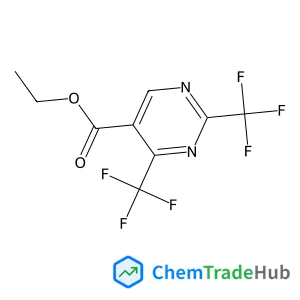
Ethyl 2,4-bis(trifluoromethyl)-5-pyrimidinecarboxylate
CAS Number:
188781-15-9
Molecular Formula:
C9H6F6N2O2
Ze Li, Chunyong Wu, Lifeng Liu, Meijiang Li, Xiongfa Yang, Chaowei Hao, Qiu Chen, Ziqiang Hu, Mengxian Luo, Guoqiao Lai, Tien-Yau Luh
Macrocyclic polysiloxanes are useful materials for the development of interpenetrating polymer networks and thermally stable materials. The main drawbacks of reported methods for the preparation of macrocyclic polysiloxanes are that mixtures of linear and cyclic polysiloxanes are commonly obtained, and complex and time-consuming separation processes are needed. Moreover, the preparation of macrocyclic polysiloxanes occasionally needs harsh conditions, and in general has low efficiency. In this research, we find that highly pure macrocyclic poly(methylvinylsiloxane)s (cPMVSs) can be chemoselectively prepared from 1,3,5,7-tetramethyl-1,3,5,7-tetravinylcyclotetrasiloxane with water catalyzed by anhydrous iron(III) chloride in high efficiency. The structure of cPMVSs is characterized by gel permeation chromatography, infrared spectroscopy, 1H- and 29Si-nuclear magnetic resonance (NMR), and viscosity. Thermogravimetric analysis shows that cPMVSs have excellent thermal stability. A metathetical ring-expanding polymerization mechanism is proposed.
Zhe Zhang, Jilin Tang
DOI: 10.1039/C6AN00745G
Joshua Jasensky, Andrew P. Boughton, Alexander Khmaladze, Jun Ding, Chi Zhang, Jason E. Swain, George W. Smith
DOI: 10.1039/C6AN00629A
Jing Li, Ke Quan, Yanjing Yang, Xiaohai Yang, Xiangxian Meng, Jin Huang, Kemin Wang
DOI: 10.1039/C9AN02003A
Jinpeng Mao, Yuexiang Lu, Ning Chang, Jiaoe Yang, Jiacheng Yang, Sichun Zhang, Yueying Liu
DOI: 10.1039/C6AN00302H
Ruqiao Zhou, Guiling Cui, Qingrong Qi, Wencai Huang, Li Yang
DOI: 10.1039/C9AN02323B
Urban J. Wünsch, Jeffrey A. Hawkes
DOI: 10.1039/C9AN02176K
Wulan Tri Wahyuni, Frank Marken
DOI: 10.1039/C9AN02186H
Nicole A. Schneck, Vera B. Ivleva, Cindy X. Cai, Jonathan W. Cooper, Q. Paula Lei
DOI: 10.1039/C9AN02098E
Klaus Koren, Peter Ø. Jensen
DOI: 10.1039/C6AN00864J
Ai-Li Sun, Qing-An Qi
DOI: 10.1039/C6AN00696E
When handling lithium chloride hydrate (1:1:1) (CAS: 16712-20-2), it is importan...
4-(4H-1,2,4-Triazol-4-yl)piperidine is generally considered safe for use in phar...
Waste containing 1,3-Thiazole-2-carboxamide (CAS: 16733-85-0) should be collecte...
5-(Difluoromethyl)-2-fluorobenzonitrile (CAS: 934175-58-3) is subject to regulat...
Methyl 3-acetamido-2-thiophenecarboxylate can be synthesized by the reaction of ...
4-Isoquinolinecarbonitrile is a chemical compound with the CAS number 34846-65-6...
Store Methyl 1H-1,2,3-triazole-4-carboxylate (CAS: 877309-59-6) in a cool, dry p...
6-Bromo[1,3]thiazolo[5,4-b]pyridin-2-amine (CAS: 1160791-13-8) is subject to the...
(2S,3S)-2-Ammonio-3-(3,4-dihydroxyphenyl)-3-hydroxypropanoate (CAS: 23651-95-8) ...
7-Bromo-3-methyl-3,4-dihydroquinazolin-4-one is a solid with a crystalline form....

Polymer Chemistry welcomes submissions in all areas of polymer science that have a strong focus on macromolecular chemistry. Manuscripts may cover a broad range of fields, yet no direct application focus is required.