


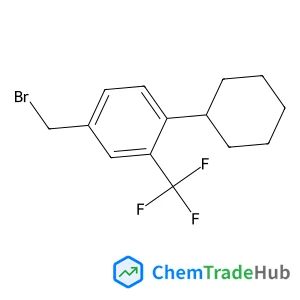
4-(Bromomethyl)-1-cyclohexyl-2-(trifluoromethyl)benzene
CAS Number:
800381-60-6
Molecular Formula:
C14H16BrF3
Fen Li, Yan Su
The advance of lithium sulfur batteries is now greatly restricted by the fast capacity fading induced by shuttle effect. Using first-principles calculations, various vacancies, N doping, and B,N co-doping in graphene sheets have been systematically explored for lithium polysufides entrapped in Li–S batteries. The Li⋯S, Li⋯C, Li⋯N and S⋯B bonds and Hirshfeld charges in the Li2S6 adsorbed defective graphene systems have been analyzed to understand the intrinsic mechanism of retaining lithium polysulfides in these systems. Total and local densities of states analyses elucidate the strongest adsorption sites among the N and B–N co-doped graphene systems. The overall electrochemical performance of Li–S batteries varies with the types of defects in graphene. Among the defective graphene systems, only the reconstructed pyrrole-like vacancy is effective for retaining lithium polysulfides. N doping induces a strong Li⋯N interaction in the defective graphene systems, in which the pyrrolic N rather than the pyridinic N plays a dominant role in trapping of lithium polysulfides. The shuttle effect can be further depressed via pyrrolic B,N co-doped defective graphene materials, especially the G–B–N-hex system with extremely strong adsorption of lithium polysulfides (4–5 eV), and simultaneous contribution from the strong Li⋯N and S⋯B interactions.

Angewandte Chemie International Edition

Journal of Enzyme inhibition and Medicinal Chemistry

Physical Chemistry Chemical Physics

Molecules

Molecular Diversity

Photochemical & Photobiological Sciences

Advanced Engineering Materials

Mini-Reviews in Medicinal Chemistry

Foundations of Chemistry

Current Pharmaceutical Biotechnology
Qimin Jiang, Jiating Li, Wenyan Huang, Dongliang Zhang, Jianhai Chen, Hongjun Yang, Xiaoqiang Xue, Bibiao Jiang
DOI: 10.1039/C7PY00844A
J. Sawada, D. Aoki, M. Kuzume, K. Nakazono, H. Otsuka, T. Takata
DOI: 10.1039/C7PY00193B
Anna Chrobok, Karolina Matuszek, Dorota Neugebauer, Rafał Bielas, Sylwia Golba, Mateusz Dulski
DOI: 10.1039/C6PY01274D
Yang Xu, Tianqi Wang, Zidong He, Aiqing Zhong, Wei Yu, Buyin Shi, Kun Huang
DOI: 10.1039/C6PY01706A
Bin Mu, Qian Li, Xiao Li, Jian Chen, Jianglin Fang, Dongzhong Chen
DOI: 10.1039/C7PY00471K
Andrea Cappelli, Marco Paolino, Giorgio Grisci, Vincenzo Razzano, Germano Giuliani, Alessandro Donati, Claudia Bonechi, Raniero Mendichi, Salvatore Battiato, Filippo Samperi, Cinzia Scialabba, Gaetano Giammona, Francesco Makovec
DOI: 10.1039/C6PY01644H
When handling lithium chloride hydrate (1:1:1) (CAS: 16712-20-2), it is importan...
4-(4H-1,2,4-Triazol-4-yl)piperidine is generally considered safe for use in phar...
Waste containing 1,3-Thiazole-2-carboxamide (CAS: 16733-85-0) should be collecte...
5-(Difluoromethyl)-2-fluorobenzonitrile (CAS: 934175-58-3) is subject to regulat...
Methyl 3-acetamido-2-thiophenecarboxylate can be synthesized by the reaction of ...
4-Isoquinolinecarbonitrile is a chemical compound with the CAS number 34846-65-6...
Store Methyl 1H-1,2,3-triazole-4-carboxylate (CAS: 877309-59-6) in a cool, dry p...
6-Bromo[1,3]thiazolo[5,4-b]pyridin-2-amine (CAS: 1160791-13-8) is subject to the...
(2S,3S)-2-Ammonio-3-(3,4-dihydroxyphenyl)-3-hydroxypropanoate (CAS: 23651-95-8) ...
7-Bromo-3-methyl-3,4-dihydroquinazolin-4-one is a solid with a crystalline form....
Physical Chemistry Chemical Physics (PCCP) is an international journal co-owned by 19 physical chemistry and physics societies from around the world. This journal publishes original, cutting-edge research in physical chemistry, chemical physics and biophysical chemistry. To be suitable for publication in PCCP, articles must include significant innovation and/or insight into physical chemistry; this is the most important criterion that reviewers and Editors will judge against when evaluating submissions. The journal has a broad scope and welcomes contributions spanning experiment, theory, computation and data science. Topical coverage includes spectroscopy, dynamics, kinetics, statistical mechanics, thermodynamics, electrochemistry, catalysis, surface science, quantum mechanics, quantum computing and machine learning. Interdisciplinary research areas such as polymers and soft matter, materials, nanoscience, energy, surfaces/interfaces, and biophysical chemistry are welcomed if they demonstrate significant innovation and/or insight into physical chemistry. Joined experimental/theoretical studies are particularly appreciated when complementary and based on up-to-date approaches.
![N-[2-(2-Pyridinyl)ethyl]-1-propanamine structure](https://static.chemtradehub.com/structs/554/55496-57-6-22b4.webp "N-[2-(2-Pyridinyl)ethyl]-1-propanamine structure")
![Benzeneacetic acid, 2-bromo-α-[[(1,1-dimethylethoxy)carbonyl]amino]-, (αS)- structure](https://static.chemtradehub.com/structs/122/1228547-87-2-f296.webp "Benzeneacetic acid, 2-bromo-α-[[(1,1-dimethylethoxy)carbonyl]amino]-, (αS)- structure")
![(1R,5R)-3-{[(2-Methyl-2-propanyl)oxy]carbonyl}-3-azabicyclo[3.1.0]hexane-1-carboxylic acid structure](https://static.chemtradehub.com/structs/116/1165450-63-4-bfe1.webp "(1R,5R)-3-{[(2-Methyl-2-propanyl)oxy]carbonyl}-3-azabicyclo[3.1.0]hexane-1-carboxylic acid structure")




