












Intrusion–extrusion spring performance of –COK-14 zeolite enhanced by structural changes
Literature Information
Publication Date
2016-06-14
DOI
10.1039/C6CP03162E
Impact Factor
3.676
Authors
Christine E. A. Kirschhock, Michiel De Prins, Elke Verheijen, Andrey Ryzhikov, T. Jean Daou, Habiba Nouali, Francis Taulelle, Johan A. Martens, Joël Patarin
View Original
Abstract
–COK-14 zeolite, the variant of COK-14 (OKO topology) with a systematically interrupted framework, exhibits unusual behaviour in high pressure intrusion–extrusion cycles of 20 M LiCl solution. After the first cycle with deviating behaviour and partially irreversible intrusion, subsequent cycles show stable reversible behaviour. The system behaves like a spring with unique progressive intrusion in the range of 10–120 MPa followed by enhanced uptake before saturation. While the intrusion–extrusion cycling leads to fragmented crystals, powder diffraction reveals high crystallinity of the fragments. Based on the detailed characterisation of the zeolite samples with XRD, Rietveld refinement, N2 adsorption, TGA and 29Si MAS NMR before and after intrusion–extrusion experiments, a model of the structure of the intruded –COK-14 samples is proposed. Intrusion–extrusion of LiCl solution systematically breaks the most strained bonds in the structure which results in a new framework connectivity with enhanced stability, which persists during the harsh intrusion–extrusion conditions.
Related Literature
Hierarchical TiO2–SnO2–graphene aerogels for enhanced lithium storage
Sheng Han, Jianzhong Jiang, Yanshan Huang, Yanping Tang, Jing Cao, Dongqing Wu
2014-11-27
Communication
DOI: 10.1039/C4CP04887C
Strain effects on oxygen migration in perovskites
Tam Mayeshiba, Dane Morgan
2014-12-05
Paper
DOI: 10.1039/C4CP05554C
Fluoride ion sensing in aqueous medium by employing nitrobenzoxadiazole-postgrafted mesoporous silica nanoparticles (MCM-41)
Gaurav Jha, Anoop N., Abdur Rahaman, Moloy Sarkar
2014-12-16
Paper
DOI: 10.1039/C4CP05350H
Nucleation and growth kinetics of zirconium-oxo-alkoxy nanoparticles
Sana Labidi, Zixian Jia, Mounir Ben Amar, Khay Chhor, Andrei Kanaev
2014-12-01
Paper
DOI: 10.1039/C4CP05149A
Zero thermal expansion in NaZn13-type La(Fe,Si)13 compounds
Wei Wang, Rongjin Huang, Chuanjun Huang, Laifeng Li
2014-11-27
Communication
DOI: 10.1039/C4CP04672B
Unusual solvent-dependent photophysical and self-assembly properties of NO2 substituted T-shaped phenazines
Dong-Chan Lee, Lacie V. Brownell, Kyoungmi Jang, Seung Ju Han, Kathleen A. Robins
2014-12-02
Paper
DOI: 10.1039/C4CP05090H
Stress effects on the initial lithiation of crystalline silicon nanowires: reactive molecular dynamics simulations using ReaxFF
Alireza Ostadhossein, Ekin D. Cubuk, Georgios A. Tritsaris, Efthimios Kaxiras, Sulin Zhang, Adri C. T. van Duin
2014-12-18
Paper
DOI: 10.1039/C4CP05198J
A direct Fe–O coordination at the FePc/MoOx interface investigated by XPS and NEXAFS spectroscopies
Lingyun Liu, Wenhua Zhang, Panpan Guo, Kai Wang, Jiaou Wang, Haijie Qian, Ibrahim Kurash, Chia-Hsin Wang, Yaw-Wen Yang, Faqiang Xu
2014-12-15
Paper
DOI: 10.1039/C4CP04199B
You might also like
Compound Q&A
What are the main uses of (5-Sulfamoyl-3-pyridinyl)boronic acid (CAS: 951233-61-7)?
(5-Sulfamoyl-3-pyridinyl)boronic acid is primarily used in chemical synthesis, p...
951233-61-7(5-Sulfamoyl-3-pyrid...
Compound Q&A
How is Benzyl 2-methyl-2-(methylsulfonyl)-4-pentenoate (CAS: 1942858-50-5) typically synthesized?
Benzyl 2-methyl-2-(methylsulfonyl)-4-pentenoate is typically synthesized via est...
1942858-50-5Benzyl 2-methyl-2-(m...
Compound Q&A
What precautions should be taken when handling 8-Fluoroquinolin-6-ol (CAS: 209353-22-0)?
When handling 8-Fluoroquinolin-6-ol (CAS: 209353-22-0), it is important to use p...
209353-22-08-Fluoroquinolin-6-o...
Compound Q&A
What are the physical and chemical properties of 1,3-Dibromo-5-(2-methyl-2-propanyl)benzene (CAS: 129316-09-2)?
1,3-Dibromo-5-(2-methyl-2-propanyl)benzene (CAS: 129316-09-2) is a crystalline c...
129316-09-21,3-Dibromo-5-(2-met...
Compound Q&A
What industries use Ethyl 7-chloro-4-oxo-1-(1,3-thiazol-2-yl)-1,4-dihydro-1,8-naphthyridine-3-carboxylate (CAS: 174726-87-5)?
Ethyl 7-chloro-4-oxo-1-(1,3-thiazol-2-yl)-1,4-dihydro-1,8-naphthyridine-3-carbox...
174726-87-5Ethyl 7-chloro-4-oxo...
Compound Q&A
What precautions should be taken when handling Delta-7-Avenasterol (CAS: 23290-26-8)?
When handling Delta-7-Avenasterol (CAS: 23290-26-8), it is important to wear app...
23290-26-8Delta-7-Avenasterol
Compound Q&A
What precautions should be taken when handling N-({(5R)-3-[3-Fluoro-4-(4-morpholinyl)phenyl]-2-oxo-1,3-oxazolidin-5-yl}methyl)acetamide (CAS: 872992-20-6)?
Proper handling involves the use of personal protective equipment such as gloves...
872992-20-6N-({(5R)-3-[3-Fluoro...
Compound Q&A
What precautions should be taken when handling 2-Methyl-2-proanyl 4-[(2-aminophenyl)amino]-1-piperidinecarboxylate (CAS: 79099-00-6)?
When handling 2-Methyl-2-proanyl 4-[(2-aminophenyl)amino]-1-piperidinecarboxylat...
79099-00-62-Methyl-2-propanyl ...
Compound Q&A
What is N-Methyl-4-chlorobenzylamine hydrochloride (CAS: 65542-24-7)?
N-Methyl-4-chlorobenzylamine hydrochloride (CAS: 65542-24-7) is a organic compou...
65542-24-7N-Methyl-4-chloroben...
Compound Q&A
Is [2-(Dodecyloxy)ethoxy]acetic acid (CAS: 27306-90-7) safe?
[2-(Dodecyloxy)ethoxy]acetic acid (CAS: 27306-90-7) is generally considered safe...
27306-90-7[2-(Dodecyloxy)ethox...
Source Journal
Physical Chemistry Chemical Physics

CiteScore:
5.5
Self-citation Rate:
10.3%
Articles per Year:
3036
Physical Chemistry Chemical Physics (PCCP) is an international journal co-owned by 19 physical chemistry and physics societies from around the world. This journal publishes original, cutting-edge research in physical chemistry, chemical physics and biophysical chemistry. To be suitable for publication in PCCP, articles must include significant innovation and/or insight into physical chemistry; this is the most important criterion that reviewers and Editors will judge against when evaluating submissions. The journal has a broad scope and welcomes contributions spanning experiment, theory, computation and data science. Topical coverage includes spectroscopy, dynamics, kinetics, statistical mechanics, thermodynamics, electrochemistry, catalysis, surface science, quantum mechanics, quantum computing and machine learning. Interdisciplinary research areas such as polymers and soft matter, materials, nanoscience, energy, surfaces/interfaces, and biophysical chemistry are welcomed if they demonstrate significant innovation and/or insight into physical chemistry. Joined experimental/theoretical studies are particularly appreciated when complementary and based on up-to-date approaches.
Recommended Compounds

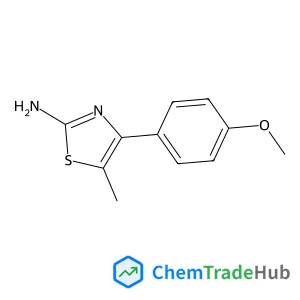
4-(4-Methoxyphenyl)-5-methyl-1,3-thiazol-2-amine
CAS Number:
105512-88-7
Molecular Formula:
C11H12N2OS
Recommended Suppliers





Disclaimer
This page provides academic journal information for reference and research purposes only. We are not affiliated with any journal publishers and do not handle publication submissions. For publication-related inquiries, please contact the respective journal publishers directly.
If you notice any inaccuracies in the information displayed, please contact us at support@chemtradehub.com. We will promptly review and address your concerns.