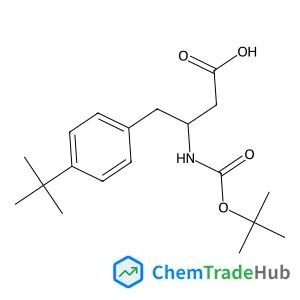
(S)-3-((tert-Butoxycarbonyl)amino)-4-(4-(tert-butyl)phenyl)butanoic acid
CAS Number:
403661-85-8
Molecular Formula:
C19H29NO4
Cristian Enachescu, Andreas Hauser
Here we reproduce the static and dynamical properties of spin-crossover complexes in the framework of the mechanoelastic model applied to triangular lattices. The switching processes between the high-spin and low-spin states are studied by combining the Monte Carlo method with the elastic lattice relaxation. The transition probabilities between the two states take into account intrinsic parameters, the values of which are approximated from experimental quantities (e.g., the energy gap, and the degeneracy ratio from the thermodynamic enthalpy and the entropy difference between the states), and the elastic force or elastic energy stored in the springs connecting the spin-changing centres. The value of the corresponding spring constant is estimated from the experimentally determined variation of the ligand-field strengths in the two spin states due to the cooperativity and the bulk modulus. Both simulated hysteresis loops and relaxation curves are in agreement with experimental data. Cooperativity related phenomena such as like-spin domain formation and the evolution of the interaction distribution with the HS fraction are also analysed.
Rozan Mohamad Yunus, Hiroko Endo
DOI: 10.1039/C5CP03958D
Chong Qiao, Aihua Wang, Jinping Zhang, Songyou Wang, Wan-Sheng Su, Yu Jia
DOI: 10.1039/C6CP03655D
Ondřej Jankovský, David Sedmidubský, Petr Šimek, Kateřina Klímová, Daniel Bouša, Chris Boothroyd, Zdeněk Sofer
DOI: 10.1039/C5CP04384K
Marat A. Ziganshin, Nadezhda S. Gubina, Alexander V. Gerasimov, Valery V. Gorbatchuk, Sufia A. Ziganshina, Anton P. Chuklanov, Anastas A. Bukharaev
DOI: 10.1039/C5CP03309H
Hongyu Zhang, Youhua Luo, Xiaojuan Feng, Lixia Zhao, Meng Zhang
DOI: 10.1039/C5CP02346G
Claudio Bulloni, Amador García-Fuente, Werner Urland, Claude Daul
DOI: 10.1039/C5CP02915E
Lorenz Keil, Michael Hartmann, Simon Lanzmich, Dieter Braun
DOI: 10.1039/C6CP00577B
DOI: 10.1039/C6CP00632A
Edward M. Kosower, Galina Borz
DOI: 10.1039/C5CP04439A
Sonja Grubišić
DOI: 10.1039/C6CP01120A
When handling 4-Methyl-6-(trifluoromethyl)quinoline (CAS: 40716-16-3), safety go...
4-(3,5-Difluorophenyl)aniline is an aromatic organic compound with the CAS numbe...
5-{[4-(Trifluoromethyl)phenyl]sulfanyl}-1,2,3-thiadiazole-4-carboxylic acid can ...
The market for 4-Benzylaniline hydrochloride (CAS: 6317-57-3) is steadily growin...
[3-(Diethylsulfamoyl)phenyl]boronic acid is generally considered safe when handl...
3-Bromo-2,5-dimethoxyaniline is mainly used in the pharmaceutical and chemical i...
N-Methyl-1-(5-methyl-1H-indol-3-yl)methanamine (CAS: 915922-67-7) is subject to ...
This compound is primarily used in the pharmaceutical industry for the synthesis...
2-Methyl-2-propanyl [(1S,3R)-3-aminocyclohexyl]carbamate (CAS: 1298101-47-9) sho...
Ethyl 2-bromo-4,4,4-trifluorobutanoate (CAS: 367-33-9) is utilized in the pharma...

Physical Chemistry Chemical Physics (PCCP) is an international journal co-owned by 19 physical chemistry and physics societies from around the world. This journal publishes original, cutting-edge research in physical chemistry, chemical physics and biophysical chemistry. To be suitable for publication in PCCP, articles must include significant innovation and/or insight into physical chemistry; this is the most important criterion that reviewers and Editors will judge against when evaluating submissions. The journal has a broad scope and welcomes contributions spanning experiment, theory, computation and data science. Topical coverage includes spectroscopy, dynamics, kinetics, statistical mechanics, thermodynamics, electrochemistry, catalysis, surface science, quantum mechanics, quantum computing and machine learning. Interdisciplinary research areas such as polymers and soft matter, materials, nanoscience, energy, surfaces/interfaces, and biophysical chemistry are welcomed if they demonstrate significant innovation and/or insight into physical chemistry. Joined experimental/theoretical studies are particularly appreciated when complementary and based on up-to-date approaches.