












Enhanced photocatalytic activity of a self-stabilized synthetic flavin anchored on a TiO2 surface
Literature Information
Publication Date
2016-06-13
DOI
10.1039/C6CP02060G
Impact Factor
3.676
Authors
Manjula Pandiri, Mohammad S. Hossain, Frank W. Foss, Jr., Krishnan Rajeshwar, Yaron Paz
View Original
Abstract
Synthetic flavin molecules were anchored on Degussa P25 titanium dioxide (TiO2). The effect of their presence on the photocatalytic (PC) activity of TiO2 was studied. Under UV light, an increase in the degradation rate of ethanol was observed. This increase was accompanied by stabilization of the anchored flavin against self-degradation. The unprecedented stabilization effect was found also in the absence of a reducing agent such as ethanol. In contrast, under the less energetic visible light, fast degradation of the anchored flavin was observed. These rather surprising observations were attributed to the propensity for charge transport from excited flavin molecules to the semiconductor and to the role that such charge transfer may play in stabilizing the overall assembly. Anchored flavins excited by UV light to their S2, S3 electronic states were able to transfer the excited electrons to the TiO2 phase whereas anchored flavin molecules that were excited by visible light to the S1 state were less likely to transfer the photo-excited electrons and therefore were destabilized. These findings may be relevant not only to anchored flavins in general but to other functionalized photocatalysts, and may open up new vistas in the implementation of sensitizers in PC systems.
Related Literature
Probing the interactions of GlcNH2 with boric acid via NMR spectroscopy
Rui Liu, Jiayu Lv, Luqi Liu, Zhenzhou Zhang, Yingxiong Wang, Xianglin Hou
2021-07-06
Paper
DOI: 10.1039/D1CP01795K
Room temperature second sound in cumulene
Claudio Melis, Giorgia Fugallo, Luciano Colombo
2021-07-02
Paper
DOI: 10.1039/D1CP00501D
Solvate electrolytes for Li and Na batteries: structures, transport properties, and electrochemistry
Yosuke Ugata, Keisuke Shigenobu, Masayoshi Watanabe
2021-09-15
Perspective
DOI: 10.1039/D1CP02946K
Gas-phase preparation and the stability of superatomic Nb11O15−
Xin Lei, Hanyu Zhang
2021-07-01
Paper
DOI: 10.1039/D1CP02128A
N–H photodissociation dynamics of electronically excited aniline: a three dimensional time-dependent quantum wavepacket study
Jyotirmoy Ray, Sai G. Ramesh
2021-06-25
Paper
DOI: 10.1039/D1CP01990B
The effect of particle size on the optical and electronic properties of magnesium oxide nanoparticles
2021-08-30
Paper
DOI: 10.1039/D1CP02683F
Local energy decomposition analysis and molecular properties of encapsulated methane in fullerene (CH4@C60)
Aleksander Jaworski, Niklas Hedin
2021-09-01
Paper
DOI: 10.1039/D1CP02333K
Realizing cool and warm white-LEDs based on color controllable (Sr,Ba)2Al3O6F:Eu2+ phosphors obtained via a microwave-assisted diffusion method
P. Ranjith, Pritha Patra, Sudipta Som, Ammu Menon, K. Jayanthi, K. Annapurna, Amarnath R. Allu
2021-07-08
Paper
DOI: 10.1039/D1CP01593A
Assessment of the performance of DFT functionals in the fulfillment of off-diagonal hypervirial relationships
Francesco F. Summa, Guglielmo Monaco, Paolo Lazzeretti, Riccardo Zanasi
2021-06-21
Paper
DOI: 10.1039/D1CP01298C
In situ quantitative study of the phase transition in surfactant adsorption layers at the silica–water interface using total internal reflection Raman spectroscopy
Thong Q. Ly, Fangyuan Yang, Steven Baldelli
2021-09-28
Paper
DOI: 10.1039/D1CP02645C
You might also like
Compound Q&A
What regulatory guidelines apply to 4-Amino-3-bromophenol (CAS: 74440-80-5)?
4-Amino-3-bromophenol (CAS: 74440-80-5) falls under the classification of a haza...
74440-80-54-Amino-3-bromopheno...
Compound Q&A
How should (17beta)-3-Oxoestr-4-en-17-yl acetate (CAS: 1425-10-1) be stored?
(17beta)-3-Oxoestr-4-en-17-yl acetate should be stored in a cool, dry place away...
1425-10-1(17beta)-3-Oxoestr-4...
Compound Q&A
What are the physical and chemical properties of 2-[(2,2-Diethoxyethyl)disulfanyl]-1,1-diethoxyethane (CAS: 76505-71-0)?
2-[(2,2-Diethoxyethyl)disulfanyl]-1,1-diethoxyethane (CAS: 76505-71-0) is a colo...
76505-71-02-[(2,2-Diethoxyethy...
Compound Q&A
What is the market or research trend for 1-(β-D-ribofuranosyl)-1H-imidazo[4,5-c]pyridin-4-amine?
The market and research for 1-(β-D-ribofuranosyl)-1H-imidazo[4,5-c]pyridin-4-ami...
6736-58-91-(beta-D-Ribofurano...
Compound Q&A
How should waste containing Conjugated Estrogen (CAS: 12126-59-9) be handled?
Waste containing Conjugated Estrogen (CAS: 12126-59-9) should be collected and d...
12126-59-9Conjugated Estrogen
Compound Q&A
What is the market or research trend for Bis(2,2,2-trifluoroethyl) (methoxycarbonylmethyl)phosphonate?
The market for Bis(2,2,2-trifluoroethyl) (methoxycarbonylmethyl)phosphonate (CAS...
88738-78-7Bis(2,2,2-trifluoroe...
Compound Q&A
Are there alternatives to 3,4'-Di-O-methylellagic acid (CAS: 57499-59-9) in synthesis?
There are several alternatives to 3,4'-Di-O-methylellagic acid (CAS: 57499-59-9)...
57499-59-93,4'-Di-O-methylella...
Compound Q&A
What regulatory guidelines apply to 2-Chloro-N,N-dimethylpyridin-4-amine (CAS: 59047-70-0)?
2-Chloro-N,N-dimethylpyridin-4-amine (CAS: 59047-70-0) is regulated under the Gl...
59047-70-02-Chloro-N,N-dimethy...
Compound Q&A
What is cerium(3+);oxygen(2-);vanadium(5+) (CAS: 13597-19-8)?
Cerium(3+);oxygen(2-);vanadium(5+) (CAS: 13597-19-8) is a complex inorganic comp...
13597-19-8cerium(3+);oxygen(2-...
Compound Q&A
Is 7-Chloro-1-iodoisoquinoline (CAS: 1203579-27-4) safe?
7-Chloro-1-iodoisoquinoline (CAS: 1203579-27-4) is generally considered safe whe...
1203579-27-47-Chloro-1-iodoisoqu...
Source Journal
Physical Chemistry Chemical Physics

CiteScore:
5.5
Self-citation Rate:
10.3%
Articles per Year:
3036
Physical Chemistry Chemical Physics (PCCP) is an international journal co-owned by 19 physical chemistry and physics societies from around the world. This journal publishes original, cutting-edge research in physical chemistry, chemical physics and biophysical chemistry. To be suitable for publication in PCCP, articles must include significant innovation and/or insight into physical chemistry; this is the most important criterion that reviewers and Editors will judge against when evaluating submissions. The journal has a broad scope and welcomes contributions spanning experiment, theory, computation and data science. Topical coverage includes spectroscopy, dynamics, kinetics, statistical mechanics, thermodynamics, electrochemistry, catalysis, surface science, quantum mechanics, quantum computing and machine learning. Interdisciplinary research areas such as polymers and soft matter, materials, nanoscience, energy, surfaces/interfaces, and biophysical chemistry are welcomed if they demonstrate significant innovation and/or insight into physical chemistry. Joined experimental/theoretical studies are particularly appreciated when complementary and based on up-to-date approaches.
Recommended Compounds
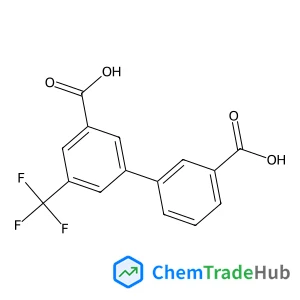
3-(3-Carboxyphenyl)-5-(trifluoromethyl)benzoic acid
CAS Number:
1261930-96-4
Molecular Formula:
C15H9F3O4

![4-[(2-Fluoro-4-methylphenyl)amino]-6-[4-(2-hydroxyethyl)-1-piperazinyl]-7-methoxy-3-cinnolinecarboxamide structure](https://static.chemtradehub.com/structs/104/1041852-85-0-fb1c.webp "4-[(2-Fluoro-4-methylphenyl)amino]-6-[4-(2-hydroxyethyl)-1-piperazinyl]-7-methoxy-3-cinnolinecarboxamide structure")
4-[(2-Fluoro-4-methylphenyl)amino]-6-[4-(2-hydroxyethyl)-1-piperazinyl]-7-methoxy-3-cinnolinecarboxamide
CAS Number:
1041852-85-0
Molecular Formula:
C23H27FN6O3
Recommended Suppliers







Disclaimer
This page provides academic journal information for reference and research purposes only. We are not affiliated with any journal publishers and do not handle publication submissions. For publication-related inquiries, please contact the respective journal publishers directly.
If you notice any inaccuracies in the information displayed, please contact us at support@chemtradehub.com. We will promptly review and address your concerns.