












A dynamical approach to non-adiabatic electron transfers at the bio-inorganic interface
Literature Information
Publication Date
2016-03-08
DOI
10.1039/C6CP00044D
Impact Factor
3.676
Authors
Laura Zanetti-Polzi, Stefano Corni
View Original
Abstract
A methodology is proposed to investigate electron transfer reactions between redox-active biomolecular systems (e.g. a protein) and inorganic surfaces. The whole system is modelled at the atomistic level using classical molecular dynamics – making an extensive sampling of the system's configurations possible – and the energies associated with the redox-active complex reduction are calculated using a hybrid quantum/classical approach along the molecular dynamics trajectory. The non-adiabaticity is introduced a posteriori using a Monte Carlo approach based on the Landau–Zener theory extended to treat a metal surface. This approach thus allows us to investigate the role of the energy fluctuations, determined by the dynamical evolution of the system, as well as the role of non-adiabaticity in affecting the kinetic rate of the electron transfer reaction. Most notably, it allows us to investigate the two contributions separately, hence achieving a detailed picture of the mechanisms that determine the rate. The analysis of the system configurations also allows us to relate the estimated electronic coupling to the structural and dynamic properties of the system. As a test case, the methodology is here applied to study the electron transfer reaction between cytochrome c and a gold surface. The results obtained explain the different electron transfer rates experimentally measured for two different concentrations of proteins on the electrode surface.
Related Literature
Pnicogen and hydrogen bonds: complexes between PH3X+ and PH2X systems
Ibon Alkorta, José Elguero
2014-12-11
Paper
DOI: 10.1039/C4CP04840G
Probing a chemical compass: novel variants of low-frequency reaction yield detected magnetic resonance
Kiminori Maeda, Jonathan G. Storey, Paul A. Liddell, Devens Gust, P. J. Hore, C. J. Wedge, Christiane R. Timmel
2014-12-24
Paper
DOI: 10.1039/C4CP04095C
A practical guide to using boron doped diamond in electrochemical research
2014-12-18
Perspective
DOI: 10.1039/C4CP04022H
Carbon nanoscroll from C4H/C4F-type graphene superlattice: MD and MM simulation insights
Yehan Tao, Xiaofang Li, Tiantian Wu, Yakang Jin, Zhongyang Zhang
2014-12-04
Paper
DOI: 10.1039/C4CP04102J
Perfect light trapping in nanoscale thickness semiconductor films with a resonant back reflector and spectrum-splitting structures
Xin-Hua Deng, Wen Yang, Jun Li
2014-12-11
Paper
DOI: 10.1039/C4CP04717F
Radiolysis of crown ether–ionic liquid systems: identification of radiolytic products and their effect on the removal of Sr2+ from nitric acid
Yinyong Ao, Weijin Yuan, Tianlin Yu, Jing Peng, Jiuqiang Li, Maolin Zhai, Long Zhao
2014-12-11
Paper
DOI: 10.1039/C4CP04294H
The effect of sugar stereochemistry on protein self-assembly: the case of β-casein micellization in different aldohexose solutions
Ofer Setter
2014-12-16
Paper
DOI: 10.1039/C4CP03686G
Remarkable improvement in microwave absorption by cloaking a micro-scaled tetrapod hollow with helical carbon nanofibers
Xiangnan Chen, Zuowan Zhou, Gang Li, Man Jiang, Xiaoling Xu, Jun Lu, Qiming Li, Yong Wang, Jihua Gou, David Hui
2014-11-28
Paper
DOI: 10.1039/C4CP04849K
Structural heterogeneity and dynamics of dyes on TiO2: implications for charge transfer across organic–inorganic interfaces
Jeffrey R. Christianson, J. R. Schmidt
2014-12-18
Paper
DOI: 10.1039/C4CP04814H
Magnetic γ-Fe2O3, Fe3O4, and Fe nanoparticles confined within ordered mesoporous carbons as efficient microwave absorbers
Jiacheng Wang, Jiandong Zhuang, Qian Liu
2014-12-11
Paper
DOI: 10.1039/C4CP04228J
You might also like
Compound Q&A
What precautions should be taken when handling 4-(2-Furylmethyl)thiomorpholine 1,1-dioxide (CAS: 79206-94-3)?
When handling 4-(2-Furylmethyl)thiomorpholine 1,1-dioxide (CAS: 79206-94-3), it ...
79206-94-34-(2-Furylmethyl)thi...
Compound Q&A
What precautions should be taken when handling 4-Chloro-N-[2-(4-morpholinyl)ethyl]benzamide (CAS: 71320-77-9)?
When handling 4-Chloro-N-[2-(4-morpholinyl)ethyl]benzamide (CAS: 71320-77-9), it...
71320-77-94-Chloro-N-[2-(4-mor...
Compound Q&A
How should waste containing 2-[2-(2-Methoxyethoxy)ethoxy]ethyl 4-methylbenzenesulfonate (CAS: 62921-74-8) be handled?
Waste containing this compound (CAS: 62921-74-8) should be handled according to ...
62921-74-82-[2-(2-Methoxyethox...
Compound Q&A
How should waste containing (S)-Methyl 2-amino-3-cyclohexylpropanoate be handled?
Waste containing (S)-Methyl 2-amino-3-cyclohexylpropanoate should be collected i...
40056-18-6(S)-Methyl 2-amino-3...
Compound Q&A
How is 5-({4-[(2S,4R)-4-Hydroxy-2-methyltetrahydro-2H-pyran-4-yl]-2-thienyl}sulfanyl)-1-methyl-1,3-dihydro-2H-indol-2-one (CAS: 166882-70-8) typically synthesized?
This compound can be synthesized using a multi-step process involving the conjug...
166882-70-85-({4-[(2S,4R)-4-Hyd...
Compound Q&A
Are there alternatives to (2E)-3-(3,4-Dichlorophenyl)acrylic acid (CAS: 7312-27-8) in synthesis?
There are several alternatives to (2E)-3-(3,4-Dichlorophenyl)acrylic acid in syn...
7312-27-8(2E)-3-(3,4-Dichloro...
Compound Q&A
How should Ethyl 6-(2-nitrophenyl)imidazo[2,1-b][1,3]thiazole-3-carboxylate (CAS: 925437-84-9) be stored?
Ethyl 6-(2-nitrophenyl)imidazo[2,1-b][1,3]thiazole-3-carboxylate (CAS: 925437-84...
925437-84-9Ethyl 6-(2-nitrophen...
Compound Q&A
How should waste containing 2-(1,3-Thiazol-2-yl)ethanamine (CAS: 18453-07-1) be handled?
Waste containing 2-(1,3-Thiazol-2-yl)ethanamine (CAS: 18453-07-1) should be coll...
18453-07-12-(1,3-Thiazol-2-yl)...
Compound Q&A
How is Methyl 5-iodo-2-methylbenzoate (CAS: 103440-54-6) typically synthesized?
Methyl 5-iodo-2-methylbenzoate can be synthesized through the iodination of meth...
103440-54-6Methyl 5-iodo-2-meth...
Compound Q&A
How is 5-Chloro[1,2,4]triazolo[1,5-a]pyridine (CAS: 1427399-34-5) typically synthesized?
5-Chloro[1,2,4]triazolo[1,5-a]pyridine is commonly synthesized via the condensat...
1427399-34-55-Chloro[1,2,4]triaz...
Source Journal
Physical Chemistry Chemical Physics

CiteScore:
5.5
Self-citation Rate:
10.3%
Articles per Year:
3036
Physical Chemistry Chemical Physics (PCCP) is an international journal co-owned by 19 physical chemistry and physics societies from around the world. This journal publishes original, cutting-edge research in physical chemistry, chemical physics and biophysical chemistry. To be suitable for publication in PCCP, articles must include significant innovation and/or insight into physical chemistry; this is the most important criterion that reviewers and Editors will judge against when evaluating submissions. The journal has a broad scope and welcomes contributions spanning experiment, theory, computation and data science. Topical coverage includes spectroscopy, dynamics, kinetics, statistical mechanics, thermodynamics, electrochemistry, catalysis, surface science, quantum mechanics, quantum computing and machine learning. Interdisciplinary research areas such as polymers and soft matter, materials, nanoscience, energy, surfaces/interfaces, and biophysical chemistry are welcomed if they demonstrate significant innovation and/or insight into physical chemistry. Joined experimental/theoretical studies are particularly appreciated when complementary and based on up-to-date approaches.
Recommended Compounds
![5-Acetyl-2,3-dihydrobenzo[b]furan structure](https://static.chemtradehub.com/structs/908/90843-31-5-eea4.webp "5-Acetyl-2,3-dihydrobenzo[b]furan structure")
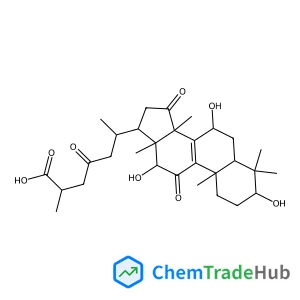
(3beta,7beta,12beta)-3,7,12-Trihydroxy-11,15,23-trioxolanost-8-en-26-oic acid
CAS Number:
98665-22-6
Molecular Formula:
C30H44O8

![[4-Amino-2-(methylsulfanyl)-5-pyrimidinyl]methanol structure](https://static.chemtradehub.com/structs/588/588-36-3-fc73.webp "[4-Amino-2-(methylsulfanyl)-5-pyrimidinyl]methanol structure")
Recommended Suppliers






Disclaimer
This page provides academic journal information for reference and research purposes only. We are not affiliated with any journal publishers and do not handle publication submissions. For publication-related inquiries, please contact the respective journal publishers directly.
If you notice any inaccuracies in the information displayed, please contact us at support@chemtradehub.com. We will promptly review and address your concerns.