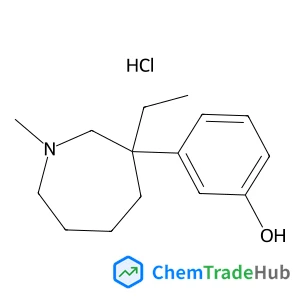
3-(3-Ethyl-1-methyl-3-azepanyl)phenol hydrochloride (1:1)
CAS Number:
59263-76-2
Molecular Formula:
C15H24ClNO
Ibon Alkorta, José Elguero
The charge-assisted complexes between PH3X+ and PH2X have been analyzed. MP2/aug′-cc-pVTZ calculations were performed and the results were supported by the Quantum Theory of Atoms in Molecules approach and the Natural Bond Orbitals method. It was found that three different configurations could be formed, i.e. those linked through a P⋯P or a P⋯X pnicogen bond and those linked through a P–H⋯P hydrogen bond. The P⋯P configurations are the most stable ones corresponding to the strongest interactions; for all complexes the P⋯P configuration exists, while the P⋯X and P–H⋯P ones are present only for some of them. Different relations between the parameters were found, especially for the P⋯P interactions where there are correlations between the P⋯P distance and the electron density at the P⋯P bond critical point (ρPP) as well as between ρPP and the charge transfer energy.

Heteroatom Chemistry

Bioorganic & Medicinal Chemistry Letters

Journal of Chemical Sciences

Main Group Chemistry

Acta Metallurgica Sinica-English Letters

Bioorganic & Medicinal Chemistry

Critical Reviews in Solid State and Materials Sciences

Topics in Catalysis

Chinese Journal of Chemistry

Herald of the Russian Academy of Sciences
Salma Khatun, Hrishikesh Bhunia, Amlan J. Pal
DOI: 10.1039/C8CP02604A
Fabian Kollhoff, Johannes Schneider, Gao Li, Sami Barkaoui, Wenjie Shen, Thomas Berger, Oliver Diwald
DOI: 10.1039/C8CP04873H
Basudeb Dutta, Joydeep Datta, Suvendu Maity, Chittaranjan Sinha, Di Sun, Partha Pratim Ray, Mohammad Hedayetullah Mir
DOI: 10.1039/C8CP04569K
José Carlos Germino, Jônatas Faleiro Berbigier, Cristina Aparecida Barboza, Marcelo Meira Faleiros, Deborah de Alencar Simoni, Miguel Tayar Galante, Matheus Serra de Holanda, Fabiano Severo Rodembusch, Teresa Dib Zambon Atvars
DOI: 10.1039/C8CP06485G
Carlos M. N. Mendonça, Debora T. Balogh, Simone C. Barbosa, Tânia E. Sintra, Sónia P. M. Ventura, Pedro Morgado, Eduardo J. M. Filipe, João A. P. Coutinho, Osvaldo N. Oliveira, Jr., Ana Barros-Timmons
DOI: 10.1039/C8CP05035J
Giuseppe Cassone, Donatella Chillé, Claudia Foti, Ottavia Giuffré, Rosina Celeste Ponterio, Jiri Sponer, Franz Saija
DOI: 10.1039/C8CP04320E
Daisuke Matsushita, Hirotaka Uji, Shunsaku Kimura
DOI: 10.1039/C8CP02315H
Jia-Huan Hou, Di Wu, Jia-Yuan Liu, Si-Yi Li, Dan Yu, Ying Li
DOI: 10.1039/C8CP00862K
Joshua L. Bradley-Shaw, Philip J. Camp, Peter J. Dowding
DOI: 10.1039/C8CP01785A
Ricardo Grau-Crespo, Dewi W. Lewis, A. Rabdel Ruiz-Salvador
DOI: 10.1039/C8CP01369A
When handling 4-(2-Furylmethyl)thiomorpholine 1,1-dioxide (CAS: 79206-94-3), it ...
When handling 4-Chloro-N-[2-(4-morpholinyl)ethyl]benzamide (CAS: 71320-77-9), it...
Waste containing this compound (CAS: 62921-74-8) should be handled according to ...
Waste containing (S)-Methyl 2-amino-3-cyclohexylpropanoate should be collected i...
This compound can be synthesized using a multi-step process involving the conjug...
There are several alternatives to (2E)-3-(3,4-Dichlorophenyl)acrylic acid in syn...
Ethyl 6-(2-nitrophenyl)imidazo[2,1-b][1,3]thiazole-3-carboxylate (CAS: 925437-84...
Waste containing 2-(1,3-Thiazol-2-yl)ethanamine (CAS: 18453-07-1) should be coll...
Methyl 5-iodo-2-methylbenzoate can be synthesized through the iodination of meth...
5-Chloro[1,2,4]triazolo[1,5-a]pyridine is commonly synthesized via the condensat...

Physical Chemistry Chemical Physics (PCCP) is an international journal co-owned by 19 physical chemistry and physics societies from around the world. This journal publishes original, cutting-edge research in physical chemistry, chemical physics and biophysical chemistry. To be suitable for publication in PCCP, articles must include significant innovation and/or insight into physical chemistry; this is the most important criterion that reviewers and Editors will judge against when evaluating submissions. The journal has a broad scope and welcomes contributions spanning experiment, theory, computation and data science. Topical coverage includes spectroscopy, dynamics, kinetics, statistical mechanics, thermodynamics, electrochemistry, catalysis, surface science, quantum mechanics, quantum computing and machine learning. Interdisciplinary research areas such as polymers and soft matter, materials, nanoscience, energy, surfaces/interfaces, and biophysical chemistry are welcomed if they demonstrate significant innovation and/or insight into physical chemistry. Joined experimental/theoretical studies are particularly appreciated when complementary and based on up-to-date approaches.