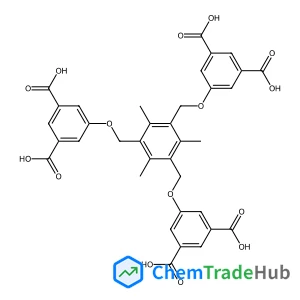
5,5',5''-(((2,4,6-Trimethylbenzene-1,3,5-triyl)tris(methylene))tris(oxy))triisophthalic acid
CAS Number:
1159974-70-5
Molecular Formula:
C36H30O15
Yang Wang, Bohua Wu, Linjie Zheng, Donghui Wei, Mingsheng Tang
A systematic theoretical study has been carried out to understand the possible mechanisms and stereoselectivity of the N-heterocyclic carbene (NHC)-catalyzed [3 + 2] annulation reaction of enals with α-ketoamides using density functional theory (DFT) calculations. The calculated results reveal that the favorable pathway comprises of seven steps, i.e., addition of the catalyst, formation of the Breslow intermediate, formation of the enolate intermediate, the C–C bond formation step, the proton transfer process, the ring-closure process and the regeneration of the catalyst. For the proton transfer process, apart from the direct proton transfer mechanism, the base TMEDA and the in situ generated Brønsted acid TMEDA·H+ mediated proton transfer mechanisms are also investigated; the free energy for the crucial proton transfer steps is found to be significantly lowered by explicit inclusion of the Brønsted acid TMEDA·H+. The computational results show that the C–C bond formation step is the stereoselectivity-determining step, in which two chirality centers assigned to the coupling carbon atoms are formed, and the RR-configured diastereomer is the predominant product, which is in good agreement with the experimental observations. Global reaction index (GRI) analysis has been performed to confirm that NHC mainly plays a role of a Lewis base catalyst. In addition, the distortion/interaction, NCI, and NBO analyses show that the strong interaction and electron delocalization of the reaction active site determine the stereoselectivity, with the RR-configured product being generated preferentially. The mechanistic insights obtained in the present study should be valuable for the rational design of an effective organocatalyst for this kind of reaction with high stereoselectivity.
Jianjun Wang, Huiying Hong, Daguo Hu, Jieling Liu, Wei Liu, Yian Shi
DOI: 10.1039/D3QO01472J
Yaxing Wu, Yunchen Jiang, Fei Wang, Bin Wang, Chao Chen
DOI: 10.1039/D3QO01804K
Fang Wang, Xiaohan Xu, Yangtian Yan, Jiayang Zhang, Yang Yang
DOI: 10.1039/D3QO01835K
Jiahao Liu, Zhuofeng Ke
DOI: 10.1039/D3QO01777J
DOI: 10.1039/D3QO01735D
Jiangwei Wen, Xue Sun, Kelu Yan, Tingtao Yan, Zhen Liu, Yang Li, Jianjing Yang
DOI: 10.1039/D3QO01577G
Krzysztof Bartkowski, Abhishek Kumar Gupta, Tomas Matulaitis, Maja Morawiak, Eli Zysman-Colman, Marcin Lindner
DOI: 10.1039/D3QO01914D
Feihu Cong, Wenjing Zhang, Gan Zhang, Jie Liu, Yicheng Zhang, Chao Zhou
DOI: 10.1039/D3OB01154B
2-Methylbenzene-1,4-diamine dihydrochloride (CAS: 615-45-2) should be stored in ...
(1S,4S)-2,5-Diazabicyclo[2.2.1]heptane dihydrobromide is generally considered sa...
(6-Chloropyridazin-3-YL)methanamine finds applications in the pharmaceutical ind...
2-Fluoro-3-methylphenol is primarily used in the synthesis of pharmaceuticals, p...
When handling 3-Methoxy-4-nitrobenzonitrile, it is important to wear appropriate...
When handling 1,3-Oxazolo[4,5-b]pyridine-2(3H)-thione (CAS: 211949-57-4), it is ...
4-Ethynylbenzamide (CAS: 90347-86-7) falls under various regulatory guidelines i...
3-(2-Ethylphenyl)-2-thioxo-4-imidazolidinone is primarily used as an intermediat...
(2-Fluoro-6-methoxyphenyl)acetic acid, also known as 4-fluoro-3-methoxybenzoic a...
Market trends for 2-[4-(Hydroxymethyl)phenoxy]ethanol (CAS: 102196-18-9) indicat...

Organic Chemistry Frontiers publishes high-quality research from across organic chemistry. Emphases are placed on studies that make significant contributions to the field of organic chemistry by reporting either new or significantly improved protocols or methodologies. Topics include, but are not limited to the following: Organic synthesis Development of synthetic methodologies Catalysis Natural products Functional organic materials Supramolecular and macromolecular chemistry Physical and computational organic chemistry
![[5-fluoro-2-(morpholine-4-carbonyl)phenyl]boronic acid structure](https://static.chemtradehub.com/structs/121/1217501-26-2-505c.webp "[5-fluoro-2-(morpholine-4-carbonyl)phenyl]boronic acid structure")
![2-Methylbenzo[h]quinoline structure](https://static.chemtradehub.com/structs/605/605-88-9-ac43.webp "2-Methylbenzo[h]quinoline structure")