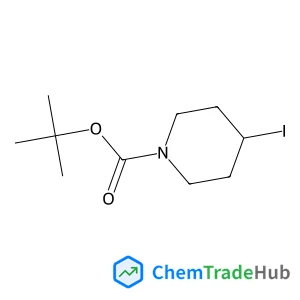
2-Methyl-2-propanyl 4-iodo-1-piperidinecarboxylate
CAS Number:
301673-14-3
Molecular Formula:
C10H18INO2
Soma Mukherjee, William. L. A. Brooks, Yuqiong Dai, Brent S. Sumerlin
Two sets of reversible covalent linkages distributed in series along a polymer backbone were used to prepare a new class of doubly-dynamic-covalent polymers capable of reversibly dissociating via two distinct pathways. These self-repairable linear polymers were prepared via step-growth Diels–Alder polymerization of an AB monomer that contained furfuryl- and maleimido groups linked by an oxime bond. Both the oxime and oxanorbornene links lent orthogonally reversible character to the polymer backbone. The sequentially distributed oxime bonds in the polymer were capable of dynamic oxime exchange in the presence of a competitive monofunctional alkoxyamine under acidic conditions, while the oxanorbornene linkages were susceptible to cleavage via retro-Diels–Alder reactions at elevated temperatures and recombination upon cooling. The self-healing or reversible nature of the dynamic-covalent oxime bonds and oxanorbornene links has potential for designing stimuli-responsive self-repairable materials for sensors and drug delivery applications.
Kathrin Winkler, Jörg Lindner, Peter Vöhringer
DOI: 10.1039/B200299J
Yasuaki Okamoto, Nobuyuki Oshima, Yasuhiro Kobayashi, Osamu Terasaki, Tetsuya Kodaira, Takeshi Kubota
DOI: 10.1039/B108639C
I. Melián-Cabrera, M. López Granados, J. L. G. Fierro
DOI: 10.1039/B201996E
Jana Chocholoušová, Jaroslav Vacek, Pavel Hobza
DOI: 10.1039/B110872G
J. H. Merkin
DOI: 10.1039/B110364B
V. V. Chasovskikh, L. L. Frumin, S. E. Peltek, G. V. Zilberstein
DOI: 10.1039/B110042D
A. Cricenti, R. M. Montereali, E. Nichelatti, S. Scaglione, F. Somma
DOI: 10.1039/B110269A
B. Luerßen, J. Janek, S. Günther, M. Kiskinova, R. Imbihl
DOI: 10.1039/B109893D
Anthony Harriman, Annabelle Mayeux, Antoinette De Nicola, Raymond Ziessel
DOI: 10.1039/B109966N
Clair Atterbury, Andrew D. J. Critchley, Richard A. Kennedy, Chris A. Mayhew, Richard P. Tuckett
DOI: 10.1039/B109567F
Waste containing (6-Bromo-2-naphthyl)oxy](dimethyl)(2-methyl-2-propanyl)silane (...
7-Fluoro-4-isoquinolinecarboxylic acid can be synthesized via a multi-step proce...
2,3,5,6-Tetrabromothieno[3,2-b]thiophene is a crystalline compound with a high m...
1-[4-(Benzylamino)-7,8-dihydro-5H-pyrano[4,3-d]pyrimidin-2-yl]-2-methyl-1H-indol...
The market for imidazo[5,1-d]-1,2,3,5-tetrazine-8-carboxylic acid, 3,4-dihydro-3...
3-(Triisopropylsilyl)propiolaldehyde is a synthetic organic compound with the CA...
6-Nitro-2H-1,4-benzoxazin-3(4H)-one (CAS: 81721-87-1) is subject to various regu...
Waste containing (3-Fluorophenyl)(4-{[(2-methyl-2-propanyl)oxy]carbonyl}-1-piper...
N,N'-4,4'-Biphenyldiyldiisonicotinamide is a white crystalline solid with a mole...
6-Bromo-8-fluoro-2-quinazolinol is primarily used in the pharmaceutical industry...

Polymer Chemistry welcomes submissions in all areas of polymer science that have a strong focus on macromolecular chemistry. Manuscripts may cover a broad range of fields, yet no direct application focus is required.