












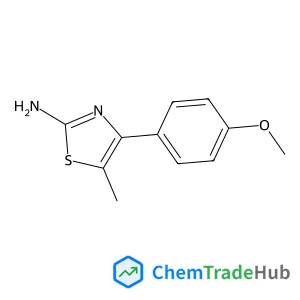
4-(4-Methoxyphenyl)-5-methyl-1,3-thiazol-2-amine
CAS Number:
105512-88-7
Molecular Formula:
C11H12N2OS
Zhi Xiang Voo, Majad Khan, Qingxing Xu, Karthikeyan Narayanan, Brandon W. J. Ng, Raidah Bte Ahmad, James L. Hedrick, Yi Yan Yang
Catheters-associated infections, which are caused by bacteria fouling and subsequent biofilm formation, are difficult to treat. In this study, diblock copolymers of antifouling poly(ethylene glycol) (PEG) having different lengths (2.4 kDa and 10 kDa) and maleimide-functionalized polycarbonate (2.4k-M and 10k-M), and diblock copolymers of PEG and polycarbonate functionalized with maleimide and ammonium (2.4k-MC and 10k-MC) were synthesized by metal-free organocatalytic ring-opening polymerization. These polymers were employed to coat onto thiol-functionalized silicone rubber (a commonly used catheter material) surface to investigate the effects of PEG length and cationic polycarbonate on antibacterial and antifouling activities. Upon contact, the 2.4k-MC and 10k-MC coatings that contain cationic polycarbonate eliminated 96% and 98% of S. aureus, and 93% and 96% of E. coli in solution, respectively, while they were unable to prevent bacteria fouling or biofilm formation. Unexpectedly, although the surface coated with 2.4k-M or 10k-M without antibacterial cationic polycarbonate block did not kill S. aureus and E. coli in solution, these coatings provided stronger antifouling function. Particularly, the 10k-M coating of longer PEG had stronger antifouling activity, and precluded formation of S. aureus and E. coli biofilms over 14 days. Moreover, the coating prevented protein fouling and platelet adhesion without inducing hemolysis. Therefore, this antifouling polymer coating is a potentially viable candidate to prevent catheter-associated infections.
Jérôme Warnant, Corine Gérardin, Patrick Lacroix-Desmazes
DOI: 10.1039/C4PY01502A
Minghui Xu, Junmin Qian, Aili Suo, Ting Liu, Xuefeng Liu, Hongjie Wang
DOI: 10.1039/C5PY00034C
Lei Yu, Long-Hai Wang, Zong-Tao Hu, Ye-Zi You, De-Cheng Wu, Chun-Yan Hong
DOI: 10.1039/C4PY01363H
Zeyun Xiao, Kuan Sun, Jegadesan Subbiah, Tianshi Qin, Shirong Lu, Balaji Purushothaman, David J. Jones, Wallace W. H. Wong
DOI: 10.1039/C4PY01631A
Daquan Chen, Jingfang Sun
DOI: 10.1039/C4PY01639D
Maike C. Lukowiak, Sascha Wettmarshausen, Gundula Hidde, Petra Landsberger, Viola Boenke, Karsten Rodenacker, Ulrike Braun, Jörg F. Friedrich, Anna A. Gorbushina, Rainer Haag
DOI: 10.1039/C4PY01375A
Xiaofeng Sui, Pekka Kujala, Geert-Jan Janssen, Edwin de Jong, Inge S. Zuhorn, Jan C. M. van Hest
DOI: 10.1039/C4PY01288G
Qiuhua Wu, Qian Wang, Guolin Zhang, Fuxin Liang
DOI: 10.1039/C5PY00267B
(5-Sulfamoyl-3-pyridinyl)boronic acid is primarily used in chemical synthesis, p...
Benzyl 2-methyl-2-(methylsulfonyl)-4-pentenoate is typically synthesized via est...
When handling 8-Fluoroquinolin-6-ol (CAS: 209353-22-0), it is important to use p...
1,3-Dibromo-5-(2-methyl-2-propanyl)benzene (CAS: 129316-09-2) is a crystalline c...
Ethyl 7-chloro-4-oxo-1-(1,3-thiazol-2-yl)-1,4-dihydro-1,8-naphthyridine-3-carbox...
When handling Delta-7-Avenasterol (CAS: 23290-26-8), it is important to wear app...
Proper handling involves the use of personal protective equipment such as gloves...
When handling 2-Methyl-2-proanyl 4-[(2-aminophenyl)amino]-1-piperidinecarboxylat...
N-Methyl-4-chlorobenzylamine hydrochloride (CAS: 65542-24-7) is a organic compou...
[2-(Dodecyloxy)ethoxy]acetic acid (CAS: 27306-90-7) is generally considered safe...

Polymer Chemistry welcomes submissions in all areas of polymer science that have a strong focus on macromolecular chemistry. Manuscripts may cover a broad range of fields, yet no direct application focus is required.
![[3-Fluoro-4-(1-pyrrolidinylcarbonyl)phenyl]boronic acid structure](https://static.chemtradehub.com/structs/874/874289-09-5-e3d4.webp "[3-Fluoro-4-(1-pyrrolidinylcarbonyl)phenyl]boronic acid structure")
![4-Fluoro-2-(4-{[(3S,4R)-4-(2-hydroxy-2-propanyl)-3-pyrrolidinyl]amino}-6,7-dimethoxy-2-quinazolinyl)phenol hydrochloride (1:1) structure](https://static.chemtradehub.com/structs/143/1431697-96-9-619c.webp "4-Fluoro-2-(4-{[(3S,4R)-4-(2-hydroxy-2-propanyl)-3-pyrrolidinyl]amino}-6,7-dimethoxy-2-quinazolinyl)phenol hydrochloride (1:1) structure")





