












Effect of molecular weight on the properties and organic solar cell device performance of a donor–acceptor conjugated polymer
Literature Information
Publication Date
2015-02-04
DOI
10.1039/C4PY01631A
Impact Factor
5.582
Authors
Zeyun Xiao, Kuan Sun, Jegadesan Subbiah, Tianshi Qin, Shirong Lu, Balaji Purushothaman, David J. Jones, Wallace W. H. Wong
View Original
Abstract
Donor–acceptor conjugated polymers with 2-(2-ethylhexyl)-3-hexyl thienyl substituted benzo[1,2-b:4,5-b′]dithiophene (BDT) as donor building block and 5,6-difluorobenzo[c][1,2,5]thiadiazole as acceptor building block have been synthesized by Stille coupling polymerization. The polymerization conditions were optimized to achieve high molecular weight polymers (number-average molecular weight, Mn, up to 139 kg mol−1). The molecular weight dependent polymer properties were studied and compared. Photovoltaic applications of the polymers in bulk heterojunction (BHJ) solar cells revealed that the power conversion efficiency increased significantly (from 0.9% to 4.1%) as the Mn increased from 10 kg mol−1 to 73 kg mol−1 while further increase of the molecular weight had less influence on the solar cell performance.
Related Literature
Tunable electronic properties and Schottky barrier in a graphene/WSe2 heterostructure under out-of-plane strain and an electric field
Guoqiang Hao, Xiaojun Ye, Shangpeng Gao, Hongbo Li
2020-09-22
Paper
DOI: 10.1039/D0CP04160B
Critical phenomenon in the room-temperature ferromagnet Ce0.65Mg0.35Co3 prepared by high-pressure annealing
Weizheng Guan, Youwei Du
2020-09-30
Paper
DOI: 10.1039/D0CP03973J
Understanding the luminescence properties of Cu(i) complexes: a quantum chemical perusal
Nora Lüdtke, Jelena Föller, Christel M. Marian
2020-09-16
Paper
DOI: 10.1039/D0CP04654J
Dynamics of confined water and its interplay with alkali cations in sodium aluminosilicate hydrate gel: insights from reactive force field molecular dynamics
Gideon A. Lyngdoh, Rajesh Kumar, Sumanta Das
2020-10-05
Paper
DOI: 10.1039/D0CP04646A
A statistical thermodynamics view of electron density polarisation: application to chemical selectivity
Frédéric Guégan, Vincent Tognetti, Jorge I. Martínez-Araya, Henry Chermette, Lynda Merzoud, Alejandro Toro-Labbé, Christophe Morell
2020-09-21
Paper
DOI: 10.1039/D0CP03228J
Coupling between structural relaxation and diffusion in glass-forming liquids under pressure variation
Katsunori Wakabayashi
2020-09-21
Paper
DOI: 10.1039/D0CP02761H
Theoretical research on the oxidation mechanism of doped carbon based catalysts for oxygen reduction reaction
Na Yang, Lanlan Peng, Li Li, Jing Li, Zidong Wei
2019-11-05
Paper
DOI: 10.1039/C9CP04691G
A data-driven approach to determine dipole moments of diatomic molecules
Xiangyue Liu, Gerard Meijer, Jesús Pérez-Ríos
2020-08-24
Paper
DOI: 10.1039/D0CP03810E
Micro-spectroscopy of HKUST-1 metal–organic framework crystals loaded with tetracyanoquinodimethane: effects of water on host–guest chemistry and electrical conductivity
Miguel Rivera-Torrente, Matthias Filez, Christian Schneider, Ewout C. van der Feltz, Konrad Wolkersdörfer, Dereje H. Taffa, Michael Wark, Roland A. Fischer, Bert M. Weckhuysen
2019-11-06
Paper
DOI: 10.1039/C9CP05082E
You might also like
Compound Q&A
What are the main uses of (5-Sulfamoyl-3-pyridinyl)boronic acid (CAS: 951233-61-7)?
(5-Sulfamoyl-3-pyridinyl)boronic acid is primarily used in chemical synthesis, p...
951233-61-7(5-Sulfamoyl-3-pyrid...
Compound Q&A
How is Benzyl 2-methyl-2-(methylsulfonyl)-4-pentenoate (CAS: 1942858-50-5) typically synthesized?
Benzyl 2-methyl-2-(methylsulfonyl)-4-pentenoate is typically synthesized via est...
1942858-50-5Benzyl 2-methyl-2-(m...
Compound Q&A
What precautions should be taken when handling 8-Fluoroquinolin-6-ol (CAS: 209353-22-0)?
When handling 8-Fluoroquinolin-6-ol (CAS: 209353-22-0), it is important to use p...
209353-22-08-Fluoroquinolin-6-o...
Compound Q&A
What are the physical and chemical properties of 1,3-Dibromo-5-(2-methyl-2-propanyl)benzene (CAS: 129316-09-2)?
1,3-Dibromo-5-(2-methyl-2-propanyl)benzene (CAS: 129316-09-2) is a crystalline c...
129316-09-21,3-Dibromo-5-(2-met...
Compound Q&A
What industries use Ethyl 7-chloro-4-oxo-1-(1,3-thiazol-2-yl)-1,4-dihydro-1,8-naphthyridine-3-carboxylate (CAS: 174726-87-5)?
Ethyl 7-chloro-4-oxo-1-(1,3-thiazol-2-yl)-1,4-dihydro-1,8-naphthyridine-3-carbox...
174726-87-5Ethyl 7-chloro-4-oxo...
Compound Q&A
What precautions should be taken when handling Delta-7-Avenasterol (CAS: 23290-26-8)?
When handling Delta-7-Avenasterol (CAS: 23290-26-8), it is important to wear app...
23290-26-8Delta-7-Avenasterol
Compound Q&A
What precautions should be taken when handling N-({(5R)-3-[3-Fluoro-4-(4-morpholinyl)phenyl]-2-oxo-1,3-oxazolidin-5-yl}methyl)acetamide (CAS: 872992-20-6)?
Proper handling involves the use of personal protective equipment such as gloves...
872992-20-6N-({(5R)-3-[3-Fluoro...
Compound Q&A
What precautions should be taken when handling 2-Methyl-2-proanyl 4-[(2-aminophenyl)amino]-1-piperidinecarboxylate (CAS: 79099-00-6)?
When handling 2-Methyl-2-proanyl 4-[(2-aminophenyl)amino]-1-piperidinecarboxylat...
79099-00-62-Methyl-2-propanyl ...
Compound Q&A
What is N-Methyl-4-chlorobenzylamine hydrochloride (CAS: 65542-24-7)?
N-Methyl-4-chlorobenzylamine hydrochloride (CAS: 65542-24-7) is a organic compou...
65542-24-7N-Methyl-4-chloroben...
Compound Q&A
Is [2-(Dodecyloxy)ethoxy]acetic acid (CAS: 27306-90-7) safe?
[2-(Dodecyloxy)ethoxy]acetic acid (CAS: 27306-90-7) is generally considered safe...
27306-90-7[2-(Dodecyloxy)ethox...
Source Journal
Polymer Chemistry

CiteScore:
8.6
Self-citation Rate:
7.3%
Articles per Year:
457
Polymer Chemistry welcomes submissions in all areas of polymer science that have a strong focus on macromolecular chemistry. Manuscripts may cover a broad range of fields, yet no direct application focus is required.
Recommended Compounds
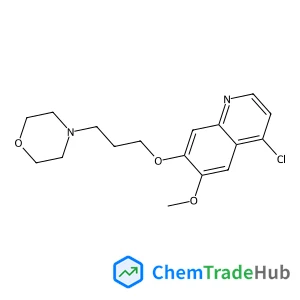
4-(3-((4-Chloro-6-methoxyquinolin-7-yl)oxy)propyl)morpholine
CAS Number:
205448-32-4
Molecular Formula:
C17H21ClN2O3
Recommended Suppliers




Disclaimer
This page provides academic journal information for reference and research purposes only. We are not affiliated with any journal publishers and do not handle publication submissions. For publication-related inquiries, please contact the respective journal publishers directly.
If you notice any inaccuracies in the information displayed, please contact us at support@chemtradehub.com. We will promptly review and address your concerns.