












Electron correlation effects of the ThO and ThS molecules in the spinor basis. A relativistic coupled cluster study of ground and excited states properties
Literature Information
Publication Date
2018-08-27
DOI
10.1039/C8CP00048D
Impact Factor
3.676
Authors
Paweł Tecmer, Cristina E. González-Espinoza
View Original
Abstract
We present a comprehensive relativistic coupled cluster study of the electronic structures of the ThO and ThS molecules in the spinor basis. Specifically, we use the single-reference coupled cluster and the multi-reference Fock Space Coupled Cluster (FSCC) methods to model their ground and electronically-excited states. Two variants of the FSCC method have been investigated: (a) one where the electronic spectrum is obtained from sector (1,1) of the Fock space, and (b) another where the excited states come from the doubly attached electronic states to the doubly charged systems (ThO2+ and ThS2+), that is, from sector (0,2) of the Fock space. Our study provides a reliable set of spectroscopic parameters such as bond lengths, excitation energies, and vibrational frequencies, as well as a detailed analysis of the electron correlation effects in the ThO and ThS molecules. Finally, we examine the first ionization potential and electron affinity of the above mentioned molecules.
Recommended Journals
Related Literature
The interaction of nitrobenzene with the hydrate basal surface of montmorillonite: an ab initio study
Danuta Leszczynska
2000-10-04
Paper
DOI: 10.1039/B004698L
Influence of water on the pillaring of montmorillonite with aminopropyltriethoxysilane
Paper
DOI: 10.1039/A901888C
Destructive adsorption of carbon tetrachloride on lanthanum and cerium oxides
Paper
DOI: 10.1039/A901847F
Reaction mechanism in the photoreduction of CO2 with CH4 over ZrO2
2000-10-26
Paper
DOI: 10.1039/B005315P
Nature of the lowest triplet states of 4′-substituted N-phenylphenothiazine derivatives
Paweł Borowicz, Jerzy Herbich, Andrzej Kapturkiewicz, Romana Anulewicz-Ostrowska, Jacek Nowacki, Günter Grampp
2000-09-08
Paper
DOI: 10.1039/B005058J
Quasiclassical trajectory calculations of collisional energy transfer: the methyl internal rotor in ethane
Paper
DOI: 10.1039/A902118C
A molecular model for lipid-mediated interaction between proteins in membranes
Sylvio May, Avinoam Ben-Shaul
2000-08-22
Paper
DOI: 10.1039/B003570J
You might also like
Compound Q&A
What precautions should be taken when handling 4-(2-Furylmethyl)thiomorpholine 1,1-dioxide (CAS: 79206-94-3)?
When handling 4-(2-Furylmethyl)thiomorpholine 1,1-dioxide (CAS: 79206-94-3), it ...
79206-94-34-(2-Furylmethyl)thi...
Compound Q&A
What precautions should be taken when handling 4-Chloro-N-[2-(4-morpholinyl)ethyl]benzamide (CAS: 71320-77-9)?
When handling 4-Chloro-N-[2-(4-morpholinyl)ethyl]benzamide (CAS: 71320-77-9), it...
71320-77-94-Chloro-N-[2-(4-mor...
Compound Q&A
How should waste containing 2-[2-(2-Methoxyethoxy)ethoxy]ethyl 4-methylbenzenesulfonate (CAS: 62921-74-8) be handled?
Waste containing this compound (CAS: 62921-74-8) should be handled according to ...
62921-74-82-[2-(2-Methoxyethox...
Compound Q&A
How should waste containing (S)-Methyl 2-amino-3-cyclohexylpropanoate be handled?
Waste containing (S)-Methyl 2-amino-3-cyclohexylpropanoate should be collected i...
40056-18-6(S)-Methyl 2-amino-3...
Compound Q&A
How is 5-({4-[(2S,4R)-4-Hydroxy-2-methyltetrahydro-2H-pyran-4-yl]-2-thienyl}sulfanyl)-1-methyl-1,3-dihydro-2H-indol-2-one (CAS: 166882-70-8) typically synthesized?
This compound can be synthesized using a multi-step process involving the conjug...
166882-70-85-({4-[(2S,4R)-4-Hyd...
Compound Q&A
Are there alternatives to (2E)-3-(3,4-Dichlorophenyl)acrylic acid (CAS: 7312-27-8) in synthesis?
There are several alternatives to (2E)-3-(3,4-Dichlorophenyl)acrylic acid in syn...
7312-27-8(2E)-3-(3,4-Dichloro...
Compound Q&A
How should Ethyl 6-(2-nitrophenyl)imidazo[2,1-b][1,3]thiazole-3-carboxylate (CAS: 925437-84-9) be stored?
Ethyl 6-(2-nitrophenyl)imidazo[2,1-b][1,3]thiazole-3-carboxylate (CAS: 925437-84...
925437-84-9Ethyl 6-(2-nitrophen...
Compound Q&A
How should waste containing 2-(1,3-Thiazol-2-yl)ethanamine (CAS: 18453-07-1) be handled?
Waste containing 2-(1,3-Thiazol-2-yl)ethanamine (CAS: 18453-07-1) should be coll...
18453-07-12-(1,3-Thiazol-2-yl)...
Compound Q&A
How is Methyl 5-iodo-2-methylbenzoate (CAS: 103440-54-6) typically synthesized?
Methyl 5-iodo-2-methylbenzoate can be synthesized through the iodination of meth...
103440-54-6Methyl 5-iodo-2-meth...
Compound Q&A
How is 5-Chloro[1,2,4]triazolo[1,5-a]pyridine (CAS: 1427399-34-5) typically synthesized?
5-Chloro[1,2,4]triazolo[1,5-a]pyridine is commonly synthesized via the condensat...
1427399-34-55-Chloro[1,2,4]triaz...
Source Journal
Physical Chemistry Chemical Physics

CiteScore:
5.5
Self-citation Rate:
10.3%
Articles per Year:
3036
Physical Chemistry Chemical Physics (PCCP) is an international journal co-owned by 19 physical chemistry and physics societies from around the world. This journal publishes original, cutting-edge research in physical chemistry, chemical physics and biophysical chemistry. To be suitable for publication in PCCP, articles must include significant innovation and/or insight into physical chemistry; this is the most important criterion that reviewers and Editors will judge against when evaluating submissions. The journal has a broad scope and welcomes contributions spanning experiment, theory, computation and data science. Topical coverage includes spectroscopy, dynamics, kinetics, statistical mechanics, thermodynamics, electrochemistry, catalysis, surface science, quantum mechanics, quantum computing and machine learning. Interdisciplinary research areas such as polymers and soft matter, materials, nanoscience, energy, surfaces/interfaces, and biophysical chemistry are welcomed if they demonstrate significant innovation and/or insight into physical chemistry. Joined experimental/theoretical studies are particularly appreciated when complementary and based on up-to-date approaches.
Recommended Compounds

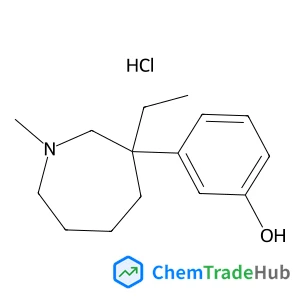
3-(3-Ethyl-1-methyl-3-azepanyl)phenol hydrochloride (1:1)
CAS Number:
59263-76-2
Molecular Formula:
C15H24ClNO
Recommended Suppliers





Disclaimer
This page provides academic journal information for reference and research purposes only. We are not affiliated with any journal publishers and do not handle publication submissions. For publication-related inquiries, please contact the respective journal publishers directly.
If you notice any inaccuracies in the information displayed, please contact us at support@chemtradehub.com. We will promptly review and address your concerns.