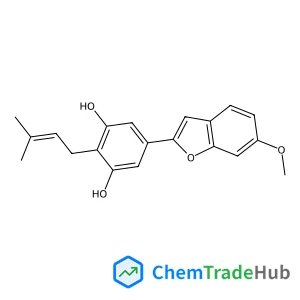
5-(6-Methoxy-1-benzofuran-2-yl)-2-(3-methyl-2-buten-1-yl)-1,3-benzenediol
CAS Number:
1017277-40-5
Molecular Formula:
C20H20O4
Abhijeet Raj
The role of resonantly stabilized radicals such as propargyl, cyclopentadienyl and benzyl in the formation of aromatic hydrocarbons such as benzene and naphthalene in the high temperature environments has been long known. In this work, the possibility of benzyl recombination to form three-ring aromatics, phenanthrene and anthracene, is explored. A reaction mechanism for it is developed, where reaction energetics are calculated using density functional theory (B3LYP functional with 6-311++G(d,p) basis set) and CBS-QB3, while temperature-dependent reaction kinetics are evaluated using transition state theory. The mechanism begins with barrierless formation of bibenzyl from two benzyl radicals with the release of 283.2 kJ mol−1 of reaction energy. The further reactions involve H-abstraction by a H atom, H-desorption, H-migration, and ring closure to gain aromaticity. Through mechanism and rate of production analyses, the important reactions leading to phenanthrene and anthracene formation are determined. Phenanthrene is found to be the major product at high temperatures. Premixed laminar flame simulations are carried out by including the proposed reactions for phenanthrene formation from benzyl radicals and compared to experimentally observed species profiles to understand their effects on species concentrations.
Feng Zheng, Xingang Zhang, Feng-Ling Qing
DOI: 10.1039/B819289H
Oksana Sereda, Amélie Blanrue, René Wilhelm
DOI: 10.1039/B817991C
Mamoru Fujitsuka, Sachiko Tojo, Teruo Shinmyozu, Tetsuro Majima
DOI: 10.1039/B810122A
Muhieddine S. Safa, Michael C. Jennings, Richard J. Puddephatt
DOI: 10.1039/B822683K
Magdalena A. Skopek, Mohamoud A. Mohamoud, Karl S. Ryder, A. Robert Hillman
DOI: 10.1039/B819084D
Masatomo Yashima, Takafumi Komatsu
DOI: 10.1039/B817280C
Teruyasu Yamamoto
DOI: 10.1039/B818792D
Samuel Tekobo, Eugene Pinkhassik
DOI: 10.1039/B817598E
When handling 2-Methyl-2-propanyl 5-amino-2-thiophenecarboxylate (CAS: 1498311-5...
5-Bromo-1,2-dichloro-3-fluorobenzene (CAS: 1000572-93-9) is a crystalline solid ...
(2R)-2-Amino-2-(4-bromophenyl)ethanol (CAS: 354153-64-3) should be stored in a c...
Methyl 4-(aminomethyl)tetrahydro-2H-pyran-4-carboxylate hydrochloride (CAS: 3627...
1,4-Dimethyl-1H-pyrazole-5-sulfonyl chloride is primarily used as an intermediat...
Dinaphtho[1,2-b:2',1'-d]furan is generally safe when handled with appropriate pe...
The market for 7-Methyl-7,9-dihydro-1H-purine-2,6,8(3H)-trione (CAS: 612-37-3) i...
2-(4-Chlorophenyl)malonaldehyde (CAS: 205676-17-1) is a colorless or light yello...
2-Methylchrysene (CAS: 3351-32-4) is typically synthesized via the reaction of c...
N-(6-aminopyrimidin-4-yl)acetamide (CAS: 89533-23-3) is generally considered saf...

Physical Chemistry Chemical Physics (PCCP) is an international journal co-owned by 19 physical chemistry and physics societies from around the world. This journal publishes original, cutting-edge research in physical chemistry, chemical physics and biophysical chemistry. To be suitable for publication in PCCP, articles must include significant innovation and/or insight into physical chemistry; this is the most important criterion that reviewers and Editors will judge against when evaluating submissions. The journal has a broad scope and welcomes contributions spanning experiment, theory, computation and data science. Topical coverage includes spectroscopy, dynamics, kinetics, statistical mechanics, thermodynamics, electrochemistry, catalysis, surface science, quantum mechanics, quantum computing and machine learning. Interdisciplinary research areas such as polymers and soft matter, materials, nanoscience, energy, surfaces/interfaces, and biophysical chemistry are welcomed if they demonstrate significant innovation and/or insight into physical chemistry. Joined experimental/theoretical studies are particularly appreciated when complementary and based on up-to-date approaches.
![L-Lysine,N6-[2-[[(1,1-dimethylethoxy)carbonyl]amino]benzoyl]-N2-[(9H-fluoren-9-ylmethoxy)carbonyl]- structure](https://static.chemtradehub.com/structs/159/159322-59-5-c046.webp "L-Lysine,N6-[2-[[(1,1-dimethylethoxy)carbonyl]amino]benzoyl]-N2-[(9H-fluoren-9-ylmethoxy)carbonyl]- structure")
![3-[7-Amino-3-(3-pyridinyl)pyrazolo[1,5-a]pyrimidin-6-yl]phenol structure](https://static.chemtradehub.com/structs/861/861249-77-6-025b.webp "3-[7-Amino-3-(3-pyridinyl)pyrazolo[1,5-a]pyrimidin-6-yl]phenol structure")