


An experimental and theoretical study of core–valence double ionisation of acetaldehyde (ethanal)
Literature Information
Publication Date
2015-11-23
DOI
10.1039/C5CP05758B
Impact Factor
3.676
Authors
O. Vahtras, M. Mucke, P. Linusson, K. Jänkälä, H. Ågren
View Original
Abstract
Core–valence double ionisation spectra of acetaldehyde (ethanal) are presented at photon energies above the carbon and oxygen 1s ionisation edges, measured by a versatile multi-electron coincidence spectroscopy technique. We use this molecule as a testbed for analyzing core–valence spectra by means of quantum chemical calculations of transition energies. These theoretical approaches range from two simple models, one based on orbital energies corrected by core valence interaction and one based on the equivalent core approximation, to a systematic series of quantum chemical electronic structure methods of increasing sophistication. The two simple models are found to provide a fast orbital interpretation of the spectra, in particular in the low energy parts, while the coverage of the full spectrum is best fulfilled by correlated models. CASPT2 is the most sophisticated model applied, but considering precision as well as computational costs, the single and double excitation configuration interaction model seems to provide the best option to analyze core–valence double hole spectra.
Recommended Journals

Electroanalysis

Acta Metallurgica Sinica-English Letters

Medicinal Chemistry Research

Journal of Asian Natural Products Research

Cellulose

Journal of the Indian Institute of Science

Polycyclic Aromatic Compounds

Heteroatom Chemistry

Critical Reviews in Solid State and Materials Sciences

NDT & E International
Related Literature
Recent advances in urea- and thiourea-containing compounds: focus on innovative approaches in medicinal chemistry and organic synthesis
Riccardo Ronchetti, Andrea Carotti, Antimo Gioiello, Emidio Camaioni
2021-05-13
Review Article
DOI: 10.1039/D1MD00058F
Sulfonium-based liposome-encapsulated antibiotics deliver a synergistic antibacterial activity
Anjali Patel, Subhasis Dey, Kamal Shokeen, Tomasz M. Karpiński, Senthilkumar Sivaprakasam, Sachin Kumar
2021-05-24
Research Article
DOI: 10.1039/D1MD00091H
Ruthenium(ii)–arene complexes as anti-metastatic agents, and related techniques
Chanchal Sonkar, Sayantan Sarkar
2021-09-15
Review Article
DOI: 10.1039/D1MD00220A
Structure-based design of haloperidol analogues as inhibitors of acetyltransferase Eis from Mycobacterium tuberculosis to overcome kanamycin resistance
Ankita Punetha, Keith D. Green, Atefeh Garzan, Nishad Thamban Chandrika, Melisa J. Willby, Allan H. Pang, Caixia Hou, Selina Y. L. Holbrook, Kyle Krieger, James E. Posey, Tanya Parish, Oleg V. Tsodikov, Sylvie Garneau-Tsodikova
2021-10-05
Research Article
DOI: 10.1039/D1MD00239B
Comprehensive overview of biased pharmacology at the opioid receptors: biased ligands and bias factors‡
Jolien De Neve, Thomas M. A. Barlow, Dirk Tourwé, Frédéric Bihel, Frédéric Simonin, Steven Ballet
2021-04-21
Review Article
DOI: 10.1039/D1MD00041A
Discovery of sustainable drugs for Alzheimer's disease: cardanol-derived cholinesterase inhibitors with antioxidant and anti-amyloid properties
Giselle de Andrade Ramos, Andressa Souza de Oliveira, Manuela Bartolini, Marina Naldi, Irene Liparulo, Christian Bergamini, Elisa Uliassi, Ling Wu, Paul E. Fraser, Monica Abreu, Alessandra Sofia Kiametis, Ricardo Gargano, Edilberto Rocha Silveira, Guilherme D. Brand, Lukas Prchal, Maria Laura Bolognesi, Luiz Antonio Soares Romeiro
2021-05-05
Research Article
DOI: 10.1039/D1MD00046B
Cyclisation strategies for stabilising peptides with irregular conformations
Quynh Ngoc Vu, Reginald Young, Haritha Krishna Sudhakar, Tianyi Gao, Tiancheng Huang, Yaw Sing Tan, Yu Heng Lau
2021-04-28
Review Article
DOI: 10.1039/D1MD00098E
Synthesis and antitumour evaluation of indole-2-carboxamides against paediatric brain cancer cells
Shahinda S. R. Alsayed, Amreena Suri, Anders W. Bailey, Samuel Lane, Chiang-Ching Huang, Li-Fang Yu, Michael Kassiou, Hendra Gunosewoyo
2021-08-23
Research Article
DOI: 10.1039/D1MD00065A
You might also like
Compound Q&A
How should waste containing 6-Chloro-5-(2'-hydroxy-3'-methoxy-4-biphenylyl)-3-(3-methoxyphenyl)-1H-pyrrolo[3,2-d]pyrimidine-2,4(3H,5H)-dione (CAS: 1346607-05-3) be handled?
Waste containing 6-Chloro-5-(2'-hydroxy-3'-methoxy-4-biphenylyl)-3-(3-methoxyphe...
1346607-05-36-Chloro-5-(2'-hydro...
Compound Q&A
What are the main uses of (3alpha,5alpha)-3-Hydroxypregnane-11,20-dione (CAS: 23930-19-0)?
(3alpha,5alpha)-3-Hydroxypregnane-11,20-dione is primarily used in the pharmaceu...
23930-19-0(3alpha,5alpha)-3-Hy...
Compound Q&A
What is the market or research trend for 4-Amino-6-chloro-2-pyridinecarboxylic acid (CAS: 546141-56-4)?
The market for 4-Amino-6-chloro-2-pyridinecarboxylic acid (CAS: 546141-56-4) is ...
546141-56-44-Amino-6-chloro-2-p...
Compound Q&A
Are there alternatives to (2-Benzoylethyl)trimethylammonium chloride (CAS: 24472-88-6) in synthesis?
Alternatives to (2-Benzoylethyl)trimethylammonium chloride (CAS: 24472-88-6) in ...
24472-88-6(2-Benzoylethyl)trim...
Compound Q&A
Is N-[4-Nitro-3-(trifluoromethyl)phenyl]acetamide (CAS: 393-12-4) safe?
N-[4-Nitro-3-(trifluoromethyl)phenyl]acetamide (CAS: 393-12-4) is generally safe...
393-12-4N-[4-Nitro-3-(triflu...
Compound Q&A
Are there alternatives to [(4R,5R,6S)-5-hydroxy-10-imino-3,7-dioxa-1,9-diazatricyclo[6.4.0.02,6]dodeca-8,11-dien-4-yl]methyl dihydrogen phosphate (CAS: 39679-56-6) in synthesis?
Alternative reagents such as other phosphates or similar functional groups can b...
39679-56-6[(4R,5R,6S)-5-hydrox...
Compound Q&A
Are there alternatives to N,N'-Bis(3-aminopropyl)-1,3-propanediamine (CAS: 4605-14-5) in synthesis?
There are alternatives to N,N'-Bis(3-aminopropyl)-1,3-propanediamine (CAS: 4605-...
4605-14-5N,N'-Bis(3-aminoprop...
Compound Q&A
What precautions should be taken when handling Aluminium trihexadecanoate (CAS: 555-35-1)?
When handling Aluminium trihexadecanoate, it is important to use appropriate per...
555-35-1Aluminium trihexadec...
Compound Q&A
What is (1,1-Dioxido-3-oxo-1,2-benzothiazol-2(3H)-yl)acetic acid (CAS: 52188-11-1)?
(1,1-Dioxido-3-oxo-1,2-benzothiazol-2(3H)-yl)acetic acid is a chemical compound ...
52188-11-1(1,1-Dioxido-3-oxo-1...
Compound Q&A
Are there alternatives to 5,5-dimethyloxolan-2-one (CAS: 3123-97-5) in synthesis?
Several alternatives to 5,5-dimethyloxolan-2-one (CAS: 3123-97-5) can be used in...
3123-97-55,5-dimethyloxolan-2...
Source Journal
Physical Chemistry Chemical Physics

CiteScore:
5.5
Self-citation Rate:
10.3%
Articles per Year:
3036
Physical Chemistry Chemical Physics (PCCP) is an international journal co-owned by 19 physical chemistry and physics societies from around the world. This journal publishes original, cutting-edge research in physical chemistry, chemical physics and biophysical chemistry. To be suitable for publication in PCCP, articles must include significant innovation and/or insight into physical chemistry; this is the most important criterion that reviewers and Editors will judge against when evaluating submissions. The journal has a broad scope and welcomes contributions spanning experiment, theory, computation and data science. Topical coverage includes spectroscopy, dynamics, kinetics, statistical mechanics, thermodynamics, electrochemistry, catalysis, surface science, quantum mechanics, quantum computing and machine learning. Interdisciplinary research areas such as polymers and soft matter, materials, nanoscience, energy, surfaces/interfaces, and biophysical chemistry are welcomed if they demonstrate significant innovation and/or insight into physical chemistry. Joined experimental/theoretical studies are particularly appreciated when complementary and based on up-to-date approaches.
Recommended Compounds
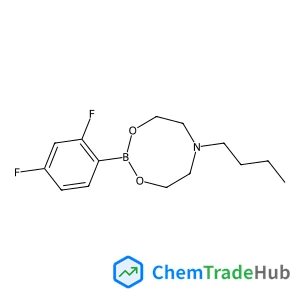
6-Butyl-2-(2,4-difluorophenyl)-1,3,6,2-dioxazaborocane
CAS Number:
1190988-98-7
Molecular Formula:
C14H20BF2NO2
![4-{[4-(Trifluoromethoxy)benzyl]oxy}benzonitrile structure](https://static.chemtradehub.com/structs/103/1036629-63-6-2172.webp "4-{[4-(Trifluoromethoxy)benzyl]oxy}benzonitrile structure")
4-{[4-(Trifluoromethoxy)benzyl]oxy}benzonitrile
CAS Number:
1036629-63-6
Molecular Formula:
C15H10F3NO2

![(3-{[4-(Aminomethyl)-6-(trifluoromethyl)-2-pyridinyl]oxy}phenyl)[(3R,4R)-3-fluoro-4-hydroxy-1-pyrrolidinyl]methanone structure](https://static.chemtradehub.com/structs/200/2007885-39-2-affc.webp "(3-{[4-(Aminomethyl)-6-(trifluoromethyl)-2-pyridinyl]oxy}phenyl)[(3R,4R)-3-fluoro-4-hydroxy-1-pyrrolidinyl]methanone structure")
(3-{[4-(Aminomethyl)-6-(trifluoromethyl)-2-pyridinyl]oxy}phenyl)[(3R,4R)-3-fluoro-4-hydroxy-1-pyrrolidinyl]methanone
CAS Number:
2007885-39-2
Molecular Formula:
C18H17F4N3O3
Recommended Suppliers





Disclaimer
This page provides academic journal information for reference and research purposes only. We are not affiliated with any journal publishers and do not handle publication submissions. For publication-related inquiries, please contact the respective journal publishers directly.
If you notice any inaccuracies in the information displayed, please contact us at support@chemtradehub.com. We will promptly review and address your concerns.