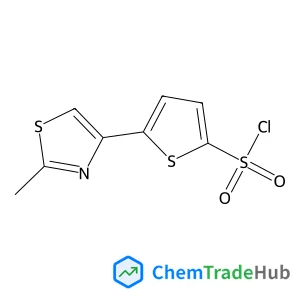
5-(2-Methyl-1,3-thiazol-4-yl)-2-thiophenesulfonyl chloride
CAS Number:
215434-25-6
Molecular Formula:
C8H6ClNO2S3
Ze Yang, Juan Xiao, Jia-Yun Wan, Zhong-Guo Liu, Ting-Ting Cao, Wen-Jie Zhang, Hang-Xing Wang
Low-dimensional carbon nanocomposite-based architectures and anchoring zero-dimensional carbon dots on two-dimensional graphene sheets may provide an important approach to develop energy harvesting and conversion strategies. In this work, as a novel photoelectrode with a high photocurrent response performance based on a composite made with all carbon-based materials consisting of p-type graphene oxide (GO) and n-type nitrogen, sulfur co-doped carbon dot (NS-CD) has been prepared via the electrophoretic deposition approach. The photoelectrochemical measurement shows that the GO/NS-CD composite greatly suppresses the charge recombination and evidently enhances the photocurrent response activity. It is anticipated that this work may pave a valuable step for the further development of all carbon-based optoelectronic devices with excellent performance.

Bioorganic & Medicinal Chemistry Letters

Journal of Chemical Sciences

Acta Metallurgica Sinica-English Letters

Chinese Journal of Chemistry

Colloid Journal

NDT & E International

Biocatalysis and Biotransformation

Critical Reviews in Solid State and Materials Sciences

Bioorganic & Medicinal Chemistry

Main Group Chemistry
H. Ratni, K. Baumann, P. Bellotti, X. A. Cook, L. G. Green, T. Luebbers, M. Reutlinger, A. F. Stepan, W. Vifian
DOI: 10.1039/D1MD00043H
Nattawadee Panyain, Aurélien Godinat, Aditya Raymond Thawani, Sofía Lachiondo-Ortega, Katie Mason, Sarah Elkhalifa, Lisa M. Smith, Jeanine A. Harrigan
DOI: 10.1039/D1MD00218J
Charlotte U. Jansen, Jesper Uhd, Jens B. Andersen, Louise D. Hultqvist, Tim H. Jakobsen, Martin Nilsson, Michael Givskov, Tim Tolker-Nielsen, Katrine M. Qvortrup
DOI: 10.1039/D1MD00275A
Jeffrey D. St. Denis, Richard J. Hall, Christopher W. Murray, Tom D. Heightman, David C. Rees
DOI: 10.1039/D0MD00375A
Kyeonghwan Kim, Jeong Hwa Lee, Sunmi Kim, Songmin Lee, Donghee Lee, Hye Yun Kim, Ikyon Kim, YoungSoo Kim
DOI: 10.1039/D1MD00030F
Hyunsoo Kim, Yoon Soo Hwang, Mingi Kim
DOI: 10.1039/D1MD00068C
Zhichang Zhao, Yeming Wang, Hong Yan, Juan Wang
DOI: 10.1039/D1MD00128K
Waste containing 6-Chloro-5-(2'-hydroxy-3'-methoxy-4-biphenylyl)-3-(3-methoxyphe...
(3alpha,5alpha)-3-Hydroxypregnane-11,20-dione is primarily used in the pharmaceu...
The market for 4-Amino-6-chloro-2-pyridinecarboxylic acid (CAS: 546141-56-4) is ...
Alternatives to (2-Benzoylethyl)trimethylammonium chloride (CAS: 24472-88-6) in ...
N-[4-Nitro-3-(trifluoromethyl)phenyl]acetamide (CAS: 393-12-4) is generally safe...
Alternative reagents such as other phosphates or similar functional groups can b...
There are alternatives to N,N'-Bis(3-aminopropyl)-1,3-propanediamine (CAS: 4605-...
When handling Aluminium trihexadecanoate, it is important to use appropriate per...
(1,1-Dioxido-3-oxo-1,2-benzothiazol-2(3H)-yl)acetic acid is a chemical compound ...
Several alternatives to 5,5-dimethyloxolan-2-one (CAS: 3123-97-5) can be used in...

Physical Chemistry Chemical Physics (PCCP) is an international journal co-owned by 19 physical chemistry and physics societies from around the world. This journal publishes original, cutting-edge research in physical chemistry, chemical physics and biophysical chemistry. To be suitable for publication in PCCP, articles must include significant innovation and/or insight into physical chemistry; this is the most important criterion that reviewers and Editors will judge against when evaluating submissions. The journal has a broad scope and welcomes contributions spanning experiment, theory, computation and data science. Topical coverage includes spectroscopy, dynamics, kinetics, statistical mechanics, thermodynamics, electrochemistry, catalysis, surface science, quantum mechanics, quantum computing and machine learning. Interdisciplinary research areas such as polymers and soft matter, materials, nanoscience, energy, surfaces/interfaces, and biophysical chemistry are welcomed if they demonstrate significant innovation and/or insight into physical chemistry. Joined experimental/theoretical studies are particularly appreciated when complementary and based on up-to-date approaches.
![2-Methyl-2-propanyl [2-(2-oxa-6-azaspiro[3.3]hept-6-yl)ethyl]carbamate structure](https://static.chemtradehub.com/structs/141/1415562-38-7-c0a4.webp "2-Methyl-2-propanyl [2-(2-oxa-6-azaspiro[3.3]hept-6-yl)ethyl]carbamate structure")
![Benzyl 2-{[(tert-butoxy)carbonyl]amino}acetate structure](https://static.chemtradehub.com/structs/542/54244-69-8-6399.webp "Benzyl 2-{[(tert-butoxy)carbonyl]amino}acetate structure")