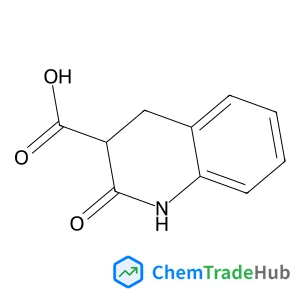
2-Oxo-1,2,3,4-tetrahydro-3-quinolinecarboxylic acid
CAS Number:
246867-17-4
Molecular Formula:
C10H9NO3
K. Koyasu, T. Ohtaki, J. Bing, K. Takahashi, F. Misaizu
We have studied reactions between linear Cn+ (n = 4–9) and D2, using ion mobility mass spectrometry techniques and quantum chemical calculations in order to understand the complex reactivity of the linear cluster cations. Only linear CnD+ products were observed for the odd (n = 5, 7, 9) linear clusters, while CnD2+ was the main product for the even clusters. For the reaction rate constants determined for these two channels, we obtained the following two features: (1) the rate constant decreases with the size n, and (2) even-sized clusters have lower rate constants than neighboring odd-sized clusters. In the theoretical calculations using the CCSD(T) and B3LYP methods with the cc-pVTZ basis, we found that a low lying 2Σ state in odd clusters may play an important role in these reactions. This opposes the previous interpretation that the 2Πg/u state is the dominant electronic state for linear Cn+ (n = 4–9) clusters. We showed that a barrierless radical abstraction forming CnD+ occurs through a direct head on approach for the 2Σ state Cn+. In contrast, a carbene-like insertion forming CnD2+ occurs through a sideways approach for the 2Πg/u state Cn+. We have concluded that the higher rate constants for the odd clusters come from the existence of symmetry broken 2Σ states which are absent in even linear clusters.
Daeseob Shim, Seung-Ho Jung, Eun-Ha Kim, Dong-Myung Yoon, Kun-Hong Lee, Soo-Hwan Jeong
DOI: 10.1039/B816534C
Xianbing Ke, Hao Hu, Keda Zhang, Wenjin Xu, Qifeng Zhu, Lamei Wu, Xianming Hu
DOI: 10.1039/B817910G
Aaron E. Engelhart, Thomas Hellman Morton, Nicholas V. Hud
DOI: 10.1039/B818409G
Piotr Michal Diakowski, Heinz-Bernhard Kraatz
DOI: 10.1039/B819876D
Zuofeng Chen, Keith Man-Chung Wong, Vonika Ka-Man Au, Yanbing Zu, Vivian Wing-Wah Yam
DOI: 10.1039/B820400D
Suzanne E. Howson, Laura E. N. Allan, Nikola P. Chmel, Guy J. Clarkson, Remy van Gorkum, Peter Scott
DOI: 10.1039/B821573A
Teruyasu Yamamoto
DOI: 10.1039/B818792D
Dae-Wi Yoon, Dustin E. Gross, Vincent M. Lynch, Chang-Hee Lee, Philip C. Bennett, Jonathan L. Sessler
DOI: 10.1039/B818077F
Daniela Pucci, Iolinda Aiello, Alessia Aprea, Anna Bellusci, Alessandra Crispini, Mauro Ghedini
DOI: 10.1039/B818603K
When handling 2-Methyl-2-propanyl 5-amino-2-thiophenecarboxylate (CAS: 1498311-5...
5-Bromo-1,2-dichloro-3-fluorobenzene (CAS: 1000572-93-9) is a crystalline solid ...
(2R)-2-Amino-2-(4-bromophenyl)ethanol (CAS: 354153-64-3) should be stored in a c...
Methyl 4-(aminomethyl)tetrahydro-2H-pyran-4-carboxylate hydrochloride (CAS: 3627...
1,4-Dimethyl-1H-pyrazole-5-sulfonyl chloride is primarily used as an intermediat...
Dinaphtho[1,2-b:2',1'-d]furan is generally safe when handled with appropriate pe...
The market for 7-Methyl-7,9-dihydro-1H-purine-2,6,8(3H)-trione (CAS: 612-37-3) i...
2-(4-Chlorophenyl)malonaldehyde (CAS: 205676-17-1) is a colorless or light yello...
2-Methylchrysene (CAS: 3351-32-4) is typically synthesized via the reaction of c...
N-(6-aminopyrimidin-4-yl)acetamide (CAS: 89533-23-3) is generally considered saf...

Physical Chemistry Chemical Physics (PCCP) is an international journal co-owned by 19 physical chemistry and physics societies from around the world. This journal publishes original, cutting-edge research in physical chemistry, chemical physics and biophysical chemistry. To be suitable for publication in PCCP, articles must include significant innovation and/or insight into physical chemistry; this is the most important criterion that reviewers and Editors will judge against when evaluating submissions. The journal has a broad scope and welcomes contributions spanning experiment, theory, computation and data science. Topical coverage includes spectroscopy, dynamics, kinetics, statistical mechanics, thermodynamics, electrochemistry, catalysis, surface science, quantum mechanics, quantum computing and machine learning. Interdisciplinary research areas such as polymers and soft matter, materials, nanoscience, energy, surfaces/interfaces, and biophysical chemistry are welcomed if they demonstrate significant innovation and/or insight into physical chemistry. Joined experimental/theoretical studies are particularly appreciated when complementary and based on up-to-date approaches.
methyl]-N,2-dimethyl-2-propanesulfinamide structure](https://static.chemtradehub.com/structs/256/2565792-50-7-8a26.webp "N-[(R)-[3-(Benzyloxy)-2-(dicyclohexylphosphino)phenyl](phenyl)methyl]-N,2-dimethyl-2-propanesulfinamide structure")