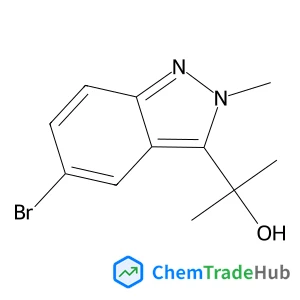
2-(5-Bromo-2-methyl-2H-indazol-3-yl)-2-propanol
CAS Number:
1823787-20-7
Molecular Formula:
C11H13BrN2O
Hui Pan
Nanostructures have attracted increasing interest for applications in electrolysis of water as electrocatalysts. In this work, the edge-catalytic effects of one dimensional (1D) VS2 nanoribbons with various edge configurations and widths have been investigated based on first-principles calculations. We show that the catalytic ability of VS2 nanoribbons strongly depends on their edge structure, edge configuration, and width. We find that the S-edges of VS2 nanoribbons are more active in electrolysis of water than V-edges due to their optimal Gibbs free energy for hydrogen evolution reaction in a wider range of hydrogen coverages. We also find that narrow nanoribbons show better catalytic performance than their wide counterparts. We further show that the S-edge of narrow VS2 nanoribbons with their V-edge covered by eight sulfur atoms has near-zero Gibbs free energy of hydrogen adsorption and comparable catalytic performance with Pt to a wide range of hydrogen coverage, which is contributed to its metallic characteristic. We expect that VS2 nanoribbons would be a promising 1D catalyst in electrolysis of water because of their impressive catalytic abilities both on the basal planes and edges.
Leonard Gura, Zechao Yang, Joachim Paier, Florian Kalaß, Matthias Brinker, Heinz Junkes, Markus Heyde, Hans-Joachim Freund
DOI: 10.1039/D2CP02363F
Branislav Milovanović, Mihajlo Etinski, Wolfgang Domcke, Nađa Došlić
DOI: 10.1039/D2CP00495J
Wei-Hai Fang
DOI: 10.1039/D2CP02016E
João R. C. Costa, Joana R. Góis, José R. Fernandes, Krzysztof Matyjaszewski, Jorge F. J. Coelho, Arménio C. Serra
DOI: 10.1039/D1PY01356D
José Campos-Martínez, Massimiliano Bartolomei, Fernando Pirani, Marta I. Hernández
DOI: 10.1039/D2CP01044E
Giovanna Bruno, Bernardo de Souza, Frank Neese
DOI: 10.1039/D2CP01623K
Xiaoyu Zhao, Danyang Xiong, Song Luo, Lili Duan
DOI: 10.1039/D2CP01780F
Ilya E. Kolesnikov, Daria V. Mamonova, Mikhail A. Kurochkin, Vassily A. Medvedev, Gongxun Bai, Tatiana Yu. Ivanova, Evgenii V. Borisov, Evgenii Yu. Kolesnikov
DOI: 10.1039/D2CP01543A
When handling 2-Methyl-2-propanyl 5-amino-2-thiophenecarboxylate (CAS: 1498311-5...
5-Bromo-1,2-dichloro-3-fluorobenzene (CAS: 1000572-93-9) is a crystalline solid ...
(2R)-2-Amino-2-(4-bromophenyl)ethanol (CAS: 354153-64-3) should be stored in a c...
Methyl 4-(aminomethyl)tetrahydro-2H-pyran-4-carboxylate hydrochloride (CAS: 3627...
1,4-Dimethyl-1H-pyrazole-5-sulfonyl chloride is primarily used as an intermediat...
Dinaphtho[1,2-b:2',1'-d]furan is generally safe when handled with appropriate pe...
The market for 7-Methyl-7,9-dihydro-1H-purine-2,6,8(3H)-trione (CAS: 612-37-3) i...
2-(4-Chlorophenyl)malonaldehyde (CAS: 205676-17-1) is a colorless or light yello...
2-Methylchrysene (CAS: 3351-32-4) is typically synthesized via the reaction of c...
N-(6-aminopyrimidin-4-yl)acetamide (CAS: 89533-23-3) is generally considered saf...

Physical Chemistry Chemical Physics (PCCP) is an international journal co-owned by 19 physical chemistry and physics societies from around the world. This journal publishes original, cutting-edge research in physical chemistry, chemical physics and biophysical chemistry. To be suitable for publication in PCCP, articles must include significant innovation and/or insight into physical chemistry; this is the most important criterion that reviewers and Editors will judge against when evaluating submissions. The journal has a broad scope and welcomes contributions spanning experiment, theory, computation and data science. Topical coverage includes spectroscopy, dynamics, kinetics, statistical mechanics, thermodynamics, electrochemistry, catalysis, surface science, quantum mechanics, quantum computing and machine learning. Interdisciplinary research areas such as polymers and soft matter, materials, nanoscience, energy, surfaces/interfaces, and biophysical chemistry are welcomed if they demonstrate significant innovation and/or insight into physical chemistry. Joined experimental/theoretical studies are particularly appreciated when complementary and based on up-to-date approaches.
![L-Lysine,N6-[2-[[(1,1-dimethylethoxy)carbonyl]amino]benzoyl]-N2-[(9H-fluoren-9-ylmethoxy)carbonyl]- structure](https://static.chemtradehub.com/structs/159/159322-59-5-c046.webp "L-Lysine,N6-[2-[[(1,1-dimethylethoxy)carbonyl]amino]benzoyl]-N2-[(9H-fluoren-9-ylmethoxy)carbonyl]- structure")