












Molecular hydrogen isotope separation by a graphdiyne membrane: a quantum-mechanical study
Literature Information
Publication Date
2022-06-13
DOI
10.1039/D2CP01044E
Impact Factor
3.676
Authors
José Campos-Martínez, Massimiliano Bartolomei, Fernando Pirani, Marta I. Hernández
View Original
Abstract
Graphdiyne (GDY) has emerged as a very promising two-dimensional (2D) membrane for gas separation technologies. One of the most challenging goals is the separation of deuterium (D2) and tritium (T2) from a mixture with the most abundant hydrogen isotope, H2, an achievement that would be of great value for a number of industrial and scientific applications. In this work we study the separation of hydrogen isotopes in their transport through a GDY membrane due to mass-dependent quantum effects that are enhanced by the confinement provided by its intrinsic sub-nanometric pores. A reliable improved Lennard-Jones force field, optimized on accurate ab initio calculations, has been built to describe the molecule–membrane interaction, where the molecule is treated as a pseudoatom. The quantum dynamics of the molecules impacting on the membrane along a complete set of incidence directions have been rigorously addressed by means of wave packet calculations in the 3D space, which have allowed us to obtain transmission probabilities and, in turn, permeances, as the thermal average of the molecular flux per unit pressure. The effect of the different incidence directions on the probabilities is analyzed in detail and it is concluded that restricting the simulations to a perpendicular incidence leads to reasonable results. Moreover, it is found that a simple 1D model—using a zero-point energy-corrected interaction potential—provides an excellent agreement with the 3D probailities for perpendicular incidence conditions. Finally, D2/H2 and T2/H2 selectivities are found to reach maximum values of about 6 and 21 at ≈50 and 45 K, respectively, a feature due to a balance between zero-point energy and tunneling effects in the transport dynamics. Permeances at these temperatures are below recommended values for practical applications, however, at slightly higher temperatures (77 K) they become acceptable while the selectivities preserve promising values, particularly for the separation of tritium.
Related Literature
Multiply reconfigurable ‘plug and play’ molecular logic via self-assembly
A. Prasanna de Silva, Catherine M. Dobbin, Thomas P. Vance
2009-02-11
Communication
DOI: 10.1039/B822181B
A double cubane structure in organoplatinum(iv) chemistry
Muhieddine S. Safa, Michael C. Jennings, Richard J. Puddephatt
2009-02-18
Communication
DOI: 10.1039/B822683K
Evidence of strong hydrogen bonding by 8-aminoguanine
Aaron E. Engelhart, Thomas Hellman Morton, Nicholas V. Hud
2008-12-01
Communication
DOI: 10.1039/B818409G
Degradable dendrimers divergently synthesized via click chemistry
Richie E. Kohman, Steven C. Zimmerman
2009-01-13
Communication
DOI: 10.1039/B818183G
Exploring the limits of encapsulation within hexameric pyrogallol[4]arene nano-capsules‡
Tamas Szabo, Ali Siavosh-Haghighi, Carol A. Deakyne, John E. Adams, Jerry L. Atwood
2009-01-09
Communication
DOI: 10.1039/B819276F
Dye displacement assay for saccharide detection with boronate hydrogels‡
Winson M. J. Ma, Marta P. Pereira Morais, François D’Hooge, Jean M. H. van den Elsen, Jonathan P. L. Cox, Tony D. James, John S. Fossey
2008-12-19
Communication
DOI: 10.1039/B814379J
Glucose sensing via polyanion formation and induced pyrene excimer emission
Cong Yu, Vivian Wing-Wah Yam
2009-02-10
Communication
DOI: 10.1039/B820397K
You might also like
Compound Q&A
What precautions should be taken when handling 2-Methyl-2-propanyl 5-amino-2-thiophenecarboxylate (CAS: 1498311-57-1)?
When handling 2-Methyl-2-propanyl 5-amino-2-thiophenecarboxylate (CAS: 1498311-5...
1498311-57-12-Methyl-2-propanyl ...
Compound Q&A
What are the physical and chemical properties of 5-Bromo-1,2-dichloro-3-fluorobenzene (CAS: 1000572-93-9)?
5-Bromo-1,2-dichloro-3-fluorobenzene (CAS: 1000572-93-9) is a crystalline solid ...
1000572-93-95-Bromo-1,2-dichloro...
Compound Q&A
How should (2R)-2-Amino-2-(4-bromophenyl)ethanol (CAS: 354153-64-3) be stored?
(2R)-2-Amino-2-(4-bromophenyl)ethanol (CAS: 354153-64-3) should be stored in a c...
354153-64-3(2R)-2-Amino-2-(4-br...
Compound Q&A
What regulatory guidelines apply to Methyl 4-(aminomethyl)tetrahydro-2H-pyran-4-carboxylate hydrochloride (CAS: 362707-24-2)?
Methyl 4-(aminomethyl)tetrahydro-2H-pyran-4-carboxylate hydrochloride (CAS: 3627...
362707-24-2Methyl 4-(aminomethy...
Compound Q&A
What are the main uses of 1,4-dimethyl-1H-pyrazole-5-sulfonyl chloride (CAS: 1174834-52-6)?
1,4-Dimethyl-1H-pyrazole-5-sulfonyl chloride is primarily used as an intermediat...
1174834-52-61,4-dimethyl-1H-pyra...
Compound Q&A
Is Dinaphtho[1,2-b:2',1'-d]furan (CAS: 239-69-0) safe?
Dinaphtho[1,2-b:2',1'-d]furan is generally safe when handled with appropriate pe...
239-69-0Dinaphtho[1,2-b:2',1...
Compound Q&A
What is the market or research trend for 7-Methyl-7,9-dihydro-1H-purine-2,6,8(3H)-trione (CAS: 612-37-3)?
The market for 7-Methyl-7,9-dihydro-1H-purine-2,6,8(3H)-trione (CAS: 612-37-3) i...
612-37-37-Methyl-7,9-dihydro...
Compound Q&A
What are the physical and chemical properties of 2-(4-Chlorophenyl)malonaldehyde (CAS: 205676-17-1)?
2-(4-Chlorophenyl)malonaldehyde (CAS: 205676-17-1) is a colorless or light yello...
205676-17-12-(4-Chlorophenyl)ma...
Compound Q&A
How is 2-Methylchrysene (CAS: 3351-32-4) typically synthesized?
2-Methylchrysene (CAS: 3351-32-4) is typically synthesized via the reaction of c...
3351-32-42-Methylchrysene
Compound Q&A
Is N-(6-aminopyrimidin-4-yl)acetamide (CAS: 89533-23-3) safe?
N-(6-aminopyrimidin-4-yl)acetamide (CAS: 89533-23-3) is generally considered saf...
89533-23-3N-(6-aminopyrimidin-...
Source Journal
Physical Chemistry Chemical Physics

CiteScore:
5.5
Self-citation Rate:
10.3%
Articles per Year:
3036
Physical Chemistry Chemical Physics (PCCP) is an international journal co-owned by 19 physical chemistry and physics societies from around the world. This journal publishes original, cutting-edge research in physical chemistry, chemical physics and biophysical chemistry. To be suitable for publication in PCCP, articles must include significant innovation and/or insight into physical chemistry; this is the most important criterion that reviewers and Editors will judge against when evaluating submissions. The journal has a broad scope and welcomes contributions spanning experiment, theory, computation and data science. Topical coverage includes spectroscopy, dynamics, kinetics, statistical mechanics, thermodynamics, electrochemistry, catalysis, surface science, quantum mechanics, quantum computing and machine learning. Interdisciplinary research areas such as polymers and soft matter, materials, nanoscience, energy, surfaces/interfaces, and biophysical chemistry are welcomed if they demonstrate significant innovation and/or insight into physical chemistry. Joined experimental/theoretical studies are particularly appreciated when complementary and based on up-to-date approaches.
Recommended Compounds
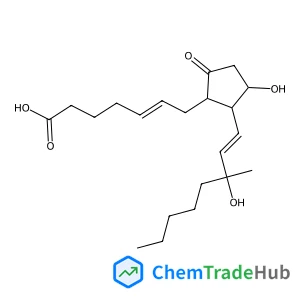
(5Z,11alpha,13E,15R)-11,15-Dihydroxy-15-methyl-9-oxoprosta-5,13-dien-1-oic acid
CAS Number:
55028-70-1
Molecular Formula:
C21H34O5
Recommended Suppliers






Disclaimer
This page provides academic journal information for reference and research purposes only. We are not affiliated with any journal publishers and do not handle publication submissions. For publication-related inquiries, please contact the respective journal publishers directly.
If you notice any inaccuracies in the information displayed, please contact us at support@chemtradehub.com. We will promptly review and address your concerns.