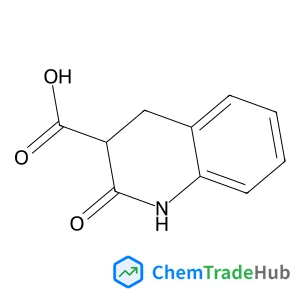
2-Oxo-1,2,3,4-tetrahydro-3-quinolinecarboxylic acid
CAS Number:
246867-17-4
Molecular Formula:
C10H9NO3
Branislav Milovanović, Mihajlo Etinski, Wolfgang Domcke, Nađa Došlić
UV irradiation of RNA leads to the formation of intra- and inter-strand crosslinks of cyclobutane type. Despite the importance of this reaction, relatively little is known about how the mutual orientation of the two bases affects the outcome of the reaction. Here we report a comparative nonadiabatic molecular dynamics study of face-to-back (F2B) and face-to-face (F2F) stacked uracil-water clusters. The computations were performed using the second-order algebraic-diagrammatic-construction (ADC(2)) method. We found that F2B stacked uracil-water clusters either relax non-reactively to the ground state by an ethylenic twist around the CC bond or remain in the lowest nπ* state in which the two bases gradually move away from each other. This finding is consistent with the low propensity for the formation of intra-strand cyclobutane dimers between adjacent RNA bases. On the contrary, in F2F stacked uracil-water clusters, in addition to non-reactive deactivation, we found a pro-reactive deactivation pathway, which may lead to the formation of cyclobutane uracil dimers in the electronic ground state. On a qualitative level, the observed photodynamics of F2F stacked uracil-water clusters explains the greater propensity of RNA to form inter-strand cyclobutane-type crosslinks.
Dhilon S. Patel, Prasad V. Bharatam
DOI: 10.1039/B816595E
Kristopher A. Kilian, Till Böcking, J. Justin Gooding
DOI: 10.1039/B815449J
Karolina Kasperkiewicz, Jan-Willem G. Bos, Andrew N. Fitch, Kosmas Prassides, Serena Margadonna
DOI: 10.1039/B815830D
Ömer Reis, Serkan Eymur, Barbaros Reis, Ayhan S. Demir
DOI: 10.1039/B817474A
Ritu Kataky, Paula Lopes
DOI: 10.1039/B822685G
Bashir Hussain, Didier Savard, Tara J. Burchell, Wolfgang Wernsdorfer, Muralee Murugesu
DOI: 10.1039/B818295G
Winson M. J. Ma, Marta P. Pereira Morais, François D’Hooge, Jean M. H. van den Elsen, Jonathan P. L. Cox, Tony D. James, John S. Fossey
DOI: 10.1039/B814379J
Jianwei Fu, Xiaobin Huang, Yawen Huang, Jiawei Zhang, Xiaozhen Tang
DOI: 10.1039/B818071G
When handling 2-Methyl-2-propanyl 5-amino-2-thiophenecarboxylate (CAS: 1498311-5...
5-Bromo-1,2-dichloro-3-fluorobenzene (CAS: 1000572-93-9) is a crystalline solid ...
(2R)-2-Amino-2-(4-bromophenyl)ethanol (CAS: 354153-64-3) should be stored in a c...
Methyl 4-(aminomethyl)tetrahydro-2H-pyran-4-carboxylate hydrochloride (CAS: 3627...
1,4-Dimethyl-1H-pyrazole-5-sulfonyl chloride is primarily used as an intermediat...
Dinaphtho[1,2-b:2',1'-d]furan is generally safe when handled with appropriate pe...
The market for 7-Methyl-7,9-dihydro-1H-purine-2,6,8(3H)-trione (CAS: 612-37-3) i...
2-(4-Chlorophenyl)malonaldehyde (CAS: 205676-17-1) is a colorless or light yello...
2-Methylchrysene (CAS: 3351-32-4) is typically synthesized via the reaction of c...
N-(6-aminopyrimidin-4-yl)acetamide (CAS: 89533-23-3) is generally considered saf...

Physical Chemistry Chemical Physics (PCCP) is an international journal co-owned by 19 physical chemistry and physics societies from around the world. This journal publishes original, cutting-edge research in physical chemistry, chemical physics and biophysical chemistry. To be suitable for publication in PCCP, articles must include significant innovation and/or insight into physical chemistry; this is the most important criterion that reviewers and Editors will judge against when evaluating submissions. The journal has a broad scope and welcomes contributions spanning experiment, theory, computation and data science. Topical coverage includes spectroscopy, dynamics, kinetics, statistical mechanics, thermodynamics, electrochemistry, catalysis, surface science, quantum mechanics, quantum computing and machine learning. Interdisciplinary research areas such as polymers and soft matter, materials, nanoscience, energy, surfaces/interfaces, and biophysical chemistry are welcomed if they demonstrate significant innovation and/or insight into physical chemistry. Joined experimental/theoretical studies are particularly appreciated when complementary and based on up-to-date approaches.