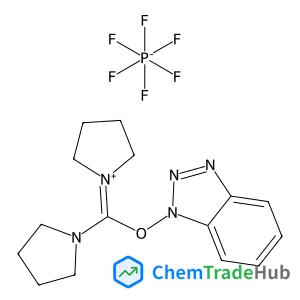
(1H-Benzotriazol-1-yloxy)(di-1-pyrrolidinyl)methylium hexafluorophosphate
CAS Number:
105379-24-6
Molecular Formula:
C15H21F6N5OP
Teng Zhang, Monica Marinescu, Laura O'Neill, Mark Wild, Gregory Offer
Understanding of the complex electrochemical, transport, and phase-change phenomena in Li–S cells requires experimental characterization in tandem with mechanistic modeling. However, existing Li–S models currently contradict some key features of experimental findings, particularly the evolution of cell resistance during discharge. We demonstrate that, by introducing a concentration-dependent electrolyte conductivity, the correct trends in voltage drop due to electrolyte resistance and activation overpotentials are retrieved. In addition, we reveal the existence of an often overlooked potential drop mechanism in the low voltage-plateau which originates from the limited rate of Li2S precipitation.

Bioorganic & Medicinal Chemistry

Journal of Asian Natural Products Research

Atomization and Sprays

NDT & E International

Critical Reviews in Solid State and Materials Sciences

Heteroatom Chemistry

Journal of the Indian Institute of Science

Herald of the Russian Academy of Sciences

Acta Metallurgica Sinica-English Letters

Medicinal Chemistry Research
Kees-Jan Weststrate, Ludo Juurlink
DOI: 10.1039/C3CP44503H
Giancarlo Cicero, Bruno Camino, Stefano Bianco, Anna Maria Ferrari, Barbara Ballarin, Claudia Barolo
DOI: 10.1039/C3CP50559F
Jan-Michael Mewes, Andreas Dreuw
DOI: 10.1039/C3CP44338H
Qing Jie, Hengzhi Wang, Weishu Liu, Hui Wang, Gang Chen, Zhifeng Ren
DOI: 10.1039/C3CP50327E
Yuuki Mogami, Yasuto Noda, Hiroto Ishikawa, K. Takegoshi
DOI: 10.1039/C3CP43778G
Guilherme Oliveira Siqueira, Tulio Matencio, Herculano Vieira da Silva, Yara Gonçalves de Souza, José Domingos Ardisson, Geraldo Magela de Lima, Arilza de Oliveira Porto
DOI: 10.1039/C3CP50549A
Alexei Bagrets
DOI: 10.1039/C3CP44286A
Yeru Liu, James Robert Jennings, Xingzhu Wang, Qing Wang
DOI: 10.1039/C3CP50998B
Kai Welke, Hiroshi C. Watanabe, Tino Wolter, Marcus Elstner
DOI: 10.1039/C3CP44181D
When handling 4-(2-Furylmethyl)thiomorpholine 1,1-dioxide (CAS: 79206-94-3), it ...
When handling 4-Chloro-N-[2-(4-morpholinyl)ethyl]benzamide (CAS: 71320-77-9), it...
Waste containing this compound (CAS: 62921-74-8) should be handled according to ...
Waste containing (S)-Methyl 2-amino-3-cyclohexylpropanoate should be collected i...
This compound can be synthesized using a multi-step process involving the conjug...
There are several alternatives to (2E)-3-(3,4-Dichlorophenyl)acrylic acid in syn...
Ethyl 6-(2-nitrophenyl)imidazo[2,1-b][1,3]thiazole-3-carboxylate (CAS: 925437-84...
Waste containing 2-(1,3-Thiazol-2-yl)ethanamine (CAS: 18453-07-1) should be coll...
Methyl 5-iodo-2-methylbenzoate can be synthesized through the iodination of meth...
5-Chloro[1,2,4]triazolo[1,5-a]pyridine is commonly synthesized via the condensat...

Physical Chemistry Chemical Physics (PCCP) is an international journal co-owned by 19 physical chemistry and physics societies from around the world. This journal publishes original, cutting-edge research in physical chemistry, chemical physics and biophysical chemistry. To be suitable for publication in PCCP, articles must include significant innovation and/or insight into physical chemistry; this is the most important criterion that reviewers and Editors will judge against when evaluating submissions. The journal has a broad scope and welcomes contributions spanning experiment, theory, computation and data science. Topical coverage includes spectroscopy, dynamics, kinetics, statistical mechanics, thermodynamics, electrochemistry, catalysis, surface science, quantum mechanics, quantum computing and machine learning. Interdisciplinary research areas such as polymers and soft matter, materials, nanoscience, energy, surfaces/interfaces, and biophysical chemistry are welcomed if they demonstrate significant innovation and/or insight into physical chemistry. Joined experimental/theoretical studies are particularly appreciated when complementary and based on up-to-date approaches.