












From crystal to glass-like thermal conductivity in crystalline minerals
Literature Information
Publication Date
2015-06-08
DOI
10.1039/C5CP02900G
Impact Factor
3.676
Authors
Y. Bouyrie, C. Candolfi, S. Pailhès, M. M. Koza, B. Malaman, A. Dauscher, J. Tobola, O. Boisron, L. Saviot, B. Lenoir
View Original
Abstract
The ability of some materials with a perfectly ordered crystal structure to mimic the heat conduction of amorphous solids is a remarkable physical property that finds applications in numerous areas of materials science, for example, in the search for more efficient thermoelectric materials that enable to directly convert heat into electricity. Here, we unveil the mechanism in which glass-like thermal conductivity emerges in tetrahedrites, a family of natural minerals extensively studied in geology and, more recently, in thermoelectricity. By investigating the lattice dynamics of two tetrahedrites of very close compositions (Cu12Sb2Te2S13 and Cu10Te4S13) but with opposite glasslike and crystal thermal transport by means of powder and single-crystal inelastic neutron scattering, we demonstrate that the former originates from the peculiar chemical environment of the copper atoms giving rise to a strongly anharmonic excess of vibrational states.
Related Literature
Effect of strain on the electronic and optical properties of Ge–Si dome shaped nanocrystals
Mahesh R. Neupane, Rajib Rahman, Roger K. Lake
2014-12-04
Paper
DOI: 10.1039/C4CP03711A
Atomic-scale models of early-stage alkali depletion and SiO2-rich gel formation in bioactive glasses
2014-12-11
Paper
DOI: 10.1039/C4CP04711G
Barium ferrite decorated reduced graphene oxide nanocomposite for effective electromagnetic interference shielding
Meenakshi Verma, Avanish Pratap Singh, Pradeep Sambyal, Bhanu Pratap Singh, S. K. Dhawan, Veena Choudhary
2014-11-12
Paper
DOI: 10.1039/C4CP04284K
Thermoelectric properties of a Mn substituted synthetic tetrahedrite
Raju Chetty, Prem Kumar D. S., Herwig Michor, Satyam Suwas, Stephan Puchegger, Gerald Giester, Ramesh Chandra Mallik
2014-12-02
Paper
DOI: 10.1039/C4CP04039B
Retarded dopant diffusion by moderated dopant–dopant interactions in Si nanowires
Jongseob Kim, Ki-Ha Hong
2014-11-21
Communication
DOI: 10.1039/C4CP04513K
Theoretical insight into hydrogen adsorption onto graphene: a first-principles B3LYP-D3 study
M. Darvish Ganji, S. M. Hosseini-khah, Z. Amini-tabar
2014-11-28
Paper
DOI: 10.1039/C4CP04399E
Oxygen adsorption onto pure and doped Al surfaces – the role of surface dopants
Cláudio M. Lousada, Pavel A. Korzhavyi
2014-12-02
Paper
DOI: 10.1039/C4CP04277H
Application of positron annihilation lifetime spectroscopy (PALS) to study the nanostructure in amphiphile self-assembly materials: phytantriol cubosomes and hexosomes
Celesta Fong, Lynne J. Waddington, Anita J. Hill
2014-12-02
Paper
DOI: 10.1039/C4CP04343J
Detecting free hemoglobin in blood plasma and serum with luminescent terbium complexes
Frank Morgner, Alexandre Lecointre, Loïc J. Charbonnière, Hans-Gerd Löhmannsröben
2014-11-24
Paper
DOI: 10.1039/C4CP04206A
Effective targeting of proton transfer at ground and excited states of ortho-(2′-imidazolyl)naphthol constitutional isomers
Thaís C. F. Oliveira, Luiz F. V. Carmo, Bárbara Murta, Luís G.T.A. Duarte, Rene A. Nome, Willian R. Rocha, Tiago A. S. Brandão
2014-12-09
Paper
DOI: 10.1039/C4CP04337E
You might also like
Compound Q&A
What are the main uses of (5-Sulfamoyl-3-pyridinyl)boronic acid (CAS: 951233-61-7)?
(5-Sulfamoyl-3-pyridinyl)boronic acid is primarily used in chemical synthesis, p...
951233-61-7(5-Sulfamoyl-3-pyrid...
Compound Q&A
How is Benzyl 2-methyl-2-(methylsulfonyl)-4-pentenoate (CAS: 1942858-50-5) typically synthesized?
Benzyl 2-methyl-2-(methylsulfonyl)-4-pentenoate is typically synthesized via est...
1942858-50-5Benzyl 2-methyl-2-(m...
Compound Q&A
What precautions should be taken when handling 8-Fluoroquinolin-6-ol (CAS: 209353-22-0)?
When handling 8-Fluoroquinolin-6-ol (CAS: 209353-22-0), it is important to use p...
209353-22-08-Fluoroquinolin-6-o...
Compound Q&A
What are the physical and chemical properties of 1,3-Dibromo-5-(2-methyl-2-propanyl)benzene (CAS: 129316-09-2)?
1,3-Dibromo-5-(2-methyl-2-propanyl)benzene (CAS: 129316-09-2) is a crystalline c...
129316-09-21,3-Dibromo-5-(2-met...
Compound Q&A
What industries use Ethyl 7-chloro-4-oxo-1-(1,3-thiazol-2-yl)-1,4-dihydro-1,8-naphthyridine-3-carboxylate (CAS: 174726-87-5)?
Ethyl 7-chloro-4-oxo-1-(1,3-thiazol-2-yl)-1,4-dihydro-1,8-naphthyridine-3-carbox...
174726-87-5Ethyl 7-chloro-4-oxo...
Compound Q&A
What precautions should be taken when handling Delta-7-Avenasterol (CAS: 23290-26-8)?
When handling Delta-7-Avenasterol (CAS: 23290-26-8), it is important to wear app...
23290-26-8Delta-7-Avenasterol
Compound Q&A
What precautions should be taken when handling N-({(5R)-3-[3-Fluoro-4-(4-morpholinyl)phenyl]-2-oxo-1,3-oxazolidin-5-yl}methyl)acetamide (CAS: 872992-20-6)?
Proper handling involves the use of personal protective equipment such as gloves...
872992-20-6N-({(5R)-3-[3-Fluoro...
Compound Q&A
What precautions should be taken when handling 2-Methyl-2-proanyl 4-[(2-aminophenyl)amino]-1-piperidinecarboxylate (CAS: 79099-00-6)?
When handling 2-Methyl-2-proanyl 4-[(2-aminophenyl)amino]-1-piperidinecarboxylat...
79099-00-62-Methyl-2-propanyl ...
Compound Q&A
What is N-Methyl-4-chlorobenzylamine hydrochloride (CAS: 65542-24-7)?
N-Methyl-4-chlorobenzylamine hydrochloride (CAS: 65542-24-7) is a organic compou...
65542-24-7N-Methyl-4-chloroben...
Compound Q&A
Is [2-(Dodecyloxy)ethoxy]acetic acid (CAS: 27306-90-7) safe?
[2-(Dodecyloxy)ethoxy]acetic acid (CAS: 27306-90-7) is generally considered safe...
27306-90-7[2-(Dodecyloxy)ethox...
Source Journal
Physical Chemistry Chemical Physics

CiteScore:
5.5
Self-citation Rate:
10.3%
Articles per Year:
3036
Physical Chemistry Chemical Physics (PCCP) is an international journal co-owned by 19 physical chemistry and physics societies from around the world. This journal publishes original, cutting-edge research in physical chemistry, chemical physics and biophysical chemistry. To be suitable for publication in PCCP, articles must include significant innovation and/or insight into physical chemistry; this is the most important criterion that reviewers and Editors will judge against when evaluating submissions. The journal has a broad scope and welcomes contributions spanning experiment, theory, computation and data science. Topical coverage includes spectroscopy, dynamics, kinetics, statistical mechanics, thermodynamics, electrochemistry, catalysis, surface science, quantum mechanics, quantum computing and machine learning. Interdisciplinary research areas such as polymers and soft matter, materials, nanoscience, energy, surfaces/interfaces, and biophysical chemistry are welcomed if they demonstrate significant innovation and/or insight into physical chemistry. Joined experimental/theoretical studies are particularly appreciated when complementary and based on up-to-date approaches.
Recommended Compounds
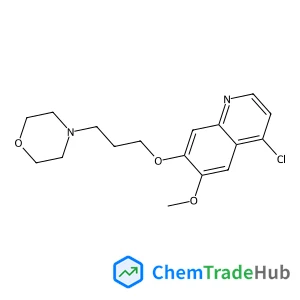
4-(3-((4-Chloro-6-methoxyquinolin-7-yl)oxy)propyl)morpholine
CAS Number:
205448-32-4
Molecular Formula:
C17H21ClN2O3
Recommended Suppliers






Disclaimer
This page provides academic journal information for reference and research purposes only. We are not affiliated with any journal publishers and do not handle publication submissions. For publication-related inquiries, please contact the respective journal publishers directly.
If you notice any inaccuracies in the information displayed, please contact us at support@chemtradehub.com. We will promptly review and address your concerns.