











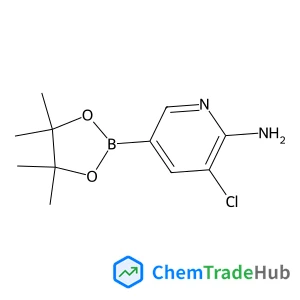
3-Chloro-5-(4,4,5,5-tetramethyl-1,3,2-dioxaborolan-2-yl)-2-pyridinamine
CAS Number:
1032758-99-8
Molecular Formula:
C11H16BClN2O2
HyukSu Han, Pascal Dufour, Sungwook Mhin, Jeong Ho Ryu, Christophe Tenailleau, Sophie Guillemet-Fritsch
Nb and In co-doped rutile TiO2 nanoceramics (n-NITO) were successfully synthesized through a chemical-solution route combined with a low temperature spark plasma sintering (SPS) technique. The particle morphology and the microstructure of n-NITO compounds were nanometric in size. Various techniques such as X-ray diffraction (XRD), X-ray photoelectron spectroscopy (XPS), thermogravimetric (TG)/differential thermal analysis (DTA), Fourier transform infrared (FTIR), and Raman spectroscopy were used for the structural and compositional characterization of the synthesized compound. The results indicated that the as-synthesized n-NITO oxalate as well as sintered ceramic have a co-doped single phase of titanyl oxalate and rutile TiO2, respectively. Broadband impedance spectroscopy revealed that novel colossal permittivity (CP) was achieved in n-NITO ceramics exhibiting excellent temperature-frequency stable CP (up to 104) as well as low dielectric loss (∼5%). Most importantly, detailed impedance data analyses of n-NITO compared to microcrystalline NITO (μ-NITO) demonstrated that the origin of CP in NITO bulk nanoceramics might be related with the pinned electrons in defect clusters and not to extrinsic interfacial effects.
Yangyang Ren
DOI: 10.1039/D2PY00395C
Xian-Chao Jin, Bai-Hao Ren, Ge-Ge Gu, Tian-Jun Yue, Wei-Min Ren
DOI: 10.1039/D2PY00185C
Marika Morone, Stephen Postle, Vincenzo Razzano, Charles Deguines, X. Allonas
DOI: 10.1039/D2PY00058J
Alvin Tanudjaja, Makoto Higuchi, Tomohiro Imai, Yoshimasa Matsumura, Ryoyu Hifumi, Shinsuke Inagi, Ikuyoshi Tomita
DOI: 10.1039/D2PY00452F
Shih-Chieh Yen, Zhong-Han Lee, Jen-Shyang Ni, Ching-Chin Chen
DOI: 10.1039/D2PY00604A
Marta Angoy, M. Victoria Jiménez, Fernando J. Lahoz, Eugenio Vispe, Jesús J. Pérez-Torrente
DOI: 10.1039/D1PY01650D
Aristea Pavlou, Alexandros Petropoulos, Michael G. Siskos, Akram Hijazi, Frédéric Dumur
DOI: 10.1039/D2PY00753C
Vikram Baddam, Lauri Välinen, Linus Kuckling, Heikki Tenhu
DOI: 10.1039/D2PY00301E
Tomoki Sakai, Nagisa Ito, Mitsuo Hara, Takahiro Seki, Mineto Uchiyama, Masami Kamigaito, Kotaro Satoh, Taiki Hoshino, Yukikazu Takeoka
DOI: 10.1039/D2PY00554A
Na Liu, Jince Zhang, Jingyi Wen, Xiaolei You, Dawei Fang
DOI: 10.1039/D2PY00081D
This compound is mainly used as an intermediate in the synthesis of antipsychoti...
Waste containing 1-(D-Ribofuranosyl)-1,4-dihydro-3-pyridinecarboxamide (CAS: 191...
2-Methyl-2-propanyl 3-bromo-3-(hydroxymethyl)-1-azetidinecarboxylate (CAS: 20079...
N-(4-Chloro-2-pyridinyl)acetamide (CAS: 245056-66-0) is a chemical compound with...
5-Chloro-2-hydroxybenzoic acid, also known as 5-chlorosalicylic acid, is an arom...
When handling 1,1-Dichloro-1-fluoroethane (CAS: 1717-00-6), it is important to u...
Fmoc-(2S,3R)-3-phenylpyrrolidine-2-carboxylic acid is a white crystalline solid ...
4-Amino-5-bromo-2-pyridinecarboxylic acid is primarily used as a precursor in th...
Handling this compound should be done with personal protective equipment (PPE) i...
When handling 8-bromo-2,2-dimethyl-3,4-dihydro-2H-1,4-benzoxazin-3-one, use prop...

Physical Chemistry Chemical Physics (PCCP) is an international journal co-owned by 19 physical chemistry and physics societies from around the world. This journal publishes original, cutting-edge research in physical chemistry, chemical physics and biophysical chemistry. To be suitable for publication in PCCP, articles must include significant innovation and/or insight into physical chemistry; this is the most important criterion that reviewers and Editors will judge against when evaluating submissions. The journal has a broad scope and welcomes contributions spanning experiment, theory, computation and data science. Topical coverage includes spectroscopy, dynamics, kinetics, statistical mechanics, thermodynamics, electrochemistry, catalysis, surface science, quantum mechanics, quantum computing and machine learning. Interdisciplinary research areas such as polymers and soft matter, materials, nanoscience, energy, surfaces/interfaces, and biophysical chemistry are welcomed if they demonstrate significant innovation and/or insight into physical chemistry. Joined experimental/theoretical studies are particularly appreciated when complementary and based on up-to-date approaches.
![2,6-Bis({(2R)-2-[hydroxy(diphenyl)methyl]-1-pyrrolidinyl}methyl)-4-methylphenol structure](https://static.chemtradehub.com/structs/877/877395-58-9-70bf.webp "2,6-Bis({(2R)-2-[hydroxy(diphenyl)methyl]-1-pyrrolidinyl}methyl)-4-methylphenol structure")



