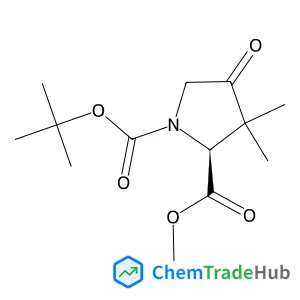
2-Methyl 1-(2-methyl-2-propanyl) (2S)-3,3-dimethyl-4-oxo-1,2-pyrrolidinedicarboxylate
CAS Number:
478698-30-5
Molecular Formula:
C13H21NO5
Andries Meijerink
Configuration coordinate diagrams, which are normally used in a qualitative manner for the energy levels of active centers in phosphors, are quantitatively obtained here for intervalence charge transfer (IVCT) states of mixed valence pairs and metal-to-metal charge transfer (MMCT) states of heteronuclear pairs, in solid hosts. The procedure relies on vibrational frequencies and excitation energies of single-ion active centers, and on differences between ion–ligand distances of the donor and the acceptor, which are attainable empirically or through ab initio calculations. The configuration coordinate diagrams of the Yb2+/Yb3+ mixed-valence pair in Yb-doped YAG and the Ce3+/Yb3+ heteronuclear pair in Ce,Yb-codoped YAG, are obtained and described. They are drawn from empirical data of the single-ions and their usefulness is discussed. The first diagram suggests that IVCT states of Yb2+/Yb3+ pairs may play an important role in the quenching of the Yb3+ emission and it provides the details of the quenching mechanism. The second diagram supports the interpretation recently given for the energy transfer from Ce3+ to Yb3+ in Ce,Yb-codoped YAG via a MMCT Ce4+–Yb2+ state and it provides the details. The analyses of the two diagrams suggest the formation of Yb2+/Yb3+ pairs after the Ce3+-to-Yb3+ MMCT, which is responsible for the temperature quenching of the Yb3+ emission excited via Ce3+ (4f → 5d) absorption in Ce,Yb-codoped YAG.
M. A. Budroni, L. Lemaigre, A. De Wit, F. Rossi
DOI: 10.1039/C4CP02196G
Yong Wu, Guo-Gang Shan, Hai-Bin Li, Shui-Xing Wu, Xin-Yao Ren, Yun Geng, Zhong-Min Su
DOI: 10.1039/C4CP04919E
Mosé Casalegno, Dariusz Kotowski, Andrea Bernardi, Silvia Luzzati, Riccardo Po, Guido Raos
DOI: 10.1039/C4CP03827D
J. García-Torres, C. Gispert, E. Gómez, E. Vallés
DOI: 10.1039/C4CP04389H
Jongseob Kim, Ki-Ha Hong
DOI: 10.1039/C4CP04513K
M. Darvish Ganji, S. M. Hosseini-khah, Z. Amini-tabar
DOI: 10.1039/C4CP04399E
Antonio Abate, Miquel Planells, Derek J. Hollman, Vishal Barthi, Suresh Chand, Henry J. Snaith, Neil Robertson
DOI: 10.1039/C4CP04685D
DOI: 10.1039/C4CP04711G
Andrew D. Ward, Martin D. King
DOI: 10.1039/C4CP05062B
Jiang-shan Luo, Xi-bo Li, You-gen Yi, Yong-jian Tang
DOI: 10.1039/C4CP04714A
(5-Sulfamoyl-3-pyridinyl)boronic acid is primarily used in chemical synthesis, p...
Benzyl 2-methyl-2-(methylsulfonyl)-4-pentenoate is typically synthesized via est...
When handling 8-Fluoroquinolin-6-ol (CAS: 209353-22-0), it is important to use p...
1,3-Dibromo-5-(2-methyl-2-propanyl)benzene (CAS: 129316-09-2) is a crystalline c...
Ethyl 7-chloro-4-oxo-1-(1,3-thiazol-2-yl)-1,4-dihydro-1,8-naphthyridine-3-carbox...
When handling Delta-7-Avenasterol (CAS: 23290-26-8), it is important to wear app...
Proper handling involves the use of personal protective equipment such as gloves...
When handling 2-Methyl-2-proanyl 4-[(2-aminophenyl)amino]-1-piperidinecarboxylat...
N-Methyl-4-chlorobenzylamine hydrochloride (CAS: 65542-24-7) is a organic compou...
[2-(Dodecyloxy)ethoxy]acetic acid (CAS: 27306-90-7) is generally considered safe...

Physical Chemistry Chemical Physics (PCCP) is an international journal co-owned by 19 physical chemistry and physics societies from around the world. This journal publishes original, cutting-edge research in physical chemistry, chemical physics and biophysical chemistry. To be suitable for publication in PCCP, articles must include significant innovation and/or insight into physical chemistry; this is the most important criterion that reviewers and Editors will judge against when evaluating submissions. The journal has a broad scope and welcomes contributions spanning experiment, theory, computation and data science. Topical coverage includes spectroscopy, dynamics, kinetics, statistical mechanics, thermodynamics, electrochemistry, catalysis, surface science, quantum mechanics, quantum computing and machine learning. Interdisciplinary research areas such as polymers and soft matter, materials, nanoscience, energy, surfaces/interfaces, and biophysical chemistry are welcomed if they demonstrate significant innovation and/or insight into physical chemistry. Joined experimental/theoretical studies are particularly appreciated when complementary and based on up-to-date approaches.