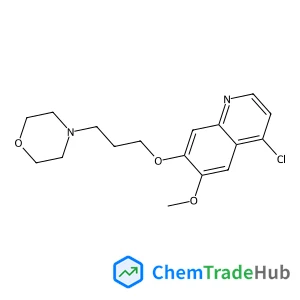
4-(3-((4-Chloro-6-methoxyquinolin-7-yl)oxy)propyl)morpholine
CAS Number:
205448-32-4
Molecular Formula:
C17H21ClN2O3
Mingzhong Li, Guodong Zhang, Carolyn A. Koh
Clathrate hydrate particle agglomeration is often considered to be one of the key limiting factors in plug formation. The hydrate particle–water interaction can play a critical role in describing hydrate agglomeration, yet is severely underexplored. Therefore, this work investigates the interactions between water droplets and cyclopentane hydrate particles using a micromechanical force (MMF) apparatus. Specifically, the effect of contact time, temperature/subcooling, contact area, and the addition of Sorbitane monooleate (Span 80) surfactant on the water droplet–hydrate particle interaction behavior are studied. The measurements indicate that hydrate formation during the measurement would increase the water–hydrate interaction force significantly. The results also indicate that the contact time, subcooling and concentration of cyclopentane, which determine the hydrate formation rate and hydrate amount, will affect the hydrate–water interaction force. In addition, the interaction forces also increase with the water–hydrate contact area. The addition of Span 80 surfactant induces a change in the hydrate morphology and renders the interfaces stable versus unstable (leading to coalescence), and the contact force can affect the hydrate–water interaction behavior significantly. Compared with the hydrate–hydrate cohesion force (measured in cyclopentane), the hydrate–water adhesion force is an order of magnitude larger. These new measurements can help to provide new and critical insights into the hydrate agglomeration process and potential strategies to control this process.
DOI: 10.1039/C4CP04711G
N. G. Balabushevich, A. V. Lopez de Guerenu, N. A. Feoktistova
DOI: 10.1039/C4CP04567J
DOI: 10.1039/C4CP03233K
Alessandro Erba, Claudio M. Zicovich-Wilson
DOI: 10.1039/C4CP04414B
M. A. Budroni, L. Lemaigre, A. De Wit, F. Rossi
DOI: 10.1039/C4CP02196G
Heinrich Krobath, Patrícia F. N. Faísca
DOI: 10.1039/C4CP05178E
Sana Labidi, Zixian Jia, Mounir Ben Amar, Khay Chhor, Andrei Kanaev
DOI: 10.1039/C4CP05149A
Taewon Lee, Deok-Yong Cho, Hyung-Soon Kwon, Han-Ill Yoo
DOI: 10.1039/C4CP04576A
Yong Wu, Guo-Gang Shan, Hai-Bin Li, Shui-Xing Wu, Xin-Yao Ren, Yun Geng, Zhong-Min Su
DOI: 10.1039/C4CP04919E
Mitsuhiko Miyazaki, Shunpei Yoshikawa, François Michels, Kentaro Misawa, Shun-ichi Ishiuchi, Makoto Sakai, Otto Dopfer, Klaus Müller-Dethlefs, Masaaki Fujii
DOI: 10.1039/C4CP04584J
(5-Sulfamoyl-3-pyridinyl)boronic acid is primarily used in chemical synthesis, p...
Benzyl 2-methyl-2-(methylsulfonyl)-4-pentenoate is typically synthesized via est...
When handling 8-Fluoroquinolin-6-ol (CAS: 209353-22-0), it is important to use p...
1,3-Dibromo-5-(2-methyl-2-propanyl)benzene (CAS: 129316-09-2) is a crystalline c...
Ethyl 7-chloro-4-oxo-1-(1,3-thiazol-2-yl)-1,4-dihydro-1,8-naphthyridine-3-carbox...
When handling Delta-7-Avenasterol (CAS: 23290-26-8), it is important to wear app...
Proper handling involves the use of personal protective equipment such as gloves...
When handling 2-Methyl-2-proanyl 4-[(2-aminophenyl)amino]-1-piperidinecarboxylat...
N-Methyl-4-chlorobenzylamine hydrochloride (CAS: 65542-24-7) is a organic compou...
[2-(Dodecyloxy)ethoxy]acetic acid (CAS: 27306-90-7) is generally considered safe...

Physical Chemistry Chemical Physics (PCCP) is an international journal co-owned by 19 physical chemistry and physics societies from around the world. This journal publishes original, cutting-edge research in physical chemistry, chemical physics and biophysical chemistry. To be suitable for publication in PCCP, articles must include significant innovation and/or insight into physical chemistry; this is the most important criterion that reviewers and Editors will judge against when evaluating submissions. The journal has a broad scope and welcomes contributions spanning experiment, theory, computation and data science. Topical coverage includes spectroscopy, dynamics, kinetics, statistical mechanics, thermodynamics, electrochemistry, catalysis, surface science, quantum mechanics, quantum computing and machine learning. Interdisciplinary research areas such as polymers and soft matter, materials, nanoscience, energy, surfaces/interfaces, and biophysical chemistry are welcomed if they demonstrate significant innovation and/or insight into physical chemistry. Joined experimental/theoretical studies are particularly appreciated when complementary and based on up-to-date approaches.