












![1-[3-(4-Morpholinylsulfonyl)phenyl]methanamine structure](https://static.chemtradehub.com/structs/933/933989-32-3-51af.webp "1-[3-(4-Morpholinylsulfonyl)phenyl]methanamine structure")
Gramicidin A disassembles large conductive clusters of its lysine-substituted derivatives in lipid membranes
Literature Information
Publication Date
2015-06-08
DOI
10.1039/C5CP02047F
Impact Factor
3.676
Authors
Yuri N. Antonenko, Grigory S. Gluhov, Alexander M. Firsov, Irina D. Pogozheva, Sergey I. Kovalchuk, Evgeniya V. Pechnikova, Elena A. Kotova, Olga S. Sokolova
View Original
Abstract
N-terminally substituted lysine derivatives of gramicidin A (gA), [Lys1]gA and [Lys3]gA, but not glutamate- or aspartate-substituted peptides have been previously shown to cause the leakage of carboxyfluorescein from liposomes. Here, the leakage induction was also observed for [Arg1]gA and [Arg3]gA, while [His1]gA and [His3]gA were inactive at neutral pH. The Lys3-containing analogue with all tryptophans replaced by isoleucines did not induce liposome leakage, similar to gA. This suggests that the presence of both tryptophans and N-terminal cationic residues is critical for pore formation. Remarkably, the addition of gA blocked the leakage induced by [Lys3]gA. By examining with fluorescence correlation spectroscopy the peptide-induced leakage of fluorescent markers from liposomes, we estimated the diameter of pores responsible for the leakage to be about 1.6 nm. Transmission electron cryo-microscopy imaging of liposomes with [Lys3]gA showed that the liposomal membranes contained high electron density particles with a size of about 40 Å, suggesting the formation of peptide clusters. No such clusterization was observed in liposomes incorporating gA or a mixture of gA with [Lys3]gA. Three-dimensional reconstruction of the clusters was compatible with their pentameric arrangement. Based on experimental data and computational modeling, we suggest that the large pore formed by [Lys3]gA represents a barrel-stave oligomeric cluster formed by antiparallel double-stranded helical dimers (DH). In a tentative model, the pentamer of dimers may be stabilized by aromatic Trp–Trp and cation–π Trp–Lys interactions between the neighboring DHs. The inhibiting effect of gA on the [Lys3]gA-induced leakage can be attributed to breaking of cation–π interactions, which prevents peptide clusterization and pore formation.
Recommended Journals
Related Literature
The UCST phase transition of a dextran based copolymer in aqueous media with tunable thermoresponsive behavior
Shaon Dey, Arpita Roy, Kalipada Manna, Sagar Pal
2022-06-15
Communication
DOI: 10.1039/D2PY00626J
Naphthoquinone-based imidazolyl esters as blue-light-sensitive Type I photoinitiators
Aristea Pavlou, Alexandros Petropoulos, Michael G. Siskos, Akram Hijazi, Frédéric Dumur
2022-08-01
Paper
DOI: 10.1039/D2PY00753C
Double hydrophilic poly(ethylene glycol)-block-poly(dehydroalanine) four-arm star block copolymers: synthesis and solution behavior
Nora Fribiczer, Sebastian Seiffert
2022-06-29
Paper
DOI: 10.1039/D2PY00579D
High-efficiency solution-processed green thermally activated delayed fluorescence OLEDs using a polymer-small molecule mixed host
Seunguk Cho, Na Yeon Kwon, Chai Won Kim, Hyoseong Lee, Jung Min Ha, Hyung Jong Kim, Han Young Woo, Sungnam Park, Min Ju Cho, Dong Hoon Choi
2022-02-25
Paper
DOI: 10.1039/D1PY01700D
Morphological transitions of cationic PISA particles by salt, triflate ions and temperature; comparison of three polycations
Vikram Baddam, Lauri Välinen, Linus Kuckling, Heikki Tenhu
2022-06-07
Paper
DOI: 10.1039/D2PY00301E
Thioanisole ester based logic gate cascade to control ROS-triggered micellar degradation
Irene Piergentili, Pepijn R. Bouwmans, Luuk Reinalda, Reece W. Lewis, Benjamin Klemm, Huanhuan Liu, Robin M. de Kruijff, Antonia G. Denkova, Rienk Eelkema
2022-03-30
Paper
DOI: 10.1039/D2PY00207H
Self-healable triboelectric nanogenerators based on ionic poly(hindered urea) network materials cross-linked with fluorinated block copolymers
Pothanagandhi Nellepalli, Twinkal Patel, Minsoo P. Kim, Junyoung Park, Zhibin Ye, Hyun Wook Jung, Hyunhyub Ko, Jung Kwon Oh
2022-07-05
Paper
DOI: 10.1039/D2PY00252C
You might also like
Compound Q&A
What are the main uses of 1-(3-Aminophenyl)-3-[(3R)-1-(3,3-dimethyl-2-oxobutyl)-2-oxo-5-(2-pyridinyl)-2,3-dihydro-1H-1,4-benzodiazepin-3-yl]urea (CAS: 155412-88-7)?
This compound is mainly used as an intermediate in the synthesis of antipsychoti...
155412-88-71-(3-Aminophenyl)-3-...
Compound Q&A
How should waste containing 1-(D-Ribofuranosyl)-1,4-dihydro-3-pyridinecarboxamide (CAS: 19132-12-8) be handled?
Waste containing 1-(D-Ribofuranosyl)-1,4-dihydro-3-pyridinecarboxamide (CAS: 191...
19132-12-81-(D-Ribofuranosyl)-...
Compound Q&A
What regulatory guidelines apply to 2-Methyl-2-propanyl 3-bromo-3-(hydroxymethyl)-1-azetidinecarboxylate (CAS: 2007919-81-3)?
2-Methyl-2-propanyl 3-bromo-3-(hydroxymethyl)-1-azetidinecarboxylate (CAS: 20079...
2007919-81-32-Methyl-2-propanyl ...
Compound Q&A
What is N-(4-Chloro-2-pyridinyl)acetamide (CAS: 245056-66-0)?
N-(4-Chloro-2-pyridinyl)acetamide (CAS: 245056-66-0) is a chemical compound with...
245056-66-0N-(4-Chloro-2-pyridi...
Compound Q&A
What is 5-Chloro-2-hydroxybenzoic acid (CAS: 321-14-2)?
5-Chloro-2-hydroxybenzoic acid, also known as 5-chlorosalicylic acid, is an arom...
321-14-25-Chloro-2-hydroxybe...
Compound Q&A
What precautions should be taken when handling 1,1-Dichloro-1-fluoroethane (CAS: 1717-00-6)?
When handling 1,1-Dichloro-1-fluoroethane (CAS: 1717-00-6), it is important to u...
1717-00-61,1-Dichloro-1-fluor...
Compound Q&A
What are the physical and chemical properties of Fmoc-(2S,3R)-3-phenylpyrrolidine-2-carboxylic acid (CAS: 281655-32-1)?
Fmoc-(2S,3R)-3-phenylpyrrolidine-2-carboxylic acid is a white crystalline solid ...
281655-32-1Fmoc-(2S,3R)-3-pheny...
Compound Q&A
What are the main uses of 4-Amino-5-bromo-2-pyridinecarboxylic acid (CAS: 1363381-01-4)?
4-Amino-5-bromo-2-pyridinecarboxylic acid is primarily used as a precursor in th...
1363381-01-44-Amino-5-bromo-2-py...
Compound Q&A
What precautions should be taken when handling (S)-tert-butyl 2-((2-(4-bromophenyl)-2-oxoethyl)carbamoyl)pyrrolidine-1-carboxylate (CAS: 1007881-98-2)?
Handling this compound should be done with personal protective equipment (PPE) i...
1007881-98-2(S)-tert-butyl 2-((2...
Compound Q&A
What precautions should be taken when handling 8-bromo-2,2-dimethyl-3,4-dihydro-2H-1,4-benzoxazin-3-one (CAS: 688363-73-7)?
When handling 8-bromo-2,2-dimethyl-3,4-dihydro-2H-1,4-benzoxazin-3-one, use prop...
688363-73-78-bromo-2,2-dimethyl...
Source Journal
Physical Chemistry Chemical Physics

CiteScore:
5.5
Self-citation Rate:
10.3%
Articles per Year:
3036
Physical Chemistry Chemical Physics (PCCP) is an international journal co-owned by 19 physical chemistry and physics societies from around the world. This journal publishes original, cutting-edge research in physical chemistry, chemical physics and biophysical chemistry. To be suitable for publication in PCCP, articles must include significant innovation and/or insight into physical chemistry; this is the most important criterion that reviewers and Editors will judge against when evaluating submissions. The journal has a broad scope and welcomes contributions spanning experiment, theory, computation and data science. Topical coverage includes spectroscopy, dynamics, kinetics, statistical mechanics, thermodynamics, electrochemistry, catalysis, surface science, quantum mechanics, quantum computing and machine learning. Interdisciplinary research areas such as polymers and soft matter, materials, nanoscience, energy, surfaces/interfaces, and biophysical chemistry are welcomed if they demonstrate significant innovation and/or insight into physical chemistry. Joined experimental/theoretical studies are particularly appreciated when complementary and based on up-to-date approaches.
Recommended Compounds
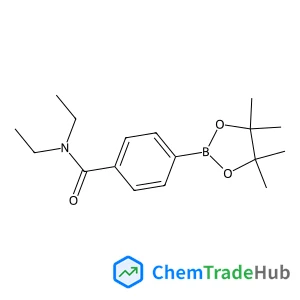
N,N-Diethyl-4-(4,4,5,5-tetramethyl-1,3,2-dioxaborolan-2-yl)benzamide
CAS Number:
325142-99-2
Molecular Formula:
C17H26BNO3
Recommended Suppliers




Disclaimer
This page provides academic journal information for reference and research purposes only. We are not affiliated with any journal publishers and do not handle publication submissions. For publication-related inquiries, please contact the respective journal publishers directly.
If you notice any inaccuracies in the information displayed, please contact us at support@chemtradehub.com. We will promptly review and address your concerns.