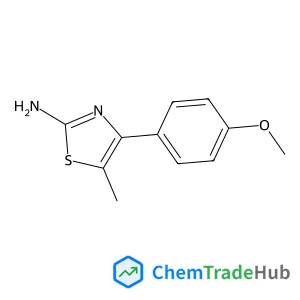
4-(4-Methoxyphenyl)-5-methyl-1,3-thiazol-2-amine
CAS Number:
105512-88-7
Molecular Formula:
C11H12N2OS
Mahesh P. Suryawanshi, Seung Wook Shin, Chang Woo Hong, Inyoung Kim, Jong H. Moon, Jae Ho Yun, Jin Hyeok Kim, Sanjay S. Kolekar
A quaternary indium- and gallium-free kesterite (KS)-based compound, copper zinc tin sulfide (Cu2ZnSnS4, CZTS), has received significant attention for its potential applications in low cost and sustainable solar cells. It is well known that the reaction time, reactivity of the precursors, and types of capping ligands used during the synthesis of colloidal nanocrystals (NCs) strongly influence the crystallographic phase of the NCs. In this research, a non-toxic and green synthetic strategy for both the synthesis of CZTS NCs and the fabrication of a highly efficient CZTS absorber layers using an ink formulation without a toxic solvent, which meets the comprehensive framework for green chemistry that covers major aspects of the environmental strain, is demonstrated. In particular, pure metastable wurtzite (WZ) CZTS NCs are synthesized using the environmentally harmless, polyol mediated hot-injection (HI) technique at a low reaction temperature. The influence of the reaction time on the properties of the CZTS NCs is investigated in detail. Based on detailed reaction time dependent phase evolution, a possible growth and formation mechanism is proposed. Furthermore, a scalable, low cost, binder free ink formulation process without ligand exchange is developed using ethanol as the dispersal solvent. The as-prepared WZ-derived CZTS NC thin films are observed to undergo a phase transformation to KS during annealing in a sulfur vapor atmosphere via rapid thermal annealing above 500 °C, and surprisingly, this process results in fully sintered, compact and uniform CZTS thin films with large sized grains. The best solar cell device fabricated using a CZTS absorber that was sulfurized at an optimized temperature exhibits a power conversion efficiency of 2.44%, which is the highest efficiency obtained using the polyol-based HI route.
Julieta S. Riva, Lidia M. Yudi
DOI: 10.1039/C4CP03483J
Yiyi Yang, Tuhina Adit Maark, Andrew Peterson, Sharvan Kumar
DOI: 10.1039/C4CP04924A
M. A. Budroni, L. Lemaigre, A. De Wit, F. Rossi
DOI: 10.1039/C4CP02196G
Fethi Khaled, Binod Raj Giri, Aamir Farooq
DOI: 10.1039/C4CP04322G
Andrew D. Ward, Martin D. King
DOI: 10.1039/C4CP05062B
Mosé Casalegno, Dariusz Kotowski, Andrea Bernardi, Silvia Luzzati, Riccardo Po, Guido Raos
DOI: 10.1039/C4CP03827D
Satoru Yamamoto, Shigeaki Nakazawa, Kenji Sugisaki, Kazunobu Sato, Kazuo Toyota, Daisuke Shiomi, Takeji Takui
DOI: 10.1039/C4CP04744C
Alexandra Lambrou, Eftychia Pinakoulaki
DOI: 10.1039/C4CP04352A
Alessandro Erba, Claudio M. Zicovich-Wilson
DOI: 10.1039/C4CP04414B
Jean-Claude Brodovitch, Brenda Addison-Jones, Khashayar Ghandi
DOI: 10.1039/C4CP04899G
(5-Sulfamoyl-3-pyridinyl)boronic acid is primarily used in chemical synthesis, p...
Benzyl 2-methyl-2-(methylsulfonyl)-4-pentenoate is typically synthesized via est...
When handling 8-Fluoroquinolin-6-ol (CAS: 209353-22-0), it is important to use p...
1,3-Dibromo-5-(2-methyl-2-propanyl)benzene (CAS: 129316-09-2) is a crystalline c...
Ethyl 7-chloro-4-oxo-1-(1,3-thiazol-2-yl)-1,4-dihydro-1,8-naphthyridine-3-carbox...
When handling Delta-7-Avenasterol (CAS: 23290-26-8), it is important to wear app...
Proper handling involves the use of personal protective equipment such as gloves...
When handling 2-Methyl-2-proanyl 4-[(2-aminophenyl)amino]-1-piperidinecarboxylat...
N-Methyl-4-chlorobenzylamine hydrochloride (CAS: 65542-24-7) is a organic compou...
[2-(Dodecyloxy)ethoxy]acetic acid (CAS: 27306-90-7) is generally considered safe...

Physical Chemistry Chemical Physics (PCCP) is an international journal co-owned by 19 physical chemistry and physics societies from around the world. This journal publishes original, cutting-edge research in physical chemistry, chemical physics and biophysical chemistry. To be suitable for publication in PCCP, articles must include significant innovation and/or insight into physical chemistry; this is the most important criterion that reviewers and Editors will judge against when evaluating submissions. The journal has a broad scope and welcomes contributions spanning experiment, theory, computation and data science. Topical coverage includes spectroscopy, dynamics, kinetics, statistical mechanics, thermodynamics, electrochemistry, catalysis, surface science, quantum mechanics, quantum computing and machine learning. Interdisciplinary research areas such as polymers and soft matter, materials, nanoscience, energy, surfaces/interfaces, and biophysical chemistry are welcomed if they demonstrate significant innovation and/or insight into physical chemistry. Joined experimental/theoretical studies are particularly appreciated when complementary and based on up-to-date approaches.

![2-Methyl-2-propanyl 4-oxo-3,9-diazabicyclo[4.2.1]nonane-9-carboxylate structure](https://static.chemtradehub.com/structs/131/1312456-05-5-9a15.webp "2-Methyl-2-propanyl 4-oxo-3,9-diazabicyclo[4.2.1]nonane-9-carboxylate structure")