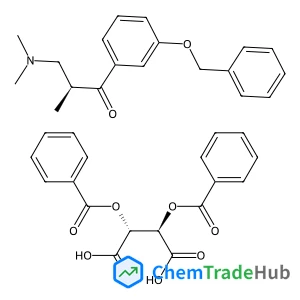
(S)-1-(3-(Benzyloxy)phenyl)-3-(dimethylamino)-2-methylpropan-1-one (2r,3r)-2,3-bis(benzoyloxy)succinate
CAS Number:
1004315-81-4
Molecular Formula:
C37H37NO10
S. R. Tripathi, K. Kawase, A. Puzenko, Yu. Feldman
Even today, the H-bonded cluster structure of water still stands as a major point of debate in the science of liquids. Much of this discussion is devoted to understand its dynamic nature. This has a direct impact on deciphering the many anomalies of water such as its exceptional heat capacity. Of these properties, dielectric permittivity and relaxation are of particular interest. The argument rages over whether the almost Debye-like character of the dispersion is the result of the reorientation of an apparent dipole moment of the water cluster or simply the cumulative effect of single water molecule reorientation. Furthermore, like many glass formers, it has a high frequency excess wing that does not fit into the accepted models of a single relaxation time of the main peak. Herein, we present evidence that the microscopic origins of both the excess wing and the main relaxation process of pure water are the same. The origin of these two features is explored and we suggest a new paradigm for water relaxation based on the concept of a proton cascade leading to a cluster reorientation.
Sebastian Mahlik, Agata Lazarowska, Jumpei Ueda, Setsuhisa Tanabe, Marek Grinberg
DOI: 10.1039/C8CP07122E
Xiangyang Duan, Chao Ma, Wentao Jin, Xiaoman Ma, Su-Huai Wei, Jinying Yu
DOI: 10.1039/C8CP02494D
Kouta Iwasaki, Masahito Yoshino, Tomoaki Yamada, Takanori Nagasaki
DOI: 10.1039/C8CP04839H
Philipp Traber, Linda Zedler, Stephan Kupfer, Stefanie Gräfe, Martin Schulz, Wolfgang Frey, Michael Karnahl
DOI: 10.1039/C8CP04595J
Sayan Banerjee, A. Sreenithya, Raghavan B. Sunoj
DOI: 10.1039/C8CP03141J
Julien Schmitt, Vincenzo Calabrese, Marcelo A. da Silva, Saskia Lindhoud, Viveka Alfredsson, Karen J. Edler
DOI: 10.1039/C8CP00355F
Lifu Chen, Chuhong Lin, Richard G. Compton
DOI: 10.1039/C8CP02311E
D. Bloos, R. Marx, P. Lutz, M. Kern, O. Laguta, C. Dietrich, J. van Slageren
DOI: 10.1039/C7CP07443C
Liang Pu, Zhong Zhang, R. Bruce King, Wesley D. Allen
DOI: 10.1039/C7CP08673C
2-Methylbenzene-1,4-diamine dihydrochloride (CAS: 615-45-2) should be stored in ...
(1S,4S)-2,5-Diazabicyclo[2.2.1]heptane dihydrobromide is generally considered sa...
(6-Chloropyridazin-3-YL)methanamine finds applications in the pharmaceutical ind...
2-Fluoro-3-methylphenol is primarily used in the synthesis of pharmaceuticals, p...
When handling 3-Methoxy-4-nitrobenzonitrile, it is important to wear appropriate...
When handling 1,3-Oxazolo[4,5-b]pyridine-2(3H)-thione (CAS: 211949-57-4), it is ...
4-Ethynylbenzamide (CAS: 90347-86-7) falls under various regulatory guidelines i...
3-(2-Ethylphenyl)-2-thioxo-4-imidazolidinone is primarily used as an intermediat...
(2-Fluoro-6-methoxyphenyl)acetic acid, also known as 4-fluoro-3-methoxybenzoic a...
Market trends for 2-[4-(Hydroxymethyl)phenoxy]ethanol (CAS: 102196-18-9) indicat...

Physical Chemistry Chemical Physics (PCCP) is an international journal co-owned by 19 physical chemistry and physics societies from around the world. This journal publishes original, cutting-edge research in physical chemistry, chemical physics and biophysical chemistry. To be suitable for publication in PCCP, articles must include significant innovation and/or insight into physical chemistry; this is the most important criterion that reviewers and Editors will judge against when evaluating submissions. The journal has a broad scope and welcomes contributions spanning experiment, theory, computation and data science. Topical coverage includes spectroscopy, dynamics, kinetics, statistical mechanics, thermodynamics, electrochemistry, catalysis, surface science, quantum mechanics, quantum computing and machine learning. Interdisciplinary research areas such as polymers and soft matter, materials, nanoscience, energy, surfaces/interfaces, and biophysical chemistry are welcomed if they demonstrate significant innovation and/or insight into physical chemistry. Joined experimental/theoretical studies are particularly appreciated when complementary and based on up-to-date approaches.