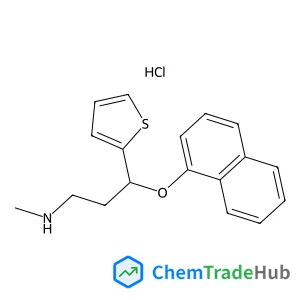
N-Methyl-3-(1-naphthyloxy)-3-(2-thienyl)-1-propanamine hydrochloride (1:1)
CAS Number:
1188266-11-6
Molecular Formula:
C18H20ClNOS
Samiran Garain, Shrabanee Sen, Dipankar Mandal
Polyvinylidene fluoride (PVDF) films are filled with various mass fractions (wt%) of hydrated metal salt (MgCl2·6H2O) (Mg-salt) to fabricate high performance piezoelectric energy harvesters (PEHs). They deliver up to 4 V of open circuit voltage by simply repeated human finger imparting (under a pressure of ∼4.45 kPa) and also generate sufficient power to turn on at least ten commercial blue light emitting diodes (LEDs) instantly. The enhanced piezo-response is attributed to the combined effect of the change in the inherent dipole moment of the electroactive phase containing PVDF itself and H-bonding arising between the Mg-salt filler and PVDF via electrostatic interactions. Furthermore, it also successfully charged the capacitors, signifying practical applicability as a piezoelectric based energy harvester power source. UV-visible optical absorption spectral analysis revealed the possibility to estimate a change in the optical band gap value at different concentrations of Mg-salt filler added PVDF films that possess a useful methodology where the Mg-salt can be used as an optical probe. In addition dielectric properties have been studied to understand the role of molecular kinetic and interfacial polarization occurs in H-bond PVDF films at different applied frequencies at room temperature.
Rahul Dev Mukhopadhyay
DOI: 10.1039/D3CS00692A
Yudong Xue
DOI: 10.1039/D3CS00706E
Marcus E. Graziotto, Clinton J. Kidman, Simon A. James, Hugh H. Harris
DOI: 10.1039/D3CS00509G
Yong Jiang, Zhong Liang, Qian Zhang, Yaping Du
DOI: 10.1039/D3CS00708A
Xinlu Zheng, Ziwei Ye, Zeeshan Akmal, Chun He, Jinlong Zhang, Lingzhi Wang
DOI: 10.1039/D3CS00462G
Weiqing Xu, Yu Wu, Wenling Gu, Dan Du, Yuehe Lin, Chengzhou Zhu
DOI: 10.1039/D3CS00767G
Yonghua Liu
DOI: 10.1039/D3SC04688E
Sean K. Sandstrom, Qiuyao Li, Yiming Sui, Mason Lyons, Chun-Wai Chang, Rui Zhang, Heng Jiang, Mingliang Yu, David Hoang, William F. Stickle, Huolin L. Xin, Zhenxing Feng, Xiulei Ji
DOI: 10.1039/D3SC04545E
Zhi-Mao Zhang, Junliang Zhang, Quan Cai
DOI: 10.1039/D3SC04335E
Waste containing 6-Chloro-5-(2'-hydroxy-3'-methoxy-4-biphenylyl)-3-(3-methoxyphe...
(3alpha,5alpha)-3-Hydroxypregnane-11,20-dione is primarily used in the pharmaceu...
The market for 4-Amino-6-chloro-2-pyridinecarboxylic acid (CAS: 546141-56-4) is ...
Alternatives to (2-Benzoylethyl)trimethylammonium chloride (CAS: 24472-88-6) in ...
N-[4-Nitro-3-(trifluoromethyl)phenyl]acetamide (CAS: 393-12-4) is generally safe...
Alternative reagents such as other phosphates or similar functional groups can b...
There are alternatives to N,N'-Bis(3-aminopropyl)-1,3-propanediamine (CAS: 4605-...
When handling Aluminium trihexadecanoate, it is important to use appropriate per...
(1,1-Dioxido-3-oxo-1,2-benzothiazol-2(3H)-yl)acetic acid is a chemical compound ...
Several alternatives to 5,5-dimethyloxolan-2-one (CAS: 3123-97-5) can be used in...

Physical Chemistry Chemical Physics (PCCP) is an international journal co-owned by 19 physical chemistry and physics societies from around the world. This journal publishes original, cutting-edge research in physical chemistry, chemical physics and biophysical chemistry. To be suitable for publication in PCCP, articles must include significant innovation and/or insight into physical chemistry; this is the most important criterion that reviewers and Editors will judge against when evaluating submissions. The journal has a broad scope and welcomes contributions spanning experiment, theory, computation and data science. Topical coverage includes spectroscopy, dynamics, kinetics, statistical mechanics, thermodynamics, electrochemistry, catalysis, surface science, quantum mechanics, quantum computing and machine learning. Interdisciplinary research areas such as polymers and soft matter, materials, nanoscience, energy, surfaces/interfaces, and biophysical chemistry are welcomed if they demonstrate significant innovation and/or insight into physical chemistry. Joined experimental/theoretical studies are particularly appreciated when complementary and based on up-to-date approaches.


![1-(1-Benzyl-1,2,3,6-tetrahydropyridin-4-yl)-1H-benzo[d]imidazol-2(3H)-one structure](https://static.chemtradehub.com/structs/603/60373-71-9-7dfb.webp "1-(1-Benzyl-1,2,3,6-tetrahydropyridin-4-yl)-1H-benzo[d]imidazol-2(3H)-one structure")